Thought of the day from Stoic philosopher Epictetus: “Men are disturbed, not by things, but by the principles and notions, which they form concerning thing.”

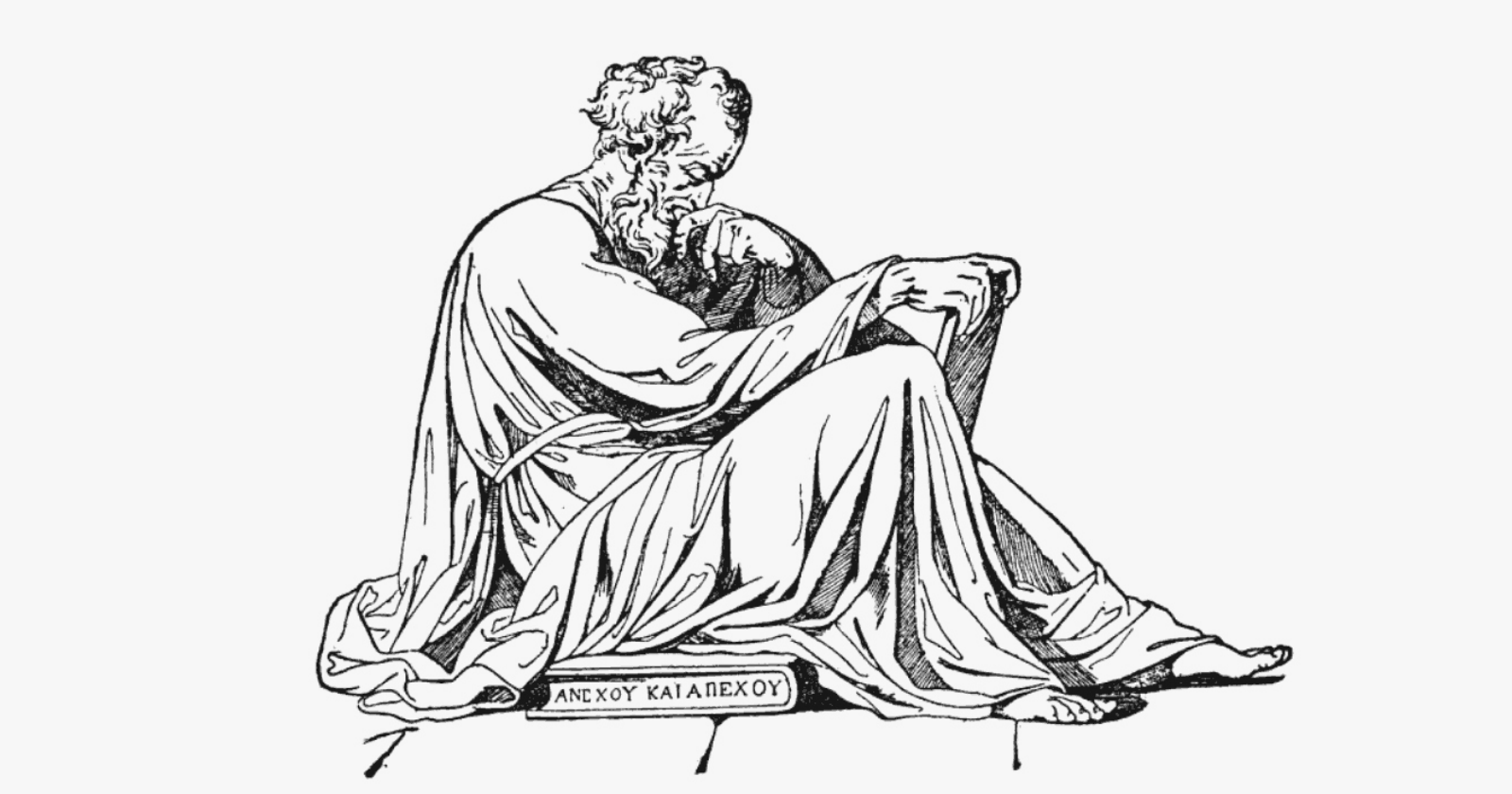
Image: "Epictetus, the slave." From a painting by Giuseppe Rossi. Voltaire's Romances (1889), via Wikimedia Commons. Public domain.
It's among the best-known lines of Stoic philosophy. Yet, as far as I can see, it nearly always appears on its own, as though Epictetus said it and stopped there. It actually opens a short chapter, and the lines that follow change how it reads.
Here is the whole of chapter 5 of the Enchiridion, in Elizabeth Carter's 1758 translation:
Men are disturbed, not by Things, but by the Principles and Notions, which they form concerning Things. Death, for Instance, is not terrible, else it would have appeared so to Socrates. But the Terror consists in our Notion of Death, that it is terrible. When therefore we are hindered, or disturbed, or grieved, let us never impute it to others, but to ourselves; that is, to our own Principles. It is the Action of an uninstructed Person to lay the Fault of his own bad Condition upon others; of one entering upon Instruction, to lay the Fault on himself; and of one perfectly instructed, neither on others, nor on himself.
The key word in the Greek is dogmata. Albert Watanabe, who edited the Enchiridion for Dickinson College Commentaries, describes dogmata as "our opinions and assessments about life", the kind that shape every state of mind, emotions included.
Epictetus's example is death. The terror comes from the judgment we add: that death is terrible.
I think it's fair to say same gap often shows up in ordinary life. Take an email from your manager that says only, "Can we talk tomorrow?" The meeting might genuinely bring bad news. You could even be right to suspect that your job is at risk. But Epictetus would ask about a further judgment: that losing your job would destroy what is genuinely good in your life.
The shortened version of the piece raises an obvious objection, and it's an assumption I've noticed a lot of people make. If my judgments are what upset me, isn't my distress my own fault?
Epictetus answers it in the same chapter. Look again at the last sentence. It describes three stages. The untaught person blames others. Someone "entering upon instruction" blames himself. And the fully taught person blames "neither on others, nor on himself."
These, of course, are stages in learning philosophy, not a description of everyone's life. Watanabe explains the "perfectly instructed" person as someone who has taken the philosophical principles fully on board. Blaming yourself marks the start of that learning. It can look like the goal, but in Epictetus's scheme it's only the halfway point.
One way to read this is that the aim was never to put yourself on trial. Beating yourself up just swaps one upsetting judgment for another. Epictetus doesn't spell that out in chapter 5, but it follows from where the chapter begins: the trouble lies in the judgment, not in the person making it.
There's another possible misunderstanding, encouraged by what "stoic" means in everyday English: not feeling much at all. If judgments are what upset us, the perfect Stoic presumably never flinches.
Scholars of Stoicism have pushed back on this view. Margaret Graver, a professor of classics at Dartmouth and the author of Stoicism and Emotion, has explained that for the Stoics the capacity to feel deeply, even to be horrified, is part of human nature. "The trick is to get our values right," she says, so that what we react to strongly is what truly matters.
There's a vivid ancient example too, from the Latin writer Aulus Gellius.
In his Attic Nights, Gellius describes sailing across the Ionian Sea in a violent storm. On board was a well-known Stoic philosopher. Gellius watched him to see how he was coping, and found him frightened and "ghastly pale", although, unlike everyone else, he wasn't wailing.
When the weather cleared, a wealthy passenger teased the philosopher for turning pale when he himself hadn't. Later, Gellius asked the philosopher about it. The philosopher reached into his bag and took out a book: the fifth book of Epictetus's Discourses.
The passage Gellius read there says that frightening first impressions hit the mind before reason has a chance to act. When a sudden alarm strikes, "even the mind of a wise man must necessarily be disturbed, must shrink and feel alarm...".
What sets the wise man apart comes next. He doesn't agree with those frightening impressions. He rejects them, the passage says, and sees nothing in them "that ought to excite fear." The foolish man, by contrast, takes them to be as dreadful as they first seemed. That's the same judgment chapter 5 names as the source of the terror.
Gellius drew his own conclusion. Fearing for a moment and turning white, he wrote, isn't the mark of a foolish or weak person. We give way briefly "rather to human weakness than because we believe that those things are what they seem." The book he read from is now lost, so we know the passage only through him.
Read alongside Gellius, the famous line becomes more precise. Epictetus isn't asking us to suppress every first reaction, or to condemn ourselves for having one. He's asking us to examine the judgments we accept as true.
Sources
- Epictetus, All the Works of Epictetus, Which Are Now Extant, translated by Elizabeth Carter (London, 1758). Scan of the first edition, Internet Archive. Source for the full text of Enchiridion chapter 5.
- Albert Watanabe, Epictetus: Encheiridion, Dickinson College Commentaries (2020). Notes on chapter 5. Source for the explanation of dogmata and of the "perfectly instructed" person.
- "Stoicism and Emotion: An Interview with Professor Margaret Graver", Daily Stoic. Source for Graver's comments on the Stoics and feeling, and for her role at Dartmouth.
- Aulus Gellius, Attic Nights, 19.1, translated by John C. Rolfe (1927). Perseus Digital Library. Source for the storm story and Gellius's conclusion.
Mal is a senior writer at Brown Brothers Media, the publisher of Philosophy Basics. He has a particular interest in philosophy, psychology, and the questions surrounding happiness, personal growth, and what makes for a meaningful life. When he's not writing, he's usually reading or working on his far-from-perfect golf swing.
More by Mal James →