
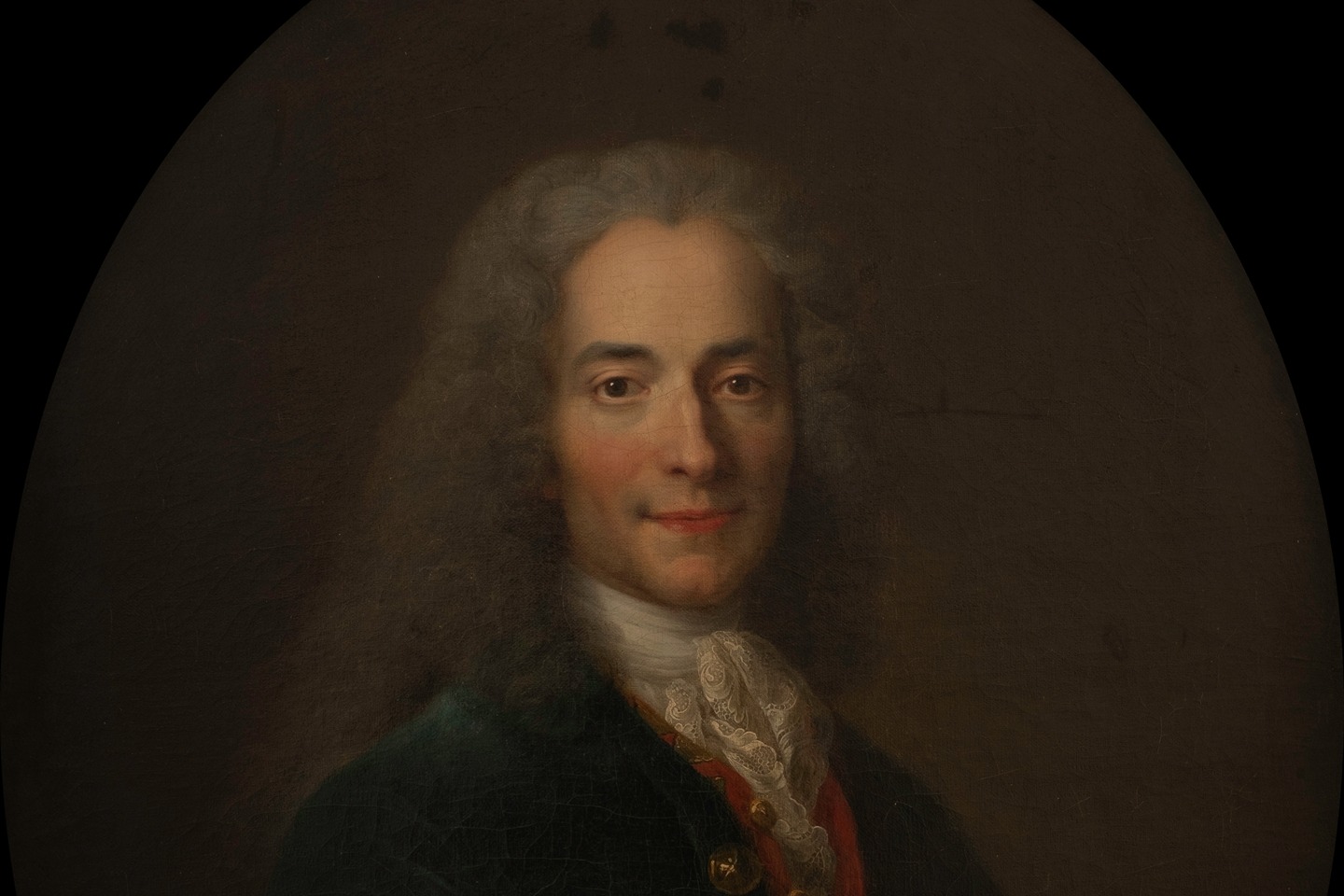
In 1729 the French government launched a lottery with a flaw, and it was the mathematician Charles-Marie de La Condamine who saw it. In Voltaire’s Luck for Lapham’s Quarterly, Roger Pearson recounts how La Condamine and his friend Voltaire joined a syndicate that won draw after draw. As statistician Sharon Lohr explains, cheap and expensive tickets had the same chance of being drawn. Voltaire’s share of the winnings helped give him the financial independence to write as he chose and to withstand the cost of challenging authority.
How the lottery worked
The lottery grew out of a problem with public debt. Confidence in government finances was so low that bonds issued by the municipality of Paris had lost much of their value. Under an order-in-council confirmed by a declaration on 6 March 1729, the bonds were to be redeemed through a monthly draw.
Only bondholders could take part, and a ticket cost one-thousandth of the bond’s face value. A 1,000-livre bond qualified its owner to buy a one-livre ticket, while a 100,000-livre bond required a ticket costing 100 livres. Both Pearson and Lohr give the repayment rate as 85% of the winning bond’s face value. Winners also shared an extra 500,000 livres that the government added to each month’s pot.
As Lohr explains, the price of a ticket rose with the size of the bond, but its chance of being drawn did not. A one-livre ticket therefore offered the same chance of benefiting from the government’s contribution as an entry costing a hundred times as much.
For a group with money to spend, that changed the arithmetic. A thousand livres in ticket fees bought a thousand one-livre entries instead of ten 100-livre ones, giving the group a hundred times as many entries for the same fees. Each cheap ticket still needed a small bond behind it, so the investors also had to acquire bonds in quantity.
Pearson describes tickets being drawn until the month’s pool was exhausted, with any overshoot deducted from later draws. The syndicate’s aim was to hold enough entries to capture a large share of those payments, while keeping its costs below what it expected to receive.
The mathematician and the writer
Lohr and the MacTutor biography of La Condamine both credit La Condamine with seeing the flaw. In Pearson’s account, Voltaire, himself a bondholder, discussed the lottery with him at a dinner party, and the two began to wonder what would happen if a syndicate bought every ticket in a draw.
Pearson finds La Condamine recorded as the owner of thirteen winning tickets that had cost him one livre each. Under the pricing rule, they stood for bonds with a combined face value of 13,000 livres. That was the sum the tickets entitled him to redeem, not his profit, which also had to cover the cost of the bonds.
Voltaire’s contribution was practical. Buying in bulk depended on the notaries authorised to sell tickets, and Pearson reports that Voltaire obtained whole ticket books by paying a deposit, which suggests an understanding with the sellers. Whether any notaries received a share remains speculation.
Much of the rest is hard to reconstruct. Pearson admits that the surviving records do not show exactly how the scheme worked, only that it did. The authorities adjusted the rules in January 1730, and the official records for March to June 1730, the lottery’s last months, are missing. Voltaire’s own winnings are thought to have come to around half a million livres.
What happened after the winnings
Le Peletier des Forts, the comptroller general of finances, argued that the syndicate had acted illegally, but the royal council ruled against him: no rules had been broken. He was dismissed, and the lottery was closed in 1730.
Voltaire’s finances improved in another way that spring. Lohr records that his inheritance was released in March 1730, after a magistrate accepted that his conduct met the conditions in his father’s will. His growing fortune therefore came from more than the lottery alone.
The Newtonian thread
Voltaire had returned from England as an admirer of Newton’s science. In the years after the lottery, that enthusiasm became part of Letters Concerning the English Nation, published in English in 1733 and followed by the French Lettres philosophiques in 1734. As the Voltaire Foundation explains, he admired Newton’s commitment to observation and to claiming only what could be verified.
In Letter XV, Voltaire tells how Newton’s early calculation relied on an inaccurate measure of the Earth. Mariners had reckoned a degree at about sixty English miles, rather than nearly seventy, and the result failed to support his reasoning. Newton set the investigation aside until Jean Picard’s more accurate measurement of a meridian allowed him to return to it.
Voltaire admired the restraint this required. His description of the thinker who would have behaved differently was much sharper:
“A half-learn’d Philosopher, remarkable only for his Vanity, would have made the Measure of the Earth agree, any how, with his System.”
Le Peletier des Forts was not quite that philosopher. Nothing suggests he bent figures to fit a theory he was attached to; in Pearson’s words, the lottery had simply been badly devised. His mistake was a near relation of the one Voltaire mocks. The vain philosopher ignores the numbers that contradict him, while the comptroller never worked out what his own numbers implied. Both trust a system because it looks coherent, or carries official authority, rather than because it has been tested. Lohr, quoting Pearson’s biography, records that Le Peletier des Forts was “condemned for his foolish ignorance of statistics”.
La Condamine did the testing the government had skipped, and he spent the proceeds testing much larger claims. Using his lottery winnings, he sailed to the eastern Mediterranean in 1731–1732, and his observations were presented to the Academy of Sciences. In 1735 he joined the expedition to what is now Ecuador to measure a degree of latitude near the equator, helping test Newton’s prediction that the Earth was flattened at the poles. Pearson suggests his newfound wealth helped fund both journeys.
It was the very measurement Voltaire had described Newton waiting for: the length of a degree on the Earth’s surface. Money won by checking a government’s arithmetic helped pay for checking Newton’s against the shape of the planet.
What the winnings changed
For Voltaire, the money bought something less measurable. Voltaire scholar Síofra Pierse connects his financial independence to his freedom to write under censorship. Pearson gives a concrete case: when the courts banned the Lettres philosophiques in 1734, its author had already withdrawn to the Château de Cirey in Champagne, where he lived for the next five years, and where his money paid for a new wing.
Nearly half a century after the lottery, Voltaire told the story himself in his Historical Commentary, written in the third person. A group that took all the tickets, he noted, stood to win a million; he joined a large company and was, as he put it, heureux: lucky. Pearson’s verdict is that Voltaire made his own luck, and the memoir hints that Voltaire knew it. It quotes, on the word of one of his partners, a letter Voltaire wrote to him: to make a fortune in this country, one need only read the council’s decrees.
The flaw had never been hidden. It sat in the government’s own published rules, there for anyone to read. What turned it into a fortune was reading those rules the way Newton treated his own theory: as something to be tested rather than trusted.
