
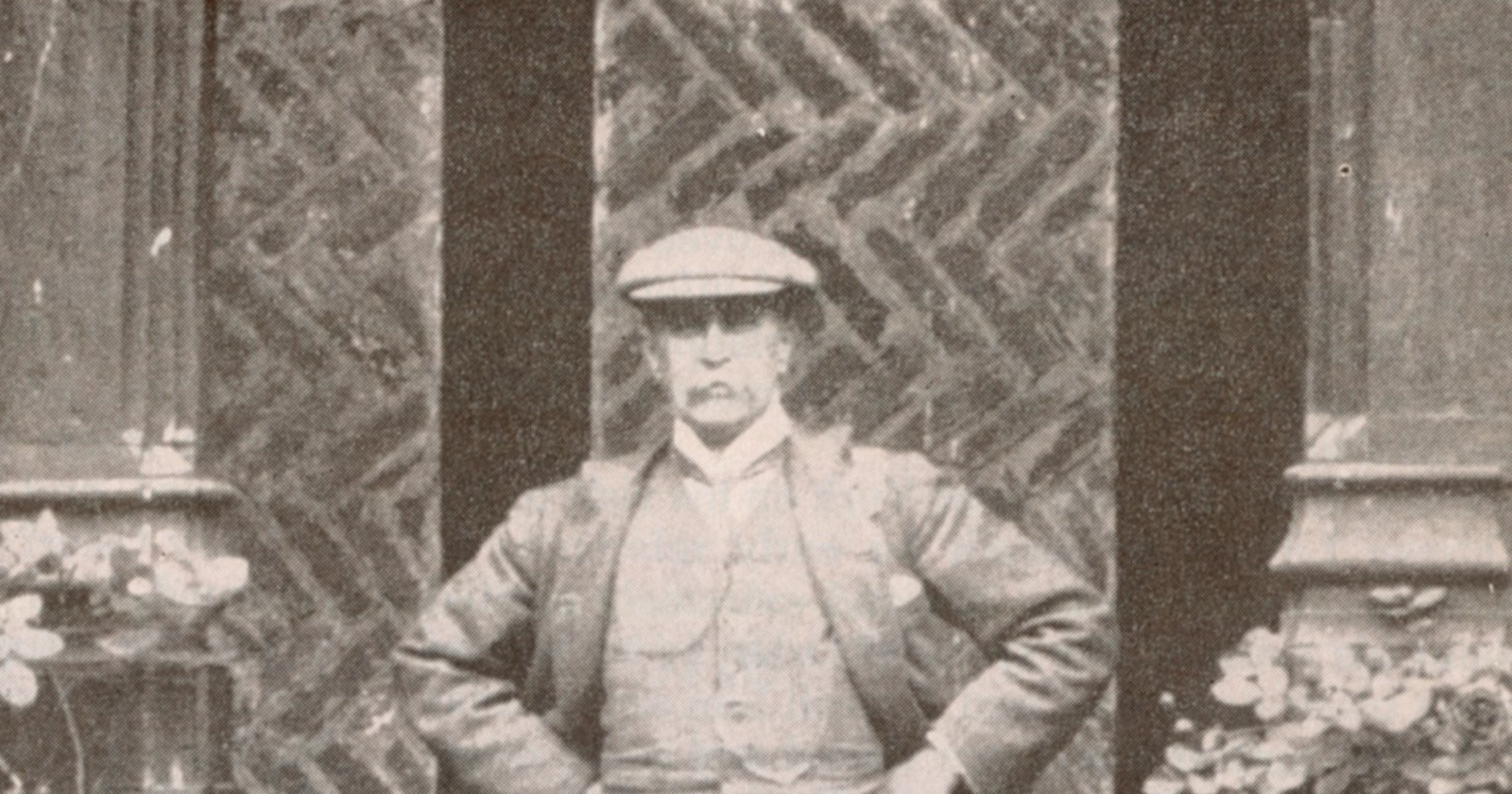
Photo: Unknown photographer, 1909 / Wikimedia Commons, public domain.
There is an old piece of advice about death that we have probably all heard: don't be afraid of it.
Epicurus said it. So did Montaigne, who had a better reason than most, as I'll explain.
In 1904, a doctor stood up at Harvard with something most of them never had: records from about five hundred deathbeds.
William Osler was one of the most famous physicians of his day, giving a lecture called Science and Immortality. For four years, nurses and young doctors on his wards had filled in a card for each patient who died, noting how the person went and whether there was any sign of fear. In the lecture, he gave the result in a single paragraph:
"I have careful records of about five hundred death-beds, studied particularly with reference to the modes of death and the sensations of the dying. The latter alone concerns us here. Ninety suffered bodily pain or distress of one sort or another, eleven showed mental apprehension, two positive terror, one expressed spiritual exaltation, one bitter remorse. The great majority gave no signs one way or the other; like their birth, their death was a sleep and a forgetting."
Look at the second sentence. "The latter alone concerns us here." The sensations of the dying, not death itself. That is a narrower question than the one the philosophers were asking, and I think it is the one most of us are actually afraid of.
Death is one question, dying is another
The most famous argument is Epicurus's. In his Letter to Menoeceus, he writes that "death is nothing to us, for good and evil imply awareness, and death is the privation of all awareness." Or, in the line everyone remembers: "when we are, death is not come, and, when death is come, we are not."
But as I read it, Epicurus is talking about being dead, and being dead is not what keeps most people awake. What keeps them awake is the stretch before it. Is it painful? Is it frightening? Will I know?
Montaigne put the line more sharply than anyone. In his essay Of Practice, he says the moment of passage is nothing to fear, "forasmuch as we can have no feeling without leisure." And then: "They are the approaches that we are to fear."
The approaches. That is what Osler counted.
What Montaigne saw from the ground
Montaigne also had evidence of his own. After a fall from his horse during France's civil wars, he lay without sense or motion, and his companions thought him dead.
When he began to come round, he writes, what he felt was not terror. It was "mixed with that sweetness that people feel when they glide into a slumber."
Then he turns to those who watch the dying, and says they have probably got it wrong. He believes the same condition holds for those "whom we see swoon with weakness in the agony of death," and he writes: "we pity them without cause, supposing them agitated with grievous dolors, or that their souls suffer under painful thoughts."
The people who watch a death assume it must be hard. The person it is happening to may be somewhere else.
Montaigne is careful, though. While he lay there unconscious, he says, he clawed at the buttons of his doublet with his nails, "and yet I felt nothing in my imagination that hurt me." And he names the opposite fear: "to have the soul vivid and afflicted, without means to declare itself."
That is the question Osler's cards could never settle. They were written by the people watching.
What the cards add
Osler grouped what his staff saw into five kinds. Ninety patients were in pain or distress. Eleven seemed worried, which is as close as he gets to fear. Two seemed terrified. One felt "spiritual exaltation" and one "bitter remorse." The rest showed nothing either way.
Osler never gave one number for the afraid. The title's thirteen looks like the eleven and the two added together. That leaves out the ninety in pain, who were not necessarily afraid, and the one with remorse.
Osler never wrote the study up. What survives is that paragraph, his own tally sheet and the cards.
Why Osler ran the study at all is a harder question. A historian of medicine who has studied his private practice records told me she could not speculate on his motives. She pointed me to Harvey Cushing's biography, The Life of Sir William Osler, which discusses the study and how he came to give the lecture (1940 edition, pages 636 to 642).
The nearest answer I found comes from Paul Mueller, then a physician at the Mayo Clinic, who went back to the cards a century later. In slides from his talk, he gives two likely reasons: Osler had a long personal interest in death, and he wanted evidence against the popular belief that dying is full of suffering, which he had already disputed in 1888 and again in 1893. That is Mueller's reading, and I can't confirm it.
Mueller counted the cards again. He found Osler had undercounted. About 38 in every 100 patients showed some distress, not 21, and most of it was physical. One card describes a man who fought the orderlies and bit one ten minutes before he died. Osler's sheet says "none."
Mueller suggests haste, not dishonesty, may explain the gap, but I wouldn't quote the thirteen as a measurement.
I don't know what the man who bit the orderly felt. Montaigne clawed at his own buttons and felt nothing, so a struggle does not prove suffering. But a "none" written beside a struggle does not prove peace either.
Still, most patients did not seem to suffer. About 62 in every 100 showed no distress at all, and the cards say why. According to those slides, of the 458 patients for whom it was recorded, 311 were in a coma before they died, and only 147 were awake. Of the 472 deaths where it was recorded, 340 were sudden.
Most of them, in other words, were in the state Montaigne said we pity "without cause."
What made the quiet
Not all of it was nature. Osler believed in opium for the dying, and a prize-winning McGill student essay says he was enthusiastic about its "free but judicious" use. I have not found a count of who received it, so I will say only that it likely mattered.
The body may have had its own supply, though the evidence is thin. In a 2015 study, researchers cut off the oxygen supply of rats and measured the brain's chemistry as they died. Serotonin rose more than tenfold in the front of the brain, and dopamine about fourfold. In a 1995 study, dogs that were awake when their hearts were stopped showed a rise in beta-endorphin, one of the body's own painkillers. Nobody has shown either in a dying person, so I will call it a possibility, not a finding.
And there is a limit to what we know. On 42 cards, the observer wrote "quiet" beside the act of dying. Someone was in the room to write that word. The quiet is what the observers saw, not something their presence caused.
A coma may not be empty either. In 2023, Gang Xu, Jimo Borjigin and colleagues recorded the brain activity of four comatose patients as their ventilators were withdrawn, in a study in PNAS. In two of them, activity surged in a region at the back of the brain thought to matter for consciousness. The authors say they do not yet know what it means, and a surge on a screen is not a feeling. But it is a reason not to assume that a quiet bed means an empty mind.
Osler called it a sleep. That is what it looked like from the chair beside the bed.
The dying who could speak
Montaigne's worst case is the mind that is awake and cannot say so. The cards can't reach it, because most of Osler's patients were in a coma.
One study lets people who were awake and close to death speak. In 2017, Amelia Goranson and four colleagues published a study in Psychological Science called "Dying Is Unexpectedly Positive." They read the blogs of 25 terminally ill people, 2,616 posts in all, and compared them with posts by healthy people asked to imagine facing death. The real patients used fewer negative words, and grew more positive as death came closer.
I asked one of the study's authors, the psychologist Kurt Gray of Ohio State University, whether his findings echo Osler's. "Yes, Osler's results echo our own!" he replied by email. "The process of dying is more positive than people think because our life is so much richer (even in death) than simply one terrible event on the horizon," he wrote, and that is "hard for people (even nurses) to understand." It is Montaigne's point about the watchers, in a modern voice.
It counts words, not feelings, and only someone awake and able to write can blog. But it speaks to the fear Montaigne could only imagine, and it points the same way as the cards. Dying seems to be less frightening than the imagining of it.
How Osler died
In the autumn of 1919, Osler became the case. J. A. Barondess's account of his last illness records that opium, as paregoric or morphine injections, was the only relief he knew.
According to a note in the American Osler Society's newsletter, he said in late November, "I've been watching this case for two months and I'm sorry I shall not see the post-mortem."
On Christmas Eve he asked for Milton's Hymn on the Morning of Christ's Nativity. By one account the reading was attempted, and Osler fell asleep.
He died five days later.
Epicurus said there is nothing to fear in being dead, because we will not be there to feel it. The cards suggest the same may be true of much of the dying, since most patients were unconscious by the end, though unconscious is not proof that nothing was felt.
So the quiet was real, but it was not only nature. Part of it was sleep, and probably part of it was medicine. The quiet is what the observers saw, not something they caused.