
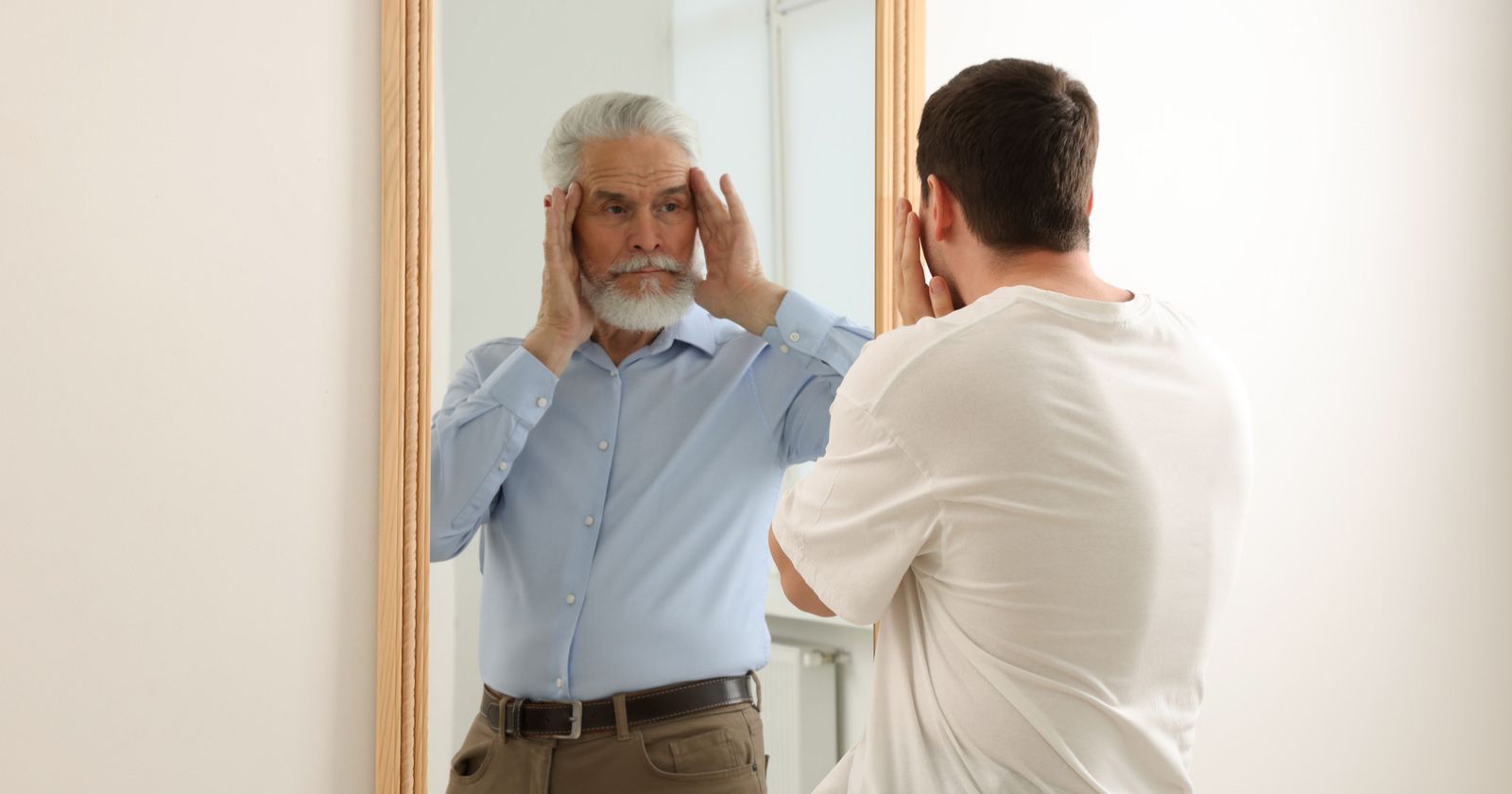
You know the feeling. A certain name pops up in your messenger app, and your shoulders tense before you've even read the message.
We usually think of stress as long hours, money worries or sleepless nights. But for many of us, one of the biggest sources of stress is a person. And that person may be doing more than ruining your mood: they may be adding to your biological age.
That's the suggestion of a 2026 study in the journal Proceedings of the National Academy of Sciences (PNAS). A team of sociologists studied 2,345 adults in Indiana. The researchers called such people "hasslers": anyone a participant said "often" hassled them, caused problems or made life difficult. They found that each extra hassler in someone's life was linked to about nine months of extra biological age.
Think of the parent who criticizes every choice you make. The sibling who starts an argument at every family dinner. The grown child who only calls when something has gone wrong. Or the jealous coworker who turns everything into a competition.
But there was a twist. The relatives people couldn't escape, such as parents and children, seemed to matter most. Yet a difficult husband or wife, arguably the hardest person of all to avoid, didn't show a clear link.
So why would a difficult relative weigh on us more than a difficult spouse?
First, what counts as a hassler?
The researchers used the Person-to-Person Health Interview Study, which interviewed Indiana adults aged 18 to 103 between October 2018 and July 2021. Each person listed the people they'd dealt with over the past six months, about five on average, and then answered one question about each of them:
"How often has (this person) hassled you, caused problems, or made life difficult?"
Only people rated "often" counted. Someone who annoys you "occasionally" didn't make the cut, because a bit of nagging can be love in disguise, like a friend who keeps pestering you to see a doctor. Even with that high bar, hasslers were common: almost three in ten people had at least one, and about one in ten had two or more.
To measure biological age, the researchers took a saliva sample from each person and read the pattern of tiny chemical tags on their DNA. That pattern shifts as we age, so scientists can read it like a clock. The team used two of these clocks, and this is where a lot of the news coverage tripped up.
The first clock, GrimAge2, is a snapshot. It asks how old your body looks compared with your birthday. Each extra hassler was linked to about nine months more on this clock. The second, DunedinPACE, measures speed. It asks how fast you're aging right now. Each extra hassler was linked to aging about 1.5% faster, which adds up to roughly 1.8 extra months over ten years.
Some outlets blurred the two. BBC Science Focus wrote of a 1.5% faster pace "or about nine months" of aging, as if they were the same thing. A Psychology Today post described the nine months as the gap between people with and without difficult people in their lives, when it's actually the estimate for each extra person.
The numbers also changed between versions of the study. An early preprint from May 2025, covered by David Robson, put the effect at about 2.5 months and 0.5% per hassler, and found that about half of people had at least one. That version counted anyone who hassled people "occasionally" as well as "often". The published paper used the stricter "often" test, which is the main reason its figures differ.
Nine months isn't a lot, and the researchers are upfront about it. They call the effects "small": the link was about 13 to 17% as big as the gap between smokers and non-smokers. And this is one study, in one US state, at one moment in time. It shows a link, not proof that difficult people make you age.
The relative you can't escape
Difficult people weren't spread evenly across people's lives. About 10% of the parents and children people named were rated as hasslers, compared with only about 3.5% of friends. Roommates and coworkers, at about 10% and 11%, were rated as hasslers just as often as family, or slightly more.
The pattern makes sense. If a friend keeps making your life hard, you can quietly stop answering their messages. You can't really do that with your mother, or with the colleague at the next desk. The researchers note that ties built on obligation, shared space or dependence produce more hasslers than the ties we choose.
So relatives weren't the people most likely to be difficult. But difficult relatives had the strongest link to faster aging, and that's the part that matches the headline. Having even one was linked to about a year of extra biological age, and relatives were the only group linked to faster aging on both clocks.
The researchers describe these family conflicts as "structurally inescapable". You can walk away from a friend, but walking away from family is a whole different story.
That reading has support outside the study. Bert Uchino, Professor of Psychology at the University of Utah, who studies relationships that are both supportive and difficult, says: "Their interpretation is consistent with lots of literature in sociology, psychology, and family studies on the constraints associated with voluntary/involuntary relationships." He adds: "We haven't regularly contrasted relationship types but when we have looked at it we find consistent associations between ambivalent spouses/family and adverse biological profiles and only sometimes with friendships."
Why didn't a difficult spouse count?
If being stuck were the whole story, spouses should have topped the list, since few people are harder to escape than a husband or wife.
Spouses were rated as hasslers about as often as anyone else: 8.5% of spouses and 8.7% of partners. Yet a difficult spouse showed no clear link to faster aging on either clock.
Before anyone forwards this to their spouse, a word of caution.
The numbers for spouses still leaned toward faster aging; they just weren't strong enough to rule out chance. And the evidence on marriage is mixed. Earlier research has tied divorce and widowhood to faster epigenetic aging, and marital stress to inflammation. But a 2025 study of 1,310 American adults also found no clear link between spouse strain and aging clocks. So this is one more piece of a puzzle, not a free pass for a rocky marriage.
Still, the researchers have an interesting idea about why spouses might be different. It comes from the German thinker Georg Simmel, who wrote about it in a 1904 essay, "The Sociology of Conflict". Simmel noticed that "people who have much in common often do each other worse and more unjust wrong than total strangers." Yet he also thought the deepest bonds were the ones best able to survive a fight. As he put it: "The strongest love can best endure a blow."
Picture the partner who leaves dishes in the sink and argues about the thermostat, but still drives you to work the morning after a fight. The stress comes wrapped in care.
The data fit that picture. Difficult relatives and outsiders tended to play fewer roles in people's lives than those who weren't difficult, with fewer kinds of help or support flowing through the relationship. Difficult spouses were rated as weaker ties too, but they didn't play noticeably fewer roles.
Uchino, who praises the study's "large sample, cutting-edge outcomes, and a focus on specific relationships," sees the spouse result differently. "In my opinion, there is little evidence that positivity from the spouse can 'buffer' negativity," he says. "There is evidence for cross-domain buffering, for instance, how a positive spouse can buffer against a negative family member but not within the same relationship."
His own 2013 study examined how perceived spousal ambivalence, in specific relationship contexts, links to inflammation.
He also notes: "Their null finding is also contrary to a very large literature examining how marital conflict is related to poorer health. So the main question that arises in my mind is whether their findings represent a true negativity association or one that is driven primarily by ambivalent relationships."
What would a Stoic say?
The finding about relatives touches one of the oldest ideas in philosophy.
Around 2,000 years ago, a former slave named Epictetus became one of the best-known Stoic philosophers, teaching people how to stay steady in a world they couldn't control. His handbook, the Enchiridion, opens with the line that sums up his thinking: "Some things are in our control and others not."
For Epictetus, your mother's comments aren't up to you, but how you respond to them is. On this view, a difficult parent can only hurt you if you let their behavior get to you. The study pushes back on that comfort. It suggests the strain of a relationship we can't leave may show up in the body, whatever attitude we take.
But a Stoic would have a reply, and one of the study's critics made a version of it. Calling someone a hassler is itself a judgment, and a calmer person might not label anyone a hassler in the first place.
Is the link real?
Quan Zhang, who works in economics and health sciences at the University of Hawaii, questioned the study in a letter in PNAS. His main worry is in the letter's title: "Do negative social ties accelerate aging in adults, or does aging erode social ties?"
In other words, it may work the other way round. People whose health is slipping may be tired, in pain or short-tempered, and so harder to get along with, or may find ordinary conversations more irritating.
The researchers replied that they had checked for this. They took people's earlier illnesses into account, and the link held, though it got a little weaker. (Their reply says this "did not attenuate" the link; the paper itself says it "was attenuated but remained significant".) They also ran a clever test using height, which the paper calls “a stable biological trait unlikely to be influenced by social relationships in adulthood.” If hasslers had been linked to height, something would have been off with the method. They weren’t.
Zhang’s second point is the one Epictetus would recognize. Calling someone a hassler depends on your own perception, and as Zhang puts it, “a neurotic or depressed person might label the same interaction as hostile that someone else would shrug off.” Neuroticism, he notes, is also linked to wear and tear across the body’s biological systems.
The researchers adjusted for two survey questions, how important people feel to others and how much others depend on them, but the paper itself admits these controls “cannot fully capture underlying dispositional or psychological factors.” So that worry still hangs in the air.
Smoking explains part of the link, too. People with more hasslers also tended to smoke more, and once the researchers accounted for that, the nine months shrank to about six.
Both sides agree a single snapshot can’t prove cause. Zhang argues that “longitudinal data with individual fixed effects would control for stable traits like personality,” and that natural experiments, such as a spouse’s death or a forced move, would be “better still.” The researchers reply that such designs answer only narrow questions, and that “family relationships are never randomly assigned.” For ties like these, they argue, “causal understanding is more likely to emerge from convergent evidence than from any single decisive design.”
How much those converging clues can tell us, when the decisive experiment can't be run, is a question philosophers of science have long argued over.
What does this mean for you?
If someone came to mind when you read the opening of this article, this study puts numbers to something you may already feel: the relationships we can't walk away from can be among the most draining.
It's worth keeping in proportion, though. The effect is small, smoking explains part of it, and the study is a single snapshot from one US state. It can't prove whether difficult people speed up aging, or whether people in poorer health simply find others harder to deal with. It doesn't show that cutting someone off would make you any younger, either. The study didn't test that, and other research hints it isn't so simple: people estranged from family members report worse health, and social isolation has been linked to faster epigenetic aging.
And no, the spouse finding isn't proof that a difficult partner is harmless. As Uchino points out, relationships that mix the good with the bad have been linked to "adverse biological profiles." Of everything in the study, the spouse result is the part most in need of a second look.
The question you're left with
Social media is full of advice to cut "toxic" people out of your life. Yet the people who seemed to matter most in this study are the ones you can't easily cut out: a parent, a child, a sibling.
Byungkyu Lee, the study’s lead author and Associate Professor of Sociology at New York University, says he has seen many social media posts citing the paper to argue exactly that. "For this reason, I don't think there is a simple solution such as 'cut ties with your family,' especially when those same family relationships may also provide essential emotional, practical, or financial support," he says.
His own takeaway: "You don't necessarily have to cut ties with parents or siblings who make your life difficult. Instead, it may be useful to reflect on these relationships with a bit more distance and objectivity."
It's advice Epictetus would recognize. If you can't escape the difficult relative, what is still up to you?
