

What is a good life?
Is it someone waiting for you at home, two toothbrushes in one glass, a shared calendar on the fridge? Or is it a quiet flat, your own schedule, and a life full of people who aren't "the one"?
If I had the answer, I'd be writing a very different article. Probably a bestseller.
I don't.
And if any line below starts to sound like I do, please don't believe me. A good life is one of the few things you can't borrow from someone else.
Still, one study kept me thinking about it longer than I'd like to admit. For 11 years in a row, 2,930 Germans who had never married, and had no committed partner at any of the yearly check-ins, were asked the same question: "All in all, how satisfied are you with your life at the moment?" About nine in ten stayed above the middle of the 0-to-10 scale the whole time.
Elaine Hoan, Geoff MacDonald and Matthew Johnson published the study, "The Eras of Singlehood," in Personality and Social Psychology Bulletin this year. They used data from pairfam, a long-running German survey that asked the same people about their relationships and family life every year, starting in 2008.
The researcher expected a 5
Here's what the numbers look like. The team followed three groups who were about 18, 26 and 36 at the first survey they used. In each one, a statistical model found a big group, 88 to 95 percent of people, whose average answer started at 8, 7 and just under 7 out of 10 and dipped only slightly, if at all, over the next decade. The small groups started low, around 3 to 5. Two of them slowly climbed. The oldest one didn't.

When I asked Hoan, the study's lead author, what surprised her, she said research has long found singles less satisfied than people in couples, so she expected "the overall average would be quite low (e.g., averaging around 5/10 on the scale)." The data said otherwise. "I was surprised by the results," she told me.
So was I. Maybe I'd absorbed the same story as everyone else: single means waiting.
Hoan pointed me to an idea from personality psychology that fits her results, the so-called hedonic treadmill: "even if individuals experience different shocks and traumas, they tend to return to an average level of happiness, which is different for each person."
Which is comforting and a little annoying at the same time. Comforting if you're single. Annoying if you were counting on someone else to fix your baseline.
Hello, are you married yet?
In Georgia, where I'm from, this question is part of the culture, which is too annoying. When my parents' acquaintances or relatives see me, they ask it first and only then say hello. Okay, I'm exaggerating, but only a little. Some of them seem to think I have a problem, and that finding me a partner is, apparently, their job.
The philosopher Elizabeth Brake, at the University of Wisconsin–Madison, has a word for the thinking behind that question: amatonormativity. She coined it for "the widespread assumption that everyone is better off in an exclusive, romantic, long-term coupled relationship, and that everyone is seeking such a relationship." That assumption, she argues, pushes friendship and solitude into "cultural invisibility."
Germany runs on a different clock. "In Germany average marriage age is 30 or higher," Josef Brüderl, a sociologist at LMU Munich and one of pairfam's principal investigators, told me. I try not to have any timelines. But I'll admit it's getting more and more confusing.
Is it the matrix, or just Germany at 8 pm?
Since moving here, I've been watching people closely, the way outsiders do. From the outside, it's hard to say what people here call a good life. One thing I can say: they don't strike me as very social. They can take real pleasure in waking up at 5 am, going for fresh air by bike and coming back before it's dark. When I go out at 7 or 8 pm, whole streets are empty. At one point I thought I was in some kind of matrix, because there was nobody around at all. When I asked other international people, they agreed.
Maybe it's the cold months. But from where I stand, a good life here looks like a peaceful life. Not exciting, not loud, just quiet. That's a generalization, I know.
In Tbilisi, people ask about your marriage before they even say hello. In Dresden, there's often nobody on the street to ask you anything at all. I still can't decide which I prefer.
The numbers fit my impression, at least partly. In 2025, 20.9 percent of people in Germany lived alone, well above the EU average of 16.5 percent, and one-person homes were the most common kind of household, at 42.1 percent, according to the Federal Statistical Office. The office adds a fair warning: living alone isn't the same as being single.
So I tried a tiny, very unscientific echo of the study: I asked a single 24-year-old in Dresden, close to the study's youngest group, the same question the researchers asked.
He gave himself a 3. "First thought was 0, but then I remembered that I had some progress in last time so I go with 3," he told me. Most singles around his age in the study rated their lives between 7 and 8; he'd sit with the small group that started low and slowly climbed. A good life, for him, means "feeling loved, feeling connected and feel held." Does it need a partner? "At the one side I'm telling myself that happiness comes from within, but I know that I feel the most happy with other persons," he said. "I would say yes."
That might be the most honest answer to the whole question. We tell ourselves happiness comes from within, and then we feel happiest with other people.
Marry, and you will regret it

The Danish philosopher Søren Kierkegaard got engaged to Regine Olsen in 1840 and broke it off about a year later. He never married. In Either/Or, published in 1843, the young writer of its first half puts it like this: "Marry, and you will regret it. Do not marry, and you will also regret it. Marry or do not marry, you will regret it either way."
I'm getting closer to my 30s, and I don't even know if I'm capable of these things. I'm not married, and so far I don't plan to be, and still I already regret the consequences of a hypothetical marriage in advance. Kierkegaard would have understood, I think. On the other hand, when I'm not in a relationship, it's hard to find a sadder person than me. Sad doesn't have to mean bad, though: I do enjoy being alone sometimes, and I doubt I'm the only one.
Around me, people my age seem to be splitting in two. My friends come from all over the world, and still the pattern looks almost strangely similar (I'm not saying it's universal). Some made their relationships more serious and took a step forward: recently, a friend and a colleague from two different countries told me almost exactly the same thing, that after years of toxic relationships they'd found the loves of their lives and are getting married soon. Others, maybe not brave enough, broke up with their partners and are now trying to enjoy life to the fullest. I'm not sure which is best.
Does finding someone make you happier? Yes. For a while
Not everyone is convinced by the study. Brüderl thinks the age groups aren't really comparable. In a country where people marry late, the 18-year-olds who stay unmarried and the 36-year-olds who stay unmarried are very different groups. "It groups 'apples and oranges' together," he told me. He also misses a comparison group: "satisfaction above the midpoint of the scale says nothing, because almost all respondents are above the midpoint (average is 8 on the scale from 0-10)." Hoan's team compared singles with each other, to see how differently their lives go, so his question is a different one: what happens when the same people pair up?
His own pairfam teaching material, which follows the same people over time, gives one answer: satisfaction with their sex life went up by about 2 points once they were in a relationship, and a little less once they moved in or married. Then the boost faded, by about 0.15 points for every year together.
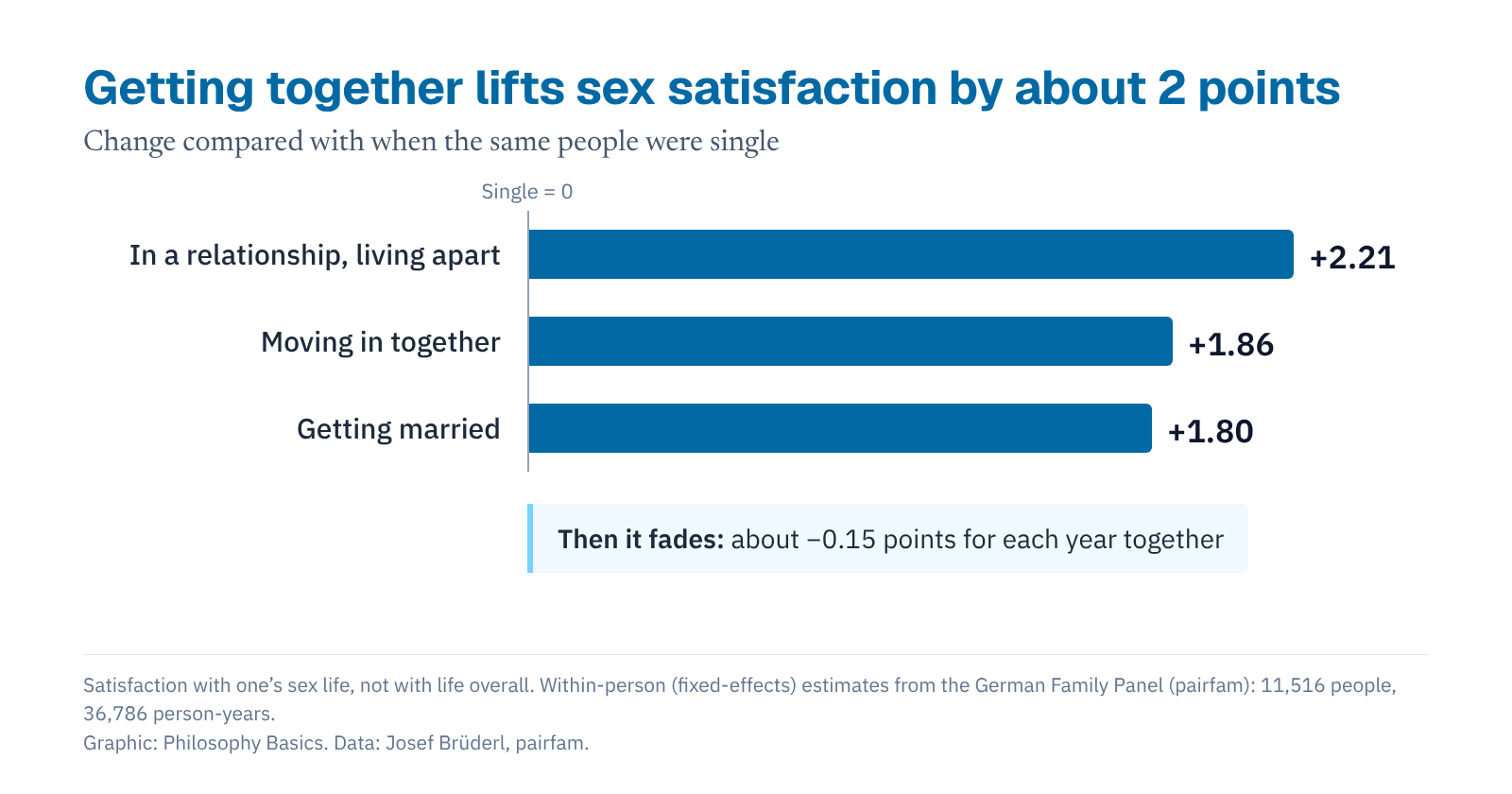
So keep in mind that it's just one country, and nobody in it was over 50. And "nine in ten" comes from a statistical model, so it doesn't mean nine in ten people said "satisfied" every single year.
Maybe this is the part that scares me. If satisfaction drifts back to its usual level either way, then at some point it gets stuck. Excitement is needed. But it's hard to choose between excitement and comfort. And comfort is hard alone.
Lonely everywhere, or just looking?
Here's something I feel everywhere, not only in Germany: loneliness seems to be in the air. Many single adults I know seem to be looking for someone. Many people in couples seem a little bored at some point. Not everyone, of course.
The World Health Organization estimates that about 1 in 6 people worldwide feel lonely, and young people more than anyone, at 21 percent. In Germany, the government's loneliness barometer found that loneliness fell between 1992 and 2013, then jumped during the pandemic, when 28.2 percent of adults felt highly lonely in 2020. Still, maybe loneliness isn't new. Maybe we just feel it more, and talk about it more, since lockdowns. I don't know.

When I asked Bella DePaulo, the author of Single at Heart, what a study like this misses, she described people who are "single at heart." They "do not want to organize their lives around a romantic partner," she told me. They're drawn to single life for "the freedom and autonomy, the potential for valuing, caring for, and spending time with a variety of people ('the ones' instead of 'The One')." And because they "savor their solitude instead of fearing it, they are very unlikely to be lonely."
I noticed something similar in myself, on a much smaller scale. At some point I stopped eating whatever sweets were around and started waiting for the ones I really love. My friendships went the same way: fewer people, chosen on purpose, instead of a wide circle kept out of habit. I've also written about how falling in love can quietly cost you two close friends. Maybe "the ones" is the part we forget to protect.
"I don't know if it is possible to feel profoundly fulfilled and contented if you are leading someone else's idea of a good life rather than your own." — Bella DePaulo
So, what is a good life?
I still don't know.
I do know that at home, I have one toothbrush and too many working desks for a single person. Some days that looks like freedom. Other days it looks like a waiting room with very good office furniture.
Maybe the only question I can work on for now is whose idea of a good life I'm living. I'm still checking which parts are mine.
If loneliness has been weighing on you for a while, talking to someone you trust, or to a therapist, can help.