
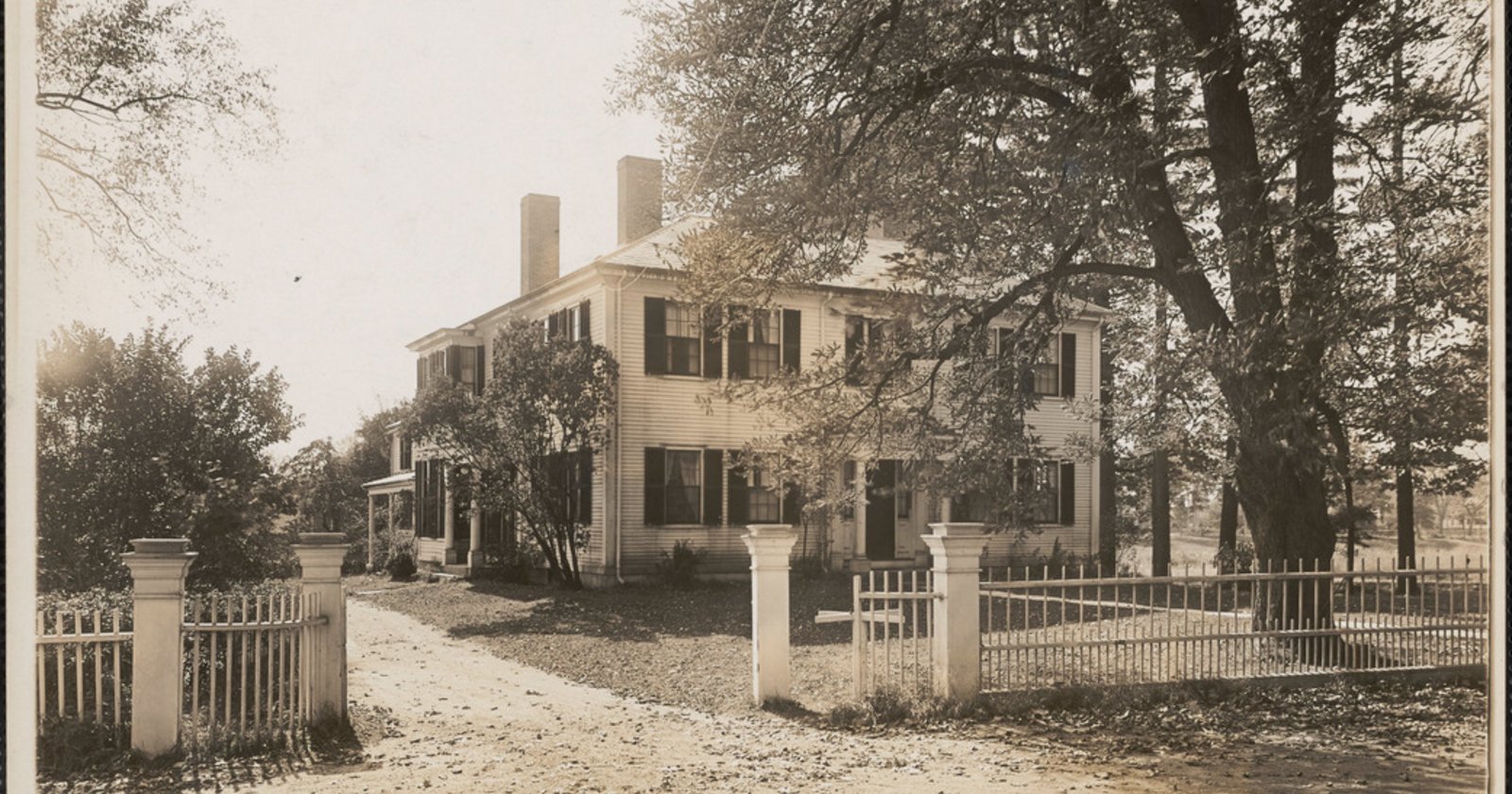

At 5:30 on the morning of July 24, 1872, Ralph Waldo Emerson was asleep on the second floor of his house in Concord, Massachusetts, when he was "awakened by the crackling of flames and the smell of smoke." According to the Concord Free Public Library's account of the fire, he shouted to wake his wife, Lidian, who slept downstairs, then "dressed hastily, and ran out into the rainy morning to rouse the neighbors."
The house had been his for 37 years.
"I have dodged the doom of building"
In the summer of 1835, Emerson bought a house on the southwest side of the Cambridge Turnpike, built in the late 1820s for a man named Charles Coolidge. The price was $3,500 for the house, a barn and about two acres, according to the Concord Library. Emerson set aside another $400 or $500 for expansion and renovation.
He announced the purchase to his brother William on July 27, 1835: "I have dodged the doom of building & have bought the Coolidge house in Concord." He was not taken with the setting. "It is in a mean place & cannot be fine until trees & flowers give it a character of its own," he wrote. Inside, he had plans: "we shall crowd so many books & papers, &, if possible, wise friends, into it."
That September he married Lydia Jackson in Plymouth. "The next day, Emerson brought his bride to the home they first called Coolidge House". In 1836 Emerson planted apple, pear, plum and peach trees on the grounds.
What the town carried out
The fire of 1872 started in the attic. Emerson's son Edward believed a kerosene lamp carried by a newly hired servant was to blame, while the Boston Daily Advertiser reported the next day that "it is supposed that the fire originated in a defective flue."
Whatever the cause, Concord turned out. The library's account says "firefighters and villagers managed to haul a great deal from the burning house." Food, clothing and furniture came out, along with Emerson's manuscripts, some of them gathered up by Louisa May Alcott and her sister May, and most of his books. A townsman, Sam Staples, stopped Lidian from going upstairs to rescue their daughter Ellen's things.
The losses were still heavy. Family papers stored in the attic were destroyed. According to the National Park Service, the fire "destroyed the roof and much of the second floor."
Five days later, Emerson wrote to the Concord Fire Department to thank its men for "the able, hearty, and in great part successful exertion in our behalf, in resisting and extinguishing the fire, which threatened to destroy my house on Wednesday morning last."
A check from a classmate
Francis Cabot Lowell, who had been at Harvard with Emerson, "personally delivered a $5,000 check," a gift from himself and several other friends to cover the costs of the fire. Soon after, Judge Hoar brought a second gift, collected among friends, "of more than twice the amount of the first," to pay for a trip to Egypt.
He sailed in October with Ellen and visited London, Paris, Florence, Rome and Egypt, seeing his old friend Thomas Carlyle for the last time. At home, Judge John Shepard Keyes oversaw the repairs, and Lidian and the Emersons' daughter Edith Forbes "threw themselves into redecorating and furnishing the house."
Emerson came home in May 1873 to ringing bells, a band, a welcome arch at his gate and schoolchildren singing "Home Sweet Home." He told the crowd: "My friends! I know that this is not a tribute to an old man and his daughter returned to their house, but to the common blood of us all—one family—in Concord!"
The one room that moved
The house still stands on the Cambridge Turnpike, and the National Park Service describes it plainly: "All of the rooms remain as they were after the 1872-1873 restoration, with the exception of the study."
The study left in 1930. That year, according to the Concord Museum, the R.W. Emerson Memorial Association concluded that the year-round demand from visitors was better served at the museum, and "sent the Study's contents to an exact reproduction of the room at the Museum."
The museum's version has his rocking chair drawn up to the round center table. "The books there now are those that were there in the 1870s," the museum says, the decade in which Concord carried most of his library out of a burning house.