
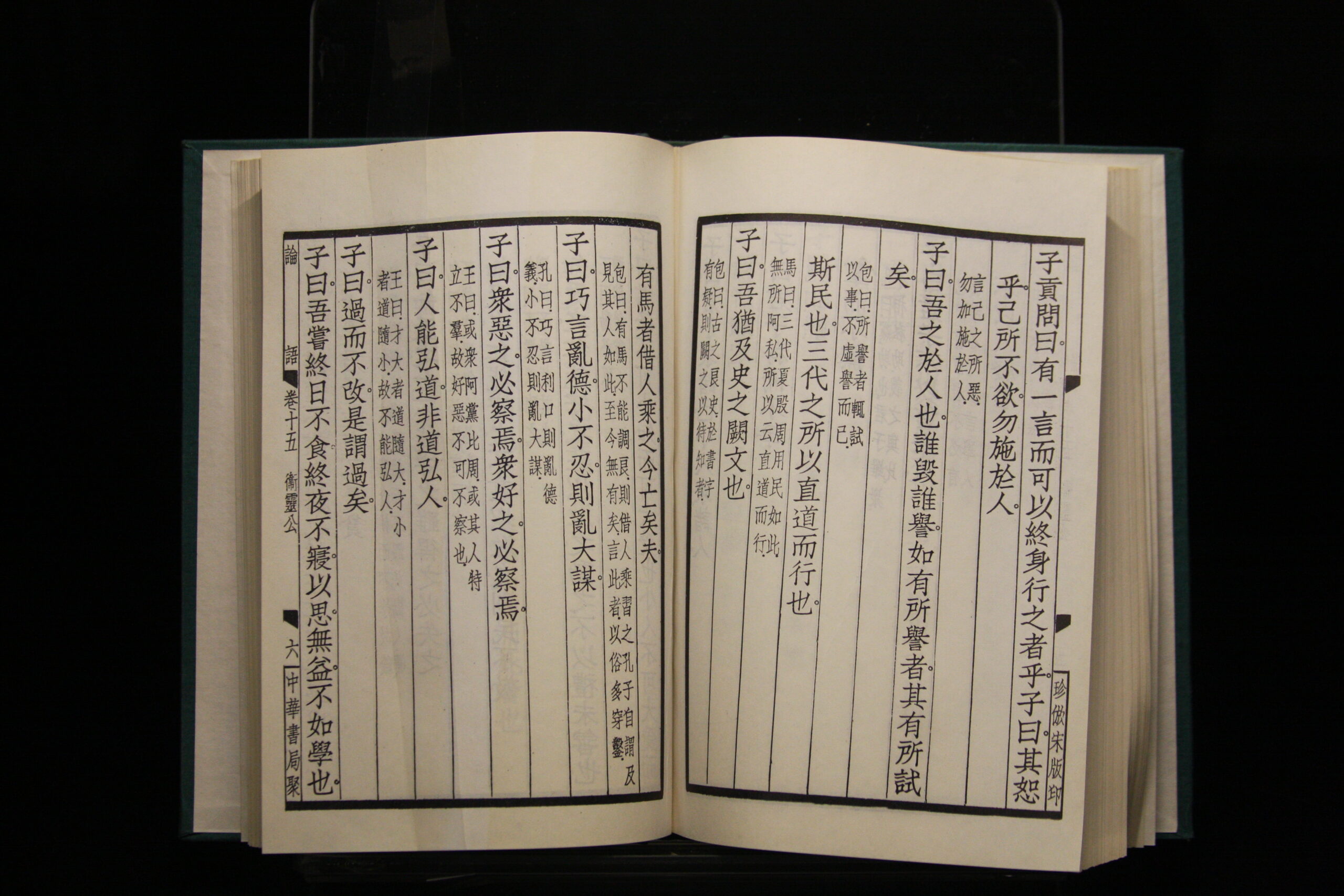
In Chinese, a person turning thirty can be described as 而立 (erli), standing firm. Forty is 不惑 (buhuo), without doubts. Fifty is 知命 (zhiming), knowing the allotment. Sixty is 耳順 (ershun), the compliant ear.
All four come from a single sentence attributed to Confucius in the Analects, Book 2, Chapter 4. Four phrases of a very old self-description are still ordinary names for those ages, and that only holds as long as the English translation does not invent extras.
The Chinese reads 子曰。吾十有五而志于學、三十而立、四十而不惑、五十而知天命、六十而耳順、七十而從心所欲、不踰矩。 The text and a modern English version sit together on the confucius-analects.org translation page.
James Legge, the translator of Confucian Analects in The Chinese Classics, gave it this way:
The Master said, 'At fifteen, I had my mind bent on learning. At thirty, I stood firm. At forty, I had no doubts. At fifty, I knew the decrees of Heaven. At sixty, my ear was an obedient organ for the reception of truth. At seventy, I could follow what my heart desired, without transgressing what was right.'
The markers are fifteen, thirty, forty, fifty, sixty and seventy. The first interval is fifteen years, not ten. Only after thirty do the steps fall a decade apart, and the sequence stops at seventy.
People quote this as a neat decade-by-decade life plan. The first step is 15 years, not 10, and the most famous English version quietly adds a word the Chinese does not have.
The question is narrow: is 2.4 a schedule anyone can set a watch by, or one man looking back, written down by other people?
The added word sits at sixty. Legge's "obedient organ for the reception of truth" is a long phrase for two Chinese characters, 耳順. The identical Legge wording appears in the bilingual text at YellowBridge's Analects, Book 2.
耳 is ear. 順 is compliant, going along with, attuned. The Chinese says the ear became compliant. It does not say what the ear was compliant to. "Truth" is Legge's addition, not the text's word.
confucius-analects.org renders the same line as "At sixty my ear was attuned," which leaves the object open. The gap matters. One version shows a man receiving something true. The other shows a man whose ear has gone along with what it heard, with the object left unstated.
Fifty carries a similar risk in the other direction. 知天命 is knowing Heaven's allotment or charge, which Legge gave as "the decrees of Heaven." Reading a later theology into those three characters puts into the sentence something the sentence does not state.
At seventy the key character is 矩 (ju), literally a carpenter's square, hence a rule, pattern or standard. Legge turned it into "what was right." The traditional reading is not that desire had been beaten down, but that desire and the standard had stopped pulling against each other.
The Analects was assembled after Confucius's death from sayings his followers carried, so 2.4 is a reported first-person speech rather than anything he wrote. Michael Nylan, Professor and Jane K. Sather History Chair at the University of California, Berkeley, and editor of the Norton Critical Edition of the Analects, described the collection in an email as "remembered conversations or imagined conversations between Kongzi and his disciples," Kongzi being the Chinese name for Confucius. Like the Buddha, she said, "the words of Kongzi were not put down in writing until centuries after the Master's death."
That limits how much any single line can carry. "We should not put too much emphasis on any one line, but rather consider what themes come up so often that they are likely to reflect Kongzi's teachings," Nylan said.
Nylan credits the translator. Legge "did a wonderful job for his era," she said, and on this passage she reads Kongzi as someone who "appears to reflect upon his progress in understanding."
Nylan resists the idea of a formula. She said "there is no one rule for Kongzi," and that Kongzi "always suggests that we need to consider the time and place when deciding what to do." She pointed to the "Wei zi" chapter of the Documents classic, "where four sages respond differently to the same situation and all are wise in their actions."
Nylan put her main objection plainly. She said "latter-day interpreters of Kongzi put WAY TOO MUCH emphasis on self-cultivation." The Analects, in her reading, "is outer-directed, plans for what he and his disciples want to do to reform social ills."
That bears directly on the life-plan reading. A staircase of inner milestones makes the passage about a self being polished in private. Nylan also noted that Kongzi often describes himself as insufficiently wise, less wise than his student Yan Hui, and lacking the good interlocutors he needs in order to improve.
None of this has dented the line's usage. Erli, buhuo, zhiming and ershun are still how ages get named in Chinese and in broader East Asian usage, and the Analects is treated in surveys of Chinese philosophy for reasons that have nothing to do with age vocabulary.
What that vocabulary preserves is the Chinese, not the English. At sixty the ear went along with what it heard, and the characters do not say what it went along with. The first step, the one rounded off whenever the passage is quoted as a decade plan, took fifteen years.