
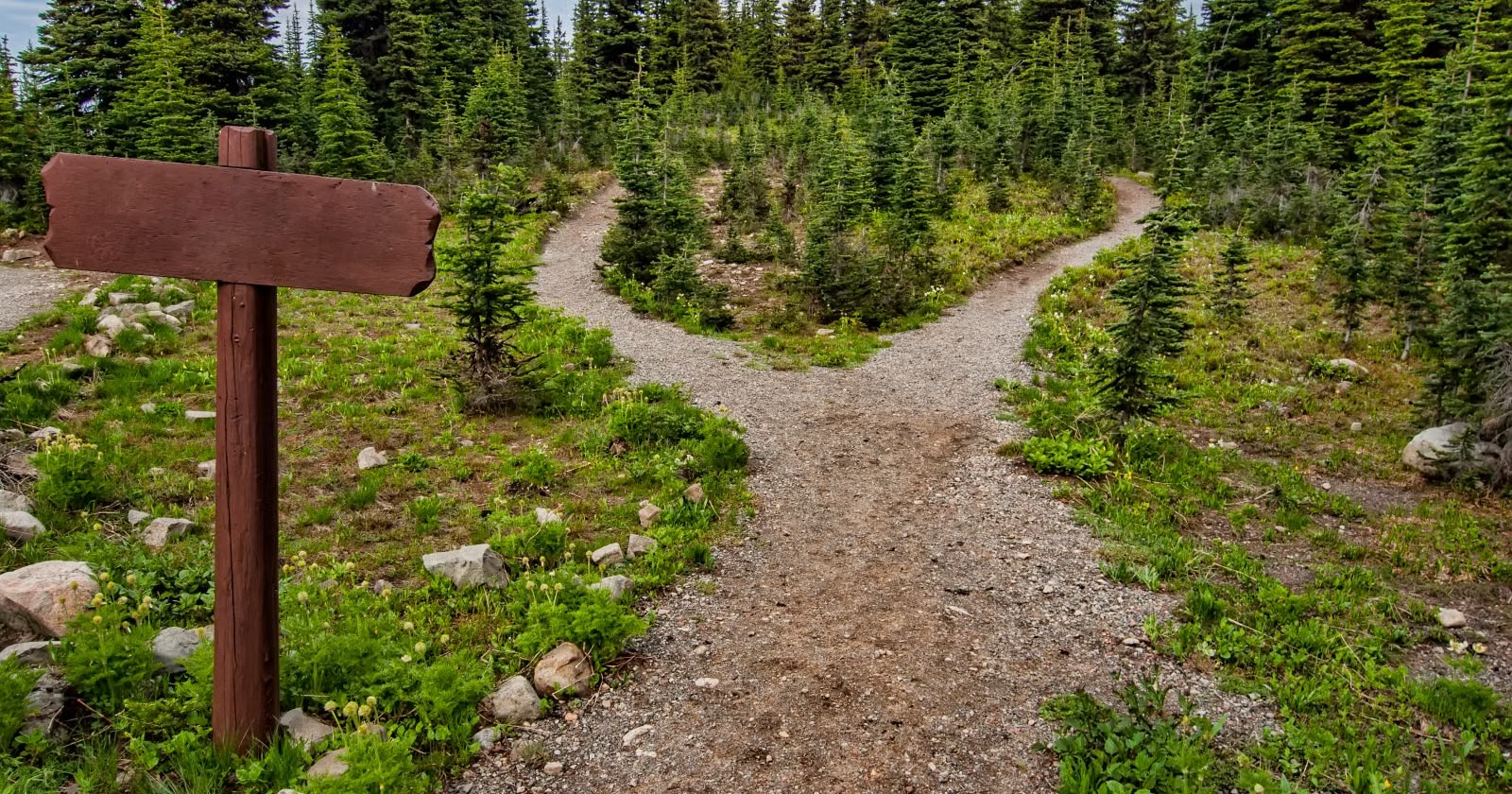
Maybe it's the job you turned down, the city you almost moved to or the person you didn't marry. Every so often, usually late at night or on a long drive, you find yourself wondering how that other life would have turned out.
That kind of wondering is normal, and it doesn't mean you chose badly. Robert Frost's "The Road Not Taken" is often read as a tribute to bold choices, but the poem is more honest than that. The two paths, Frost admits, were worn "really about the same." Many readers take his closing lines, in which the speaker imagines "telling this with a sigh" years later, as a hint that the choice only seems so decisive in the retelling (Mountain Interval, 1916).
Most real decisions are like that. You picked between options that both had something going for them, using what you knew at the time. The most useful distinction is between a good decision and a good outcome. You can judge the first by what you knew and valued then, even when the second was partly out of your hands. Here are eight quiet signs your choices have served you well, and some practical ways to think about the ones you still wonder about.
These aren't proof that every decision was right, or that another path couldn't have worked. They're reasons to assess your choices more fairly: what made sense then, what has served you well and what you might still change.
1. You judge your past self by what you knew then
Looking back, it's easy to think you should have seen how things would turn out. Research suggests that feeling is often an illusion. In a classic set of experiments, people who were told how an event had turned out judged that outcome as more likely than people who weren't told. Even when asked to answer as if they didn't know the outcome, they struggled to set that knowledge aside (Journal of Experimental Psychology: Human Perception and Performance, 1975). Psychologists now call this hindsight bias.
Søren Kierkegaard made a similar point in his journals: life can only be understood looking backward, but it has to be lived going forward. You made your choice facing forward, without the information you have now.
Try writing down what you actually knew at the time, the options you really had and what you were trying to protect. If you can read it back and think, "Given all that, it was a reasonable call," you're judging your past self fairly.
2. You don't compare your real life with an imaginary highlight reel
The road not taken has an unfair advantage: it never has to deal with real life. In a series of six studies, people's most lasting regrets were more often about falling short of who they hoped to be than about failing at their duties. The researchers found that people tend to deal quickly with regrets about obligations, while regrets about unrealized dreams are more likely to linger (Emotion, 2018).
That other life often stars an idealized version of you. But in reality, you would have taken your temperament, your worries and your bad days with you.
When you picture the other road, include its likely benefits and costs, and leave room for what you cannot know. The different job might have brought better pay and longer hours; the move might have brought excitement and distance from people you love. You don't need to prove that life would have been worse to recognize what your actual choice gave you.
3. The reasons behind it still make sense to you
Outcomes are partly luck. Reasons are yours. You may have stayed close to aging parents, chosen security for your children or turned down a promotion that would have cost you your evenings.
Even if the result was mixed, a choice made for reasons you still respect is one you can stand behind. A good decision and a good outcome aren't always the same thing.
When you think about a road you didn't take, name the value that shaped your choice. If you'd still put that value first today, you chose in line with who you are.
4. You committed, and the choice became yours
Keeping options open feels safer, but it may make people less satisfied. In one study, photography students chose which of two prints to keep. Those who were told they could swap later liked their chosen print less than those whose choice was final. Yet most participants still said they would prefer the option to change their minds (Journal of Personality and Social Psychology, 2002).
The researchers suggested that a final decision lets people settle into it and appreciate what they chose. That's about feeling settled after choosing, not proof that the choice was the best one. But constantly reopening a decision can get in the way of enjoying it.
If a decision can't sensibly be undone, give yourself permission to stop reviewing it. Put your energy into making the most of the life you chose.
5. You can appreciate what followed without endorsing every part of the choice
Every road leads to its own people and places. Your choice brought you friendships, skills, a neighborhood, perhaps children or grandchildren, that the other road would not have.
That doesn't mean the other path would have been empty. It would have had its own good things. But you wouldn't have had these, and these are real.
Make a short list of the people and experiences you value that followed from your choice. Their importance doesn't erase its costs. You can love your children, treasure a friendship or value something you learned while still wishing parts of the past had been different.
6. You can tell the story with some turns for the better
How you tell your life story seems to matter. In a study of adults in midlife and college students, people whose life stories included more "redemption sequences," in which a bad experience led to something good, tended to report greater well-being. Stories in which good things turned bad were linked to lower well-being among the midlife adults (Personality and Social Psychology Bulletin, 2001). That study found associations, so it can't show which came first.
You don't have to pretend every hard choice turned out for the best. But if you can say, "That was a difficult year, and it's also when I learned what I'm capable of," you're telling a story that includes growth as well as loss.
7. The pang passes without pulling you backward
Regret often points to where you still see possibility. In an analysis of regret research, people's biggest regrets centered on education, career, romance, parenting, the self and leisure, and they were most intense in areas where people saw real opportunity for change (Personality and Social Psychology Bulletin, 2005).
That makes some regrets useful. If you still wonder about studying art, you can take a class. If you miss a friendship you let slip, you can write to them. The road not taken isn't always completely closed.
When the door really is shut, a passing pang of "what if" is just a memory. It becomes a problem only if it keeps you from enjoying the life in front of you.
8. You'd make many of the same choices again
Near the end of his life, Michel de Montaigne looked back with unusual calm. "Were I to live my life over again, I should live it just as I have lived it; I neither complain of the past, nor do I fear the future" (Essays 3.2, "Of Repentance", Charles Cotton's translation).
Few people can say that about every decision, and you don't need to. If you look back over the big choices and find that you'd make many of them again, knowing what you know now, that's a quiet sign you've lived according to what matters to you.
When the wondering is telling you something
Sometimes "what if" is more than idle curiosity. If you keep returning to the same regret, it may be pointing to something you still want: a skill, a place, a relationship or a kind of work. Small experiments, such as a short course, a visit or a phone call, can tell you more than years of wondering.
And if regret has turned into constant rumination, keeps you awake or comes with a low mood that won't lift, it's worth talking to a doctor or someone you trust.
One place to start
Pick one choice you still wonder about. On one side of a page, write what you knew and wanted at the time. On the other, list what exists in your life because of the road you took.
Then add one more question at the bottom: "Is there anything useful I can still do about this?" If there is, choose one small step. If there isn't, keep the page somewhere you can find it, and read it the next time the other road calls.