

I find it hard to believe in luck. Maybe that’s what years in research do to you. Everyone around you speaks in sample sizes, effect sizes and confidence intervals, and “it just happened” never counts as an answer.
Then a colleague told me about her trip to a conference in Munich. She ran for the train and reached the platform just as it pulled away, and in that moment she realised it was the wrong one. If she’d caught it, she would have missed the conference.
That kind of luck is easy to spot: she believed something false, and chance saved her. The sneakier kind works the other way round. You believe something for a good reason, it turns out true, and your reason had nothing to do with it. You never find out, so you never call it luck. In 1963, a philosopher showed this in under 1,000 words, and philosophers have been arguing about it ever since.
Does this person know? You decide
Before the philosophy, try three short stories. For each one, ask yourself: does this person know, or not?
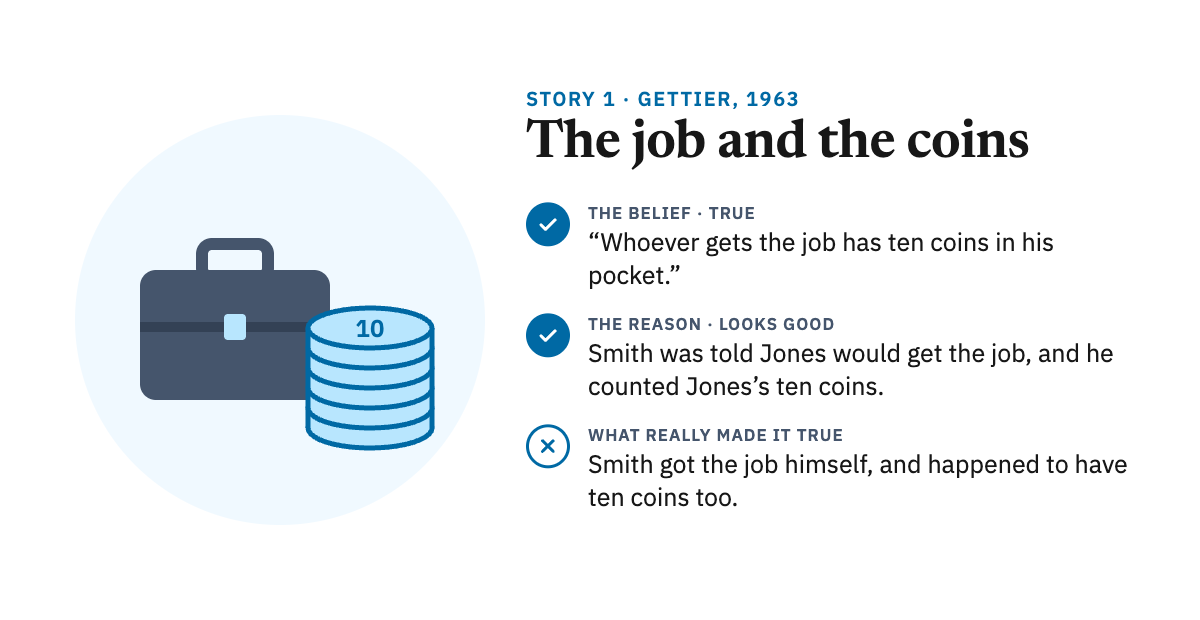
The job and the coins. Smith and Jones have both applied for the same job. The company president has told Smith that Jones will get it, and ten minutes ago Smith counted ten coins in Jones’s pocket. So Smith concludes: whoever gets the job has ten coins in his pocket. Then Smith gets the job himself. And, without knowing it, he also has ten coins in his own pocket.
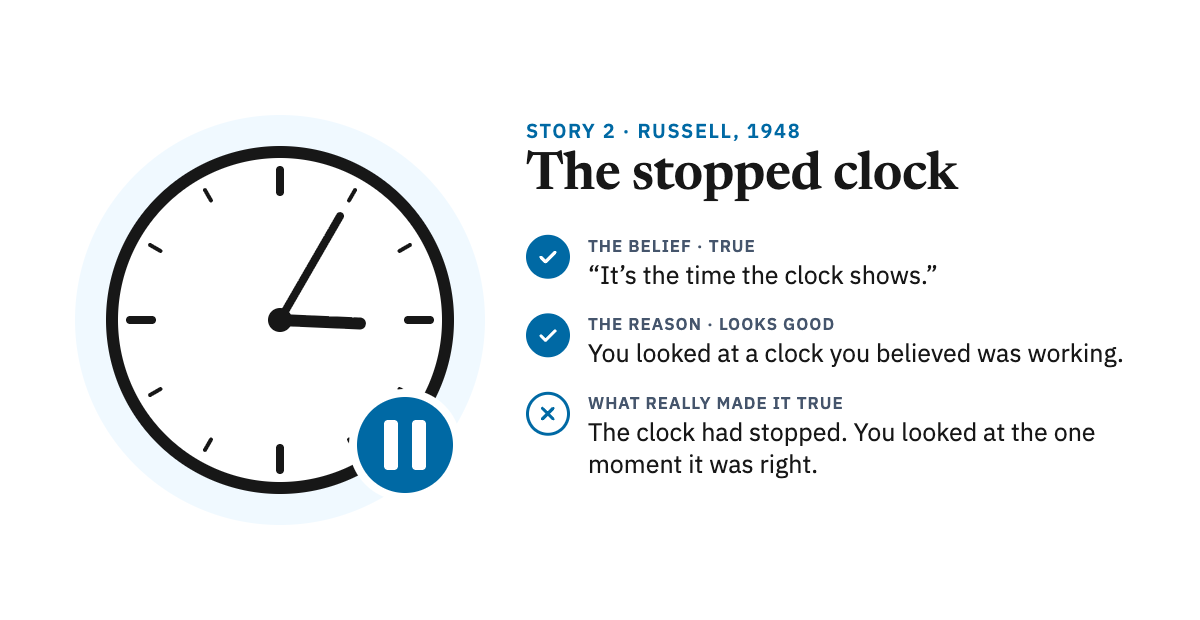
The stopped clock. You look at a clock you believe is working. In fact it has stopped, but you happen to look at it at the one moment it’s right. Bertrand Russell put this one in his 1948 book Human Knowledge, about a man who looks at a clock “which is not going, though he thinks it is”.
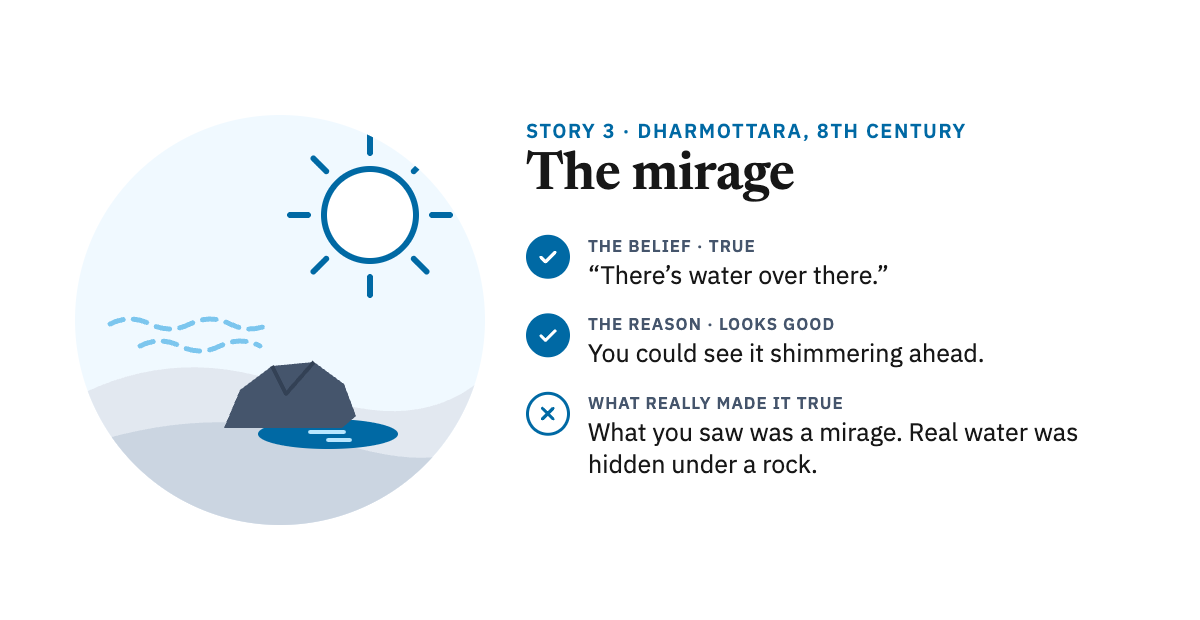
The mirage. This one is about 1,250 years old. The Indian philosopher Dharmottara, writing around 770 CE, described it like this (as quoted from Georges Dreyfus’s 1997 book in the Stanford Encyclopedia of Philosophy): “Imagine that we are seeking water on a hot day. We suddenly see water, or so we think. In fact, we are not seeing water but a mirage, but when we reach the spot, we are lucky and find water right there under a rock.”
Keep your answers in mind. We’ll come back to them.
Whenever a coincidence like this happens to me, I reach for the same explanation: a self-fulfilling prophecy. I’m not sure it explains everything, but still. The sociologist Robert Merton, who coined the term in 1948, described it as “a false definition of the situation evoking a new behavior which makes the originally false conception come true.” He also noted that “each of us has his favored specimen.” Mine is probably overused.
Gettier’s cases are almost the opposite. In a self-fulfilling prophecy, your belief makes itself true. In a Gettier case, nothing you believed or did had anything to do with it, which is exactly why they’re so easy to miss.
Under 1,000 words against an idea as old as Plato
By the middle of the 20th century, many philosophers worked with a neat recipe for knowing something. You believe it, it’s true, and you have good reasons for believing it. Textbooks call it “justified true belief”.
The recipe is older than the name. In Plato’s Meno, Socrates compares true opinions to the statues of Daedalus, which were said to run away unless tied down. True opinions, he says, “are not of much value until they are fastened by the tie of the cause”. In the Theaetetus, a young mathematician suggests that knowledge is “true opinion, combined with reason”, and by the end of the dialogue Socrates has rejected that too.
Edmund Gettier noticed the difference. In his first footnote, he wrote that “Plato seems to be considering some such definition at Theaetetus 201, and perhaps accepting one at Meno 98.” Seems to. Perhaps. I like that hedge. It’s a kind of care you rarely see when people sum up his paper.
The paper itself, “Is Justified True Belief Knowledge?”, appeared in Analysis in June 1963. It is three pages long. I counted: about 920 words of main text, plus three short footnotes. Gettier needed only two ideas, which he states at the start. You can be justified in believing something false. And if you correctly work something out from a justified belief, you’re justified in believing that too. Then come his two examples. The first is the coins story. In the second, Smith has good reason to think Jones owns a Ford, so he’s also justified in believing “Either Jones owns a Ford, or Brown is in Barcelona”, a city he picked at random. Jones doesn’t own a Ford. But “by the sheerest coincidence”, Brown is in Barcelona. Both times, Smith’s belief is justified, true, and still not knowledge.
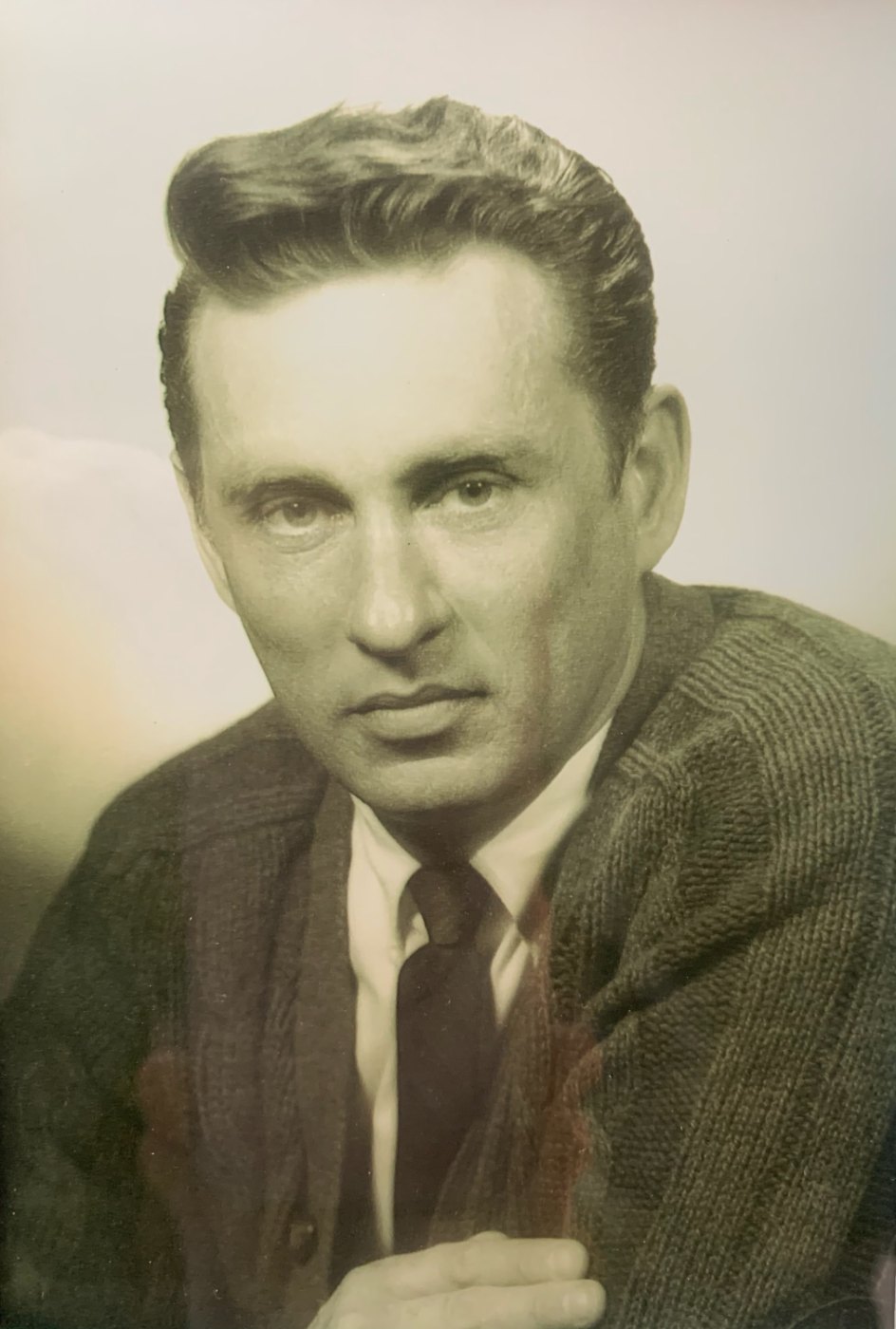
The story behind it is almost as good. Gettier was in his mid-thirties, teaching at Wayne State University in Detroit, unpublished and under pressure to publish before his tenure review. “He had one idea, which was to write about knowledge,” David Edmonds wrote in Times Higher Education. Gettier himself wasn’t sure about it: “Up to the last moment of decision, I would never have dreamed of submitting a philosophy paper that consisted of nothing but a counterexample.”
He got tenure. A second paper, accepted by the journal Crítica to help his case, never came out at all. The journal lost its copy, and Gettier didn’t have one, the philosopher Earl Conee recalled, from what one of Gettier’s Wayne State colleagues told him. When Edmonds asked him, half a century later, whether he’d ever been tempted to publish more, the answer was short.
“No”, he answered, “because I really have nothing more to say.” Edmund Gettier, asked whether he had been tempted to publish more, quoted by David Edmonds in Times Higher Education (2013)
Other philosophers had plenty more to say. In the six decades since, they’ve tried again and again to patch the recipe, and none of the fixes listed in the Stanford Encyclopedia of Philosophy has won everyone over.
Jennifer Nagel, a philosopher at the University of Toronto, walks through the stopped clock, the mirage and her own experiments in a conversation with Curt Jaimungal on Theories of Everything. The Gettier part runs from about 48 to 55 minutes.
Do ordinary people see what Gettier saw?
For decades, philosophers trusted their gut on these cases. Then researchers started asking everyone else.
In 2013, Nagel, Valerie San Juan and Raymond Mar gave people a range of Gettier cases. Their participants rated the beliefs as justified, but they were still less likely to call them knowledge, and that held across ethnicity and gender. One detail caught my eye as someone who studies emotion: people who scored higher on empathy tended to rate the beliefs in the stories as more justified.
A few years later, Edouard Machery and colleagues took a Gettier case to 24 sites in 23 countries, in 17 languages. When the question set really knowing against only thinking you know, most people in 23 of the 24 sites said the person didn’t know.

When I asked Machery what such a widely shared intuition says about the old idea of knowledge as true belief with something added, he told me that, in his opinion, “the whole body of literature in experimental epistemology suggests that, as conceived by people across a surprising range of languages and cultures, knowledge is indeed true belief plus something else.” “It is not quite clear what the something else is, however,” he added. “It seems to have something to do with luck, or at least some forms of luck. Truth should not have been reached by sheer luck.” But not every kind of luck rules knowledge out: “getting it right while one was likely to get it wrong does not disqualify a belief for being knowledge.”
So far, so Gettier.
But two psychologists, Christina Starmans and Ori Friedman, found something odder. In a 2020 study, they gave the same kind of cases to philosophers, to academics from seven other fields and to laypeople. Laypeople and the other academics answered an ordinary case and a Gettier case in much the same way. Philosophers didn’t.
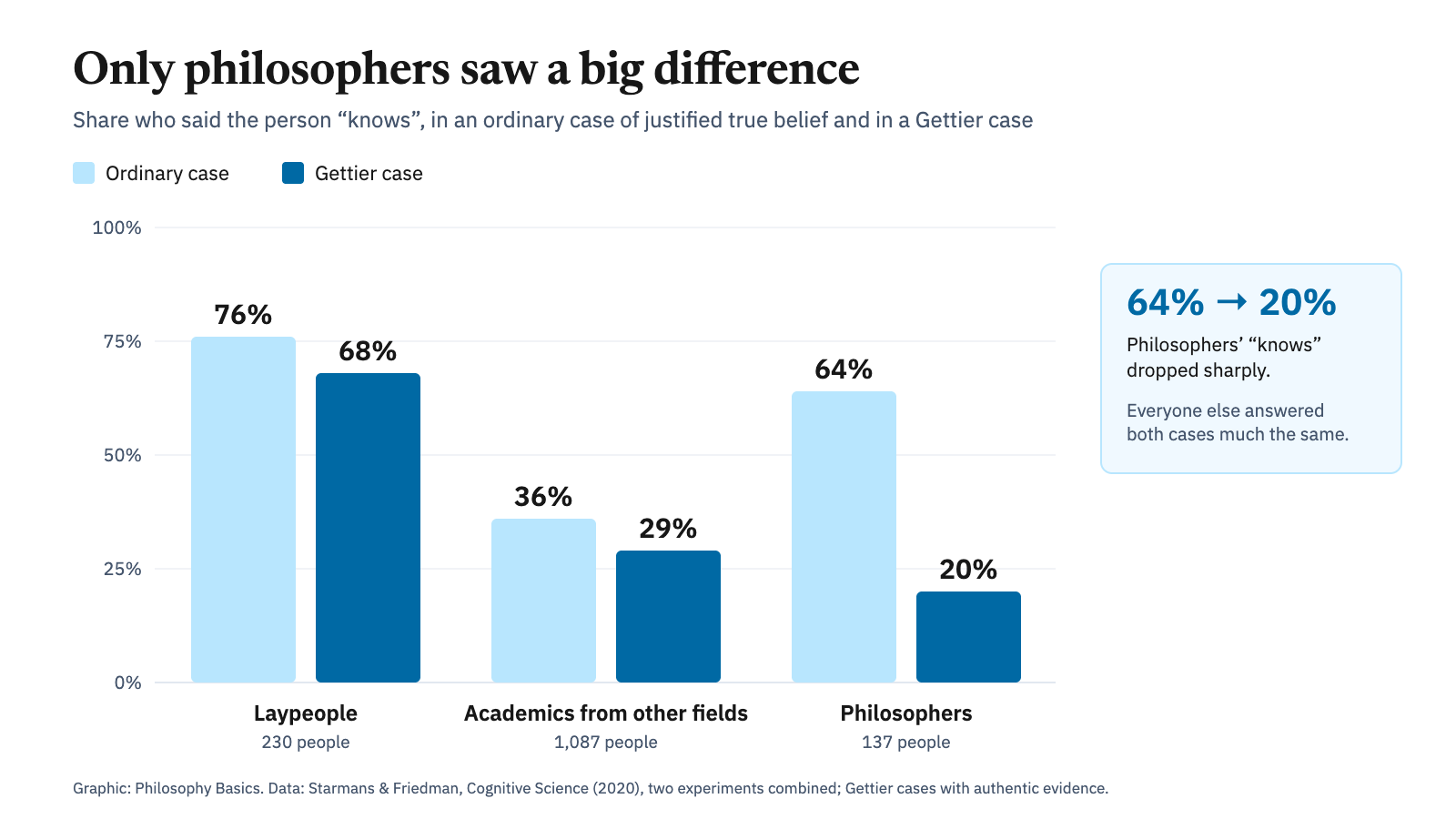
Part of the split is about the kind of case. When the evidence was faulty from the start, like a stopped clock or a mirage, people tend to say the person didn’t know. When the evidence was real and something else made the belief true, as with Smith’s coins, many people say “knows”. And 95% of the philosophers had met Gettier cases before, against 0 to 7% in the other fields.
I asked Starmans, an associate professor of psychology at the University of Toronto, what philosophy training might change. She didn’t pretend to know. “I think the real answer is that all we know is that philosophers’ intuitions about knowledge differ from those of other academics and of laypeople,” she told me. “We don’t really know why, at least not from the existing data.”
Some explanations she can rule out. Because other academics see knowledge so differently from philosophers, “advanced education and the pursuit of knowledge do not inevitably lead to the standard philosophical view of knowledge.” Nor is it simply that laypeople reflect less before answering, or lack education.
She and Friedman raise a few other possibilities in their paper. One is self-selection: “people who have the ‘wrong’ intuitions are less likely to keep taking philosophy classes.” Another is something like “indoctrination”: “you are told by professors how you are supposed to think about these cases, and genuinely come to think of them that way.” And then there’s the answer a philosopher might give: that training “leads to a better understanding of the true nature of knowledge.”
Did your answers change between the clock and the coins?
Right, but for which reason?
I said at the start that I find it hard to believe in luck. Writing this, I noticed something less comfortable. When I reread my own work months later, I sometimes see that the same finding could have come from something else entirely. Same result, different reason. Was I right because I knew, or because the data happened to line up?
I trust good methods and careful interpretation. But if I’m being cynical, it’s hard to trust numbers, however good you are at statistics. It’s hard to trust myself, too.
Maybe that’s what Gettier gives people like me: permission to admit that sometimes we’re right by luck. I hope it gets easier to say. My colleague’s wrong train has already made it a little easier.