In a 2010 study of 2,250 adults, minds were wandering in nearly half the moments people were asked about, and what they were thinking about explained more of their happiness than what they were doing


Is a wandering mind an unhappy mind? A 2010 paper in Science answered yes in its title, "A Wandering Mind Is an Unhappy Mind." Read past the title, though, and the answer turns out to be "it depends where it wandered to."
Two Harvard psychologists, Matthew Killingsworth and Daniel Gilbert, built an iPhone app that buzzed people at random moments. Among the 2,250 adults they analysed, mind wandering "occurred in 46.9% of the samples". Note the word samples. Nobody timed anyone's thoughts through a day. Each sample was one buzz, one moment, caught mid-whatever.
Three questions at every buzz
When the phone buzzed, it asked three things. How good or bad do you feel right now, on a slider from "very bad" to "very good"? What are you doing, out of 22 activities? And are you thinking about something else? If yes, was that thought pleasant, neutral or unpleasant? Most of the 2,250 people were in the United States, and the average age was 34.
I use this kind of sampling in my own research on measuring emotion in everyday life, so I'm professionally obliged to like it. It's good at telling you how a moment felt. It can't tell you how a life went.
What you're thinking beats what you're doing
The headline result: what people were thinking about explained more of their happiness than what they were doing. From one moment to the next, mind wandering accounted for 10.8 percent of the ups and downs in a person's happiness, against 4.6 percent for the activity. Wandering also showed up almost everywhere, in "at least 30% of the samples taken during every activity except making love".
What about money? It wasn't part of this study, but Killingsworth later analysed 1,725,994 reports from 33,391 employed Americans and found that well-being kept rising with income, with no point where it levelled off. Penn Today's report on the study adds that income is only a modest determinant of happiness.
Pleasant daydreams were free
Here's the part most summaries skip: what the mind wandered to.
Of the wandering, 42.5 percent was pleasant, 31 percent neutral and 26.5 percent unpleasant.
And the price?
When people's minds drifted somewhere pleasant, they felt about the same as when they stayed on task. The paper's wording is that they were "no happier when thinking about pleasant topics than about their current activity". Neutral thoughts dragged happiness down by 7.2 points on the 0 to 100 scale. Unpleasant ones dragged it down by 23.9.
So a pleasant daydream cost nothing. It wasn't a bonus either.
Where the damage sits
Here's the whole story in one picture. In the top bar, unpleasant thoughts were about a quarter of all the wandering. In the bottom bar, they caused about 72% of the drop in happiness. Pleasant thoughts caused almost none.
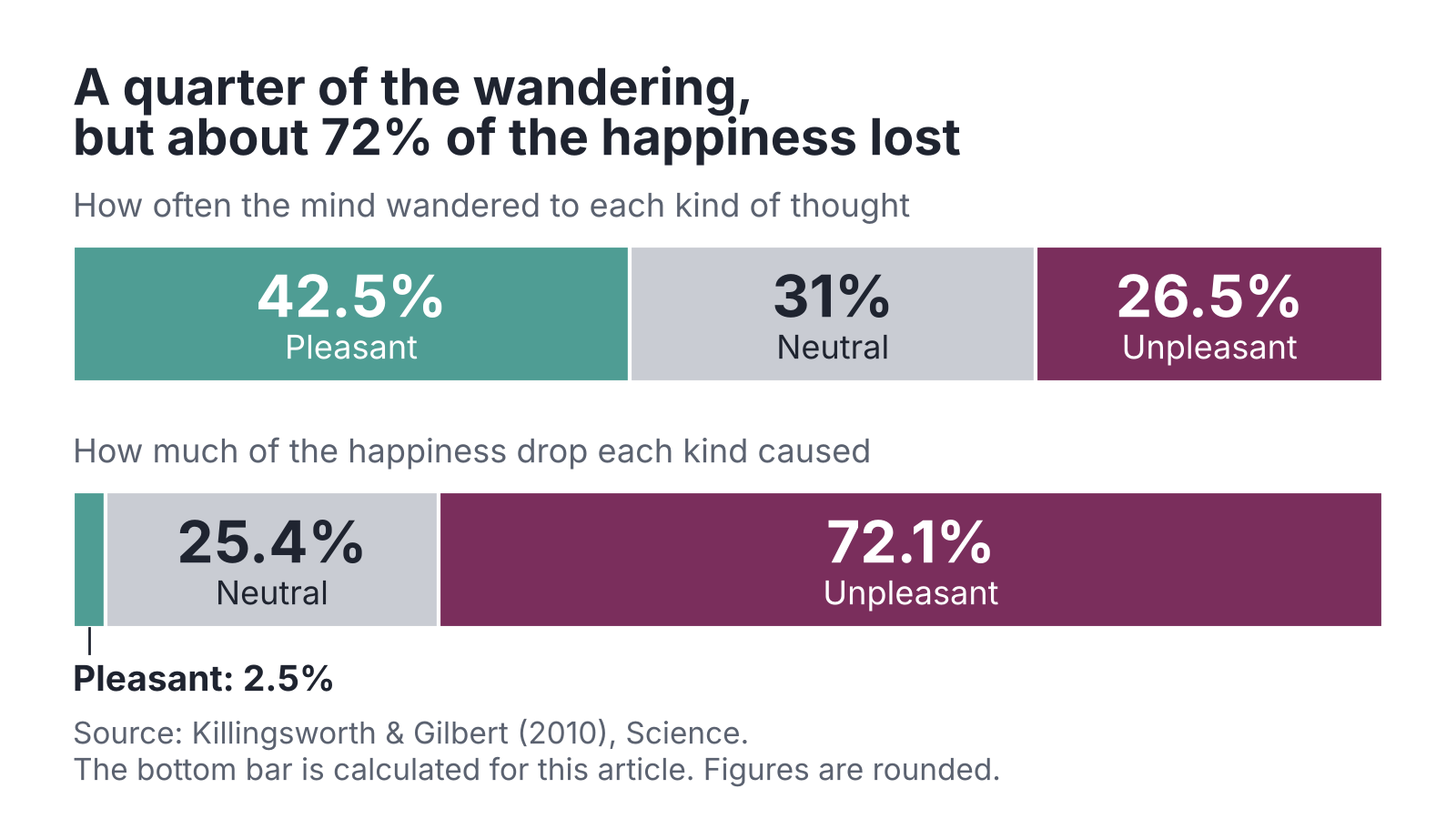
How I got the bottom bar: for each kind of thought, I multiplied how often it showed up by how much it cost, then compared each result with the total. The total comes to about 8.8 points on the 0 to 100 scale, which matches the paper's own figure of 8.79. The split by topic is my own back-of-the-envelope sum, though, so read it as a rough guide, not a result from the paper.
Still, the pattern is hard to miss: one kind of thought did most of the damage.
Which came first, the wandering or the mood?
Killingsworth and Gilbert say the wandering usually comes first. Their time-lag analyses, they write, "strongly suggested that mind wandering in our sample was generally the cause, and not merely the consequence, of unhappiness".
Not everyone buys it. In 2013, Poerio, Totterdell and Miles prompted people on their smartphones for seven days. In their study, sadness tended to come before mind wandering. Mind wandering on its own wasn't linked to a later mood, and it predicted feeling worse only when its content was negative.
Their conclusion is that mind wandering isn't inherently harmful to well-being.
Both sides rely on the same kind of evidence, people reporting their own mood one prompt at a time. Neither can see inside a thought as it happens, and a sampling study alone can't settle which came first.
Seneca got there first
Long before anyone's phone buzzed, Seneca made a similar complaint. Letter 13 is usually titled "On Groundless Fears". In it, he tells his friend Lucilius, in Richard Gummere's translation, "we suffer more often in imagination than in reality." The picture we form in advance, he suggests, can hurt more than the event itself.
Can the study back him up?
Not really. It sorted thoughts into pleasant, neutral and unpleasant. It doesn't report whether they were about the future, or whether the dreaded thing ever happened.
What it does echo is the shape of his complaint: one kind of thought carries most of the cost.
Mine does it most when I'm falling asleep, going ahead to plans and to-dos, or back to memories. Not a bedtime story anyone would choose: tomorrow's to-do list, with flashbacks. I think the study is right that what's in the thought matters more than the drifting itself.
"The ability to think about what is not happening is a cognitive achievement that comes at an emotional cost." (Killingsworth and Gilbert, 2010)
So should you stop daydreaming?
In this study, the cost of a wandering mind came from neutral and unpleasant thoughts.
Pleasant ones were free.
What it can't tell us is bigger. It doesn't show that being present beats income, relationships or health, because none of those were compared. It doesn't settle whether wandering causes unhappiness or follows it. And it measured how people felt at the moment of the buzz, not how satisfied they were with their lives. The split by topic, too, is my reading of the paper's figures, not something the paper reports.
Almost half of all those moments were spent somewhere else. The study could say what that cost. It couldn't say where the mind would have been better off going.
Mine will probably wander off to tomorrow's to-do list again tonight. At least now I know that's the expensive kind of trip.
And you? Where does your mind go when it wanders, and does it come back happier?
Sources:
- Killingsworth & Gilbert, A Wandering Mind Is an Unhappy Mind, Science, 2010.
- Poerio et al., Mind-wandering and negative mood: Does one thing really lead to another?, Consciousness and Cognition, 2013.
- Killingsworth, Experienced well-being rises with income, even above $75,000 per year, PNAS, 2021.
- Seneca, Letter 13: On Groundless Fears, translated by Richard M. Gummere.
Nato Lagidze
Nato Lagidze is a writer and researcher at Brown Brothers Media, the publisher of Philosophy Basics. A PhD candidate in psychology, she joined the house in 2022 and writes about what research on the mind adds to old questions about how to live, from meaning and happiness to friendship and how we judge one another.
More by Nato Lagidze →