
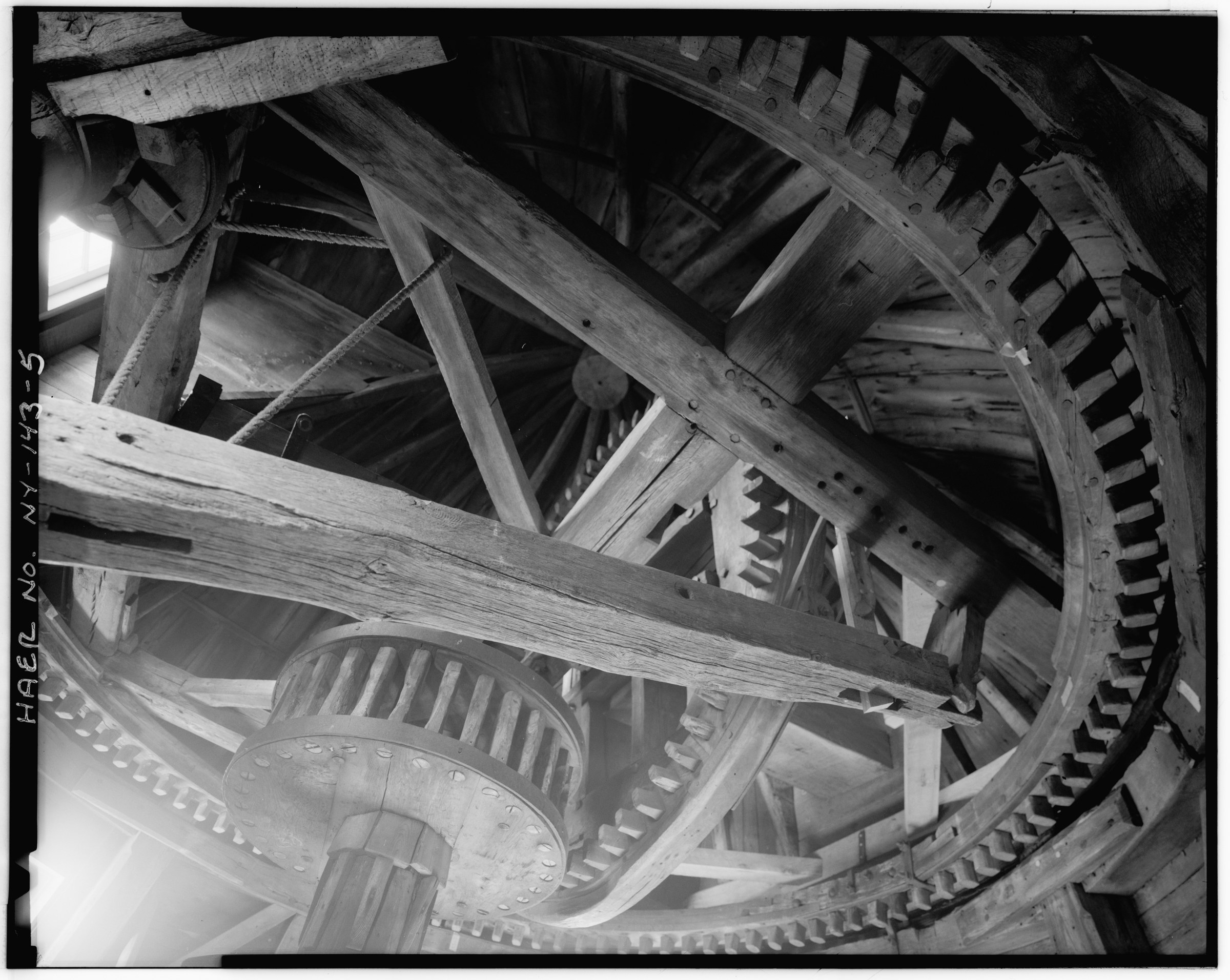

In section 17 of the Monadology, the philosopher Gottfried Wilhelm Leibniz asks you to imagine a machine built so that it thinks, enlarged until you could walk into it as into a mill, and he says that inside you would find only pieces pushing one another and nothing that explains a perception. Translations from the French in this article are my own plain renderings.
The section opens with the claim the mill is there to back up. Perception and what depends on it, Leibniz writes, is inexplicable by mechanical reasons, that is by figures and motions.
Then the supposition. Suppose a machine whose structure made it think, feel and have perception. One could conceive it enlarged while keeping the same proportions, the French says, "en sorte qu'on y puisse entrer comme dans un moulin", so that one could enter it as into a mill.
Visiting it inside, the text continues, one will find "que des pièces qui se poussent les unes les autres, et jamais de quoi expliquer une perception". Only pieces that push one another, and never anything with which to explain a perception.
The conclusion follows at once. Perception must be sought "dans la substance simple et non dans le composé ou dans la machine", in the simple substance and not in the composite or in the machine. A simple substance, section 1 of the same text says, is one without parts, which enters into composites.
So what is the walk through the machine meant to settle?
Simple substance and composite are both fixed earlier in the same text. Section 1 says the monad is nothing other than "une substance simple qui entre dans les composés", a simple substance that enters into composites, and that simple here means "sans parties", without parts.
Section 2 does the other half of the pair. A composite, Leibniz writes there, is nothing other than "un amas ou aggregatum des simples", a heap or aggregate of simples.
Section 17 uses a term the text has already fixed. Section 14 calls it the passing state that enfolds and represents a multitude in the unity or in the simple substance, and says it must be distinguished from apperception or from consciousness.
Section 17 does not stop at the negative result. Its closing lines say that perceptions and their changes are also all one can find in the simple substance, and that in this alone can consist all the internal actions of simple substances.
Section 18 carries that forward. One could give all created simple substances the name entelechies, it says, because they have in them a certain perfection, and a sufficiency that makes them sources of their internal actions and, as it were, "des automates incorporels", incorporeal automata.
I think the mill reads better as the 1714 argument it is, about perception and simple substance, than as a slogan lifted out of it later. It is an ancestor of what Wikipedia's page on Leibniz's gap states as the problem that thoughts cannot be observed or perceived solely by examining brain properties, events and processes.
The label is not Leibniz's. The term Leibniz's gap was coined by Robert Cummins and named after Leibniz, who first presented the problem in the Monadology in 1714, the same page says.
The two English versions in play here are Wikipedia's printed rendering of the passage and my own. Wikipedia prints an English version of the passage, with no translator named, that keeps the mill and has "pieces which push one against another".
Section 17 rests its opening claim on a single supposition. It states that perception is inexplicable by figures and motions, then offers the enlarged machine for the reader to walk through and find only pieces pushing one another and nothing that explains a perception. No worked case is set against the claim.
What the passage settles for later philosophy is open as well. The gap applies to materialism and dualism alike, the Wikipedia page says, and it describes the mind-body problem as unsolved.
Machine language runs through the rest of the work. In section 64 of the same text, every organic body of a living thing is called a kind of divine machine or natural automaton that infinitely surpasses all artificial automata.
The text reached print slowly. Leibniz wrote it in French during his last stay in Vienna, from 1712 to September 1714, and it remained unpublished until 1840, Wikipedia's article on the Monadology says, while a German translation appeared in 1720 as Lehrsätze über die Monadologie and the Acta Eruditorum printed a Latin version the following year. The Athena page carrying the French heads the work as written in 1714, in a French edition of 1840.
Section 17 sits between section 16, where Leibniz writes that M. Bayle should not have found a difficulty there, as he did in his Dictionary, article Rorarius, and section 18 on entelechies. It runs to five sentences on the Athena page, in a work that Wikipedia's article on the Monadology describes as presenting its metaphysics in some 90 paragraphs.