
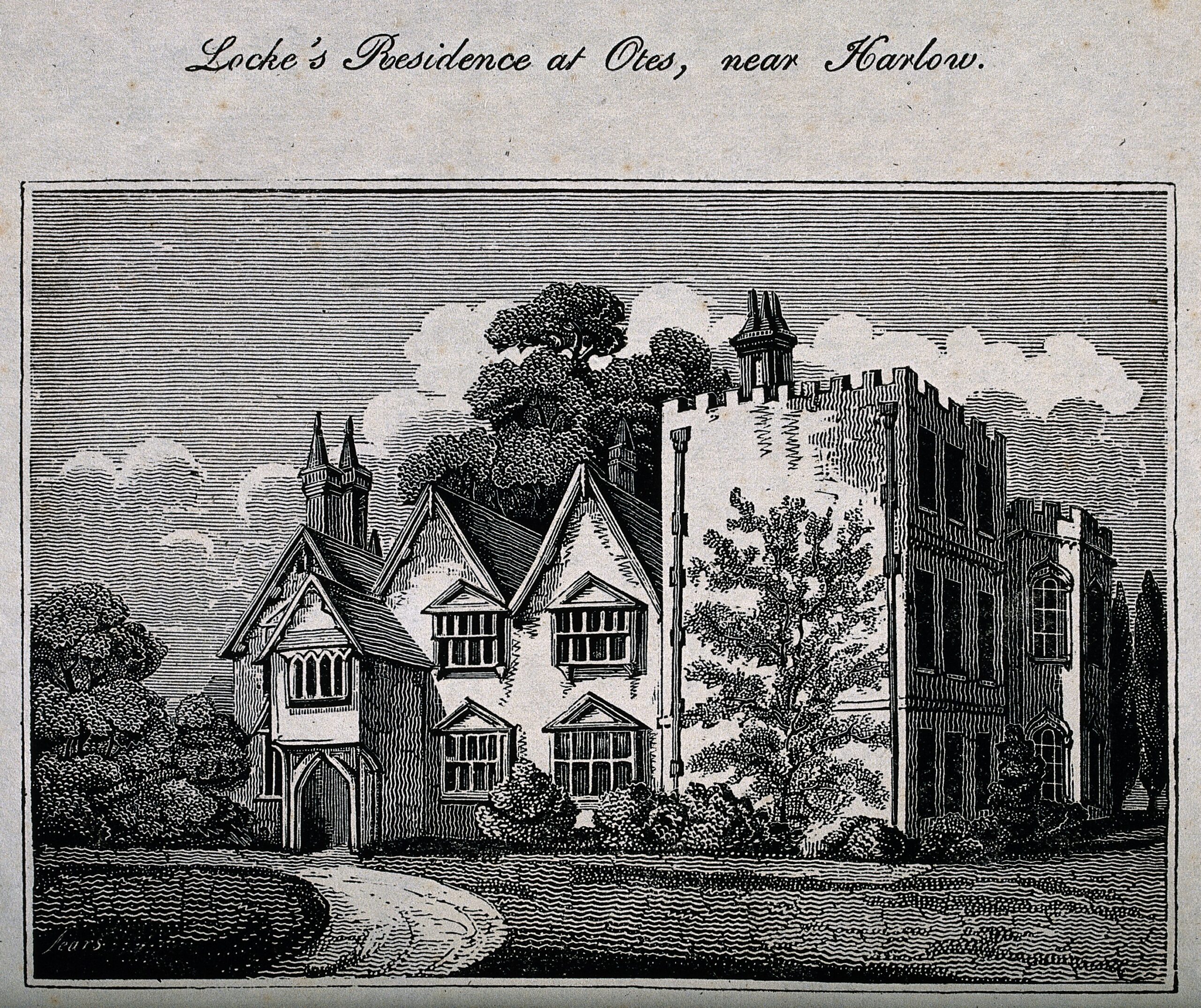

John Locke liked the question enough to print it. William Molyneux, who sent the problem to Locke in a letter and whom Locke was proud to call his friend, asked what a man born blind would make of two shapes he already knew by hand, the moment he was made to see, before he touched them. Locke added the exchange to the second edition of his Essay Concerning Human Understanding in 1694.
"Suppose a man born blind, and now adult, and taught by his touch to distinguish between a cube and a sphere of the same metal, and nighly of the same bigness, so as to tell, when he felt one and the other, which is the cube, which the sphere. Suppose then the cube and sphere placed on a table, and the blind man be made to see : quaere, whether by his sight, before he touched them, he could now distinguish and tell which is the globe, which the cube ?"
Molyneux's own answer was no. A man who has learned how a globe and a cube feel, he reasoned, has not yet learned what that feel must look like. Locke agreed, and said so warmly: "I agree with this thinking gentleman, whom I am proud to call my friend, in his answer to this problem".
Then Locke added a qualification that still does work. The blind man, he wrote in the 1694 text, "at first sight, would not be able with certainty to say which was the globe, which the cube". At first sight. With certainty.
We still argue about whether a brain comes ready to match what a hand knows to what an eye sees, or whether it has to learn the match. This is the clean form of that argument, and it now has a real post-surgery test behind it. The interesting part is not only the first no, but how fast the link then formed.
The live question is whether a shape known by touch shows up in the very first look.
We like to think the senses share one picture of the world. Locke thought that link has to be learned, and a careful modern test fits his answer at first look, though it can't settle the question. What it does show is that the link can form in days, not years.
The test came in 2011. Held and colleagues reported in Nature Neuroscience that they had tested five patients treated through Project Prakash, a sight restoration effort in India, within 48 hours of surgery on the first eye. Four had dense congenital bilateral cataracts, and one, a 16-year-old girl, had bilateral congenital corneal opacities.
Before treatment the five could only tell light from dark, and two of them could also judge the direction of a bright light. None could tell forms apart. The test used 20 pairs of simple three-dimensional shapes from a children's set, shown large on a plain white background so that weak acuity would not decide the outcome.
The first results, taken two days after sight onset, split cleanly. Touch to touch matching averaged 98%, and vision to vision averaged 92%. Touch to vision averaged 58%, near chance on a two-choice task.
Then it moved. Three of the five were retested with new but similar objects and no training in between, and touch to vision improved significantly in as little as five days, the paper reports, "given only natural real-world visual experience". The main text gives no later average.
The authors were careful about what this showed. They wrote that their results suggest the answer to Molyneux's question is likely negative, because the newly sighted "did not exhibit an immediate transfer of their tactile shape knowledge to the visual domain", and they left open whether transfer would have been immediate had the patients possessed three-dimensional visual representations from sight onset.
The distance from Locke's wording is real. His man was "now adult", and these patients were 8 to 17 years old. The objects were shapes from a children's set, not a cube and a sphere of the same metal. Acuity after surgery was limited, even though the vision to vision scores came in high.
Whether that counts as Molyneux's question or a narrowed version of it is still argued over among philosophers. The patients were asked to match by sight the thing they had just handled, which is one way to cash out the original wording and not the only one.
Brian Glenney, Associate Professor of Philosophy at Norwich University, reads the near-chance first score as a result that might be a false negative. The cross-modal pathways that connect sight to touch, he said in an email, "may be inadequately prepared cortically and thus produce a false negative". He co-edited Molyneux's Question and the History of Philosophy, published by Routledge in 2020.
The other half of his worry is the fix. If researchers went on to test whether those cross-modal pathways were working, Glenney said, they would likely prompt the very perceptual learning that the whole design is meant to keep out. He calls this a double-bind.
"with our current empirical methodologies we cannot empirically test Molyneux's problem while also ensuring the feasibility of full cross-modal cortical restoration"
Glenney also said the demand for an immediate test is not Molyneux's. Immediate testing, he wrote, is "a condition added later by Locke" in the 1694 Essay, and much of his own work tries to get back to the original problem. Many researchers, he said, still treat immediacy as the best guard against contamination from perceptual learning.
He pointed instead to a 2016 experiment by Chen and colleagues on rapidly restored integration in a young child, published in Current Biology, which he called "a stronger methodology" and suggested watching on video.
Researchers who know the bind often turn to other newly sighted subjects, he said, such as human newborns and non-human animals, where recognition has to be read off looking or bodily movement. His caution is that behavior-based tests may recruit different cortical pathways, including the dorsal stream, and so probe a different system from the verbal matching of 2011. A resolution is possible, he wrote, but "existing methodologies remain insufficient".
Molyneux told Locke he had put the problem to divers very ingenious men and hardly ever met one who gave at first the answer he thought true, until they heard his reasons. Locke printed that, and left the problem standing as an occasion to consider "how much he may be beholden to experience, improvement, and acquired notions".
What nobody could check in 2011 is the thing Glenney points at. Two days after surgery there is still no way to show whether the route from touch to sight was ready and failing, or simply not built yet. Until that can be measured without teaching the patient something along the way, what stands is narrow and worth having anyway, a near-chance first score followed by a match that came good inside a week.