
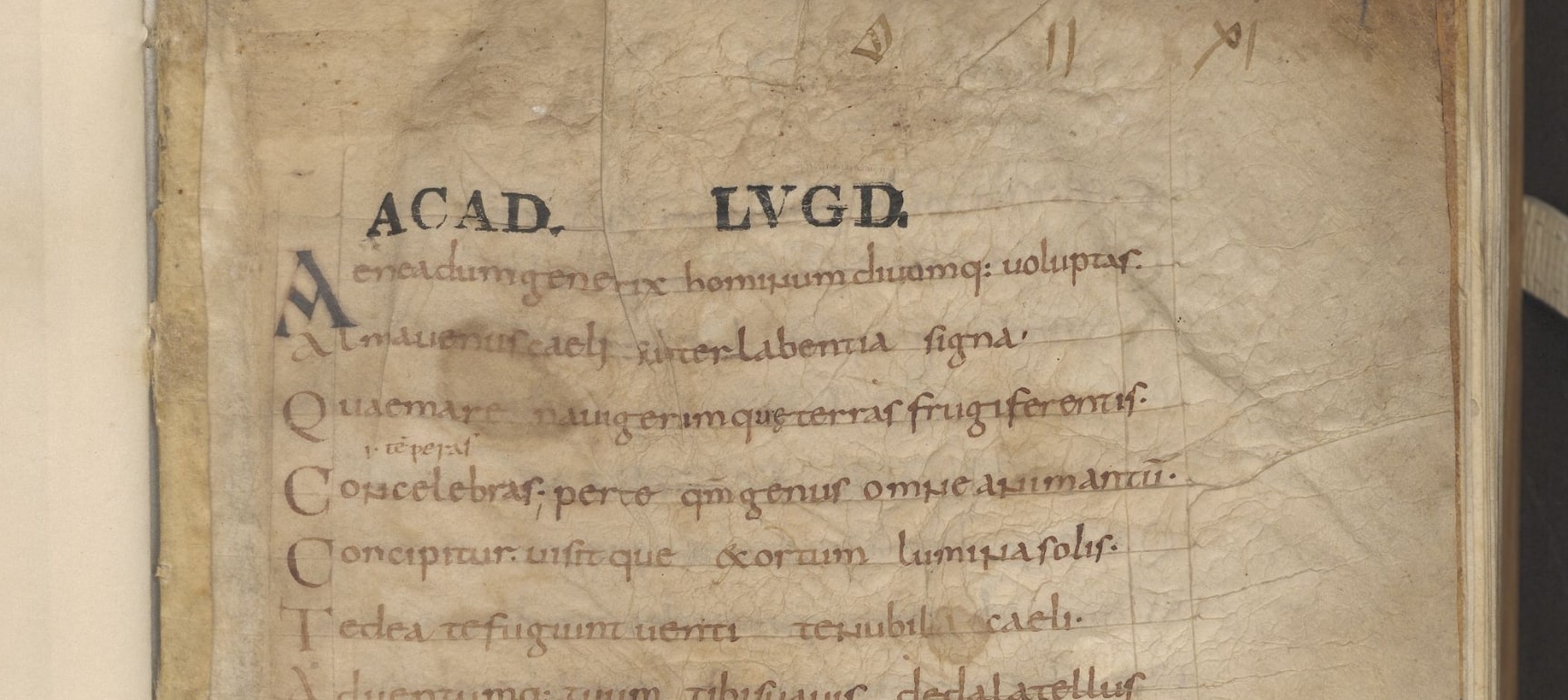

It is easy not to mind the long ages before birth, and hard not to mind the endless stretch after death. The Roman poet Lucretius says those two stretches are the same, one held up to the other like a mirror. The interesting part is that serious readers still do not agree whether the mirror is fair.
The image comes in Book III of De Rerum Natura, Lucretius's long poem on the nature of things. The Latin can be read in full in The Latin Library's text of Book III, and W. E. Leonard's verse translation is available on Perseus and Wikisource. In Leonard's version, lines 972 to 977 read as follows.
Look back: Nothing to us was all fore-passèd eld
Of time the eternal, ere we had a birth.
And Nature holds this like a mirror up
Of time-to-be when we are dead and gone.
And what is there so horrible appears?
Now what is there so sad about it all?
Is't not serener far than any sleep?
We treat the time after death as a darkness waiting for us, and the time before birth as nothing at all. Lucretius says they are the same stretch of nonexistence, and philosophers still have not settled whether he is right.
The open question is whether that mirror reflects truly.
Leonard's “mirror” renders the Latin speculum. It is worth noticing how the passage ends. Lucretius does not close with a theorem. He closes with questions, asking the reader what is so horrible or so sad, and whether the state he describes is not “serener far than any sleep”.
The ground beneath the image is Epicurean. The Stanford Encyclopedia of Philosophy entry on death, written by Steven Luper, calls Lucretius “a follower of Epicurus”. It quotes Epicurus's Letter to Menoeceus, which holds that “everything good and bad lies in sensation” and that “when we are, death is not, and when death is present, then we are not”. The mirror itself, though, is Lucretius's image, not Epicurus's.
Earlier in Book III the poet states the conclusion the mirror serves. Death, in Leonard's rendering of line 830, “Is nothing, nor concerns us in the least,” and the reason follows: “Since nature of mind is mortal evermore.” The Latin opens Nil igitur mors est ad nos. A few lines on, recalling the time when Carthaginian armies came from every side, the poem says “we felt no touch of ill”.
Just before the mirror comes a legal metaphor. “And in fee-simple life is given to none,” Leonard writes, “But unto all mere usufruct.” In Latin it is a single compact line, vitaque mancipio nulli datur, omnibus usu. Life is held on loan, not owned outright, and the poem then turns to look backward.
James Warren, Professor of Ancient Philosophy at the University of Cambridge and a Fellow of Corpus Christi College, has written closely on these lines. His article “Lucretius, Symmetry arguments, and fearing death” appeared in Phronesis in 2001, and his book Facing Death: Epicurus and his Critics was published by Oxford in 2004.
“The point I was arguing in that paper was principally aimed at those who find in those lines an explicit reference to our prospective attitude towards death, in other words our prospective attitude to the fact that our lives will end,” Warren told Philosophy Basics. On that reading, he wrote, “when we look backwards, we are not currently pained when we think of the fact that our lives had a beginning.”
His own reading is different. “I think that Lucretius is instead reminding us that just as the time before our birth was not bad for us, so too the time after our death will not be bad to us,” he said in an email. “If he is addressing our current prospective attitude, then this comes as a secondary point: if something will not be bad when it happens then it is foolish to be pained in advance when thinking about it.”
Luper raises a separate question about the argument's target. He notes that it “admits of more than one interpretation”, depending on whether it targets dying, being dead, or both. If the complaint is that death cuts off more good life, the reflection looks less exact. If a life ends up being good for us, birth “starts a good thing going”, the entry observes, while death “brings a good thing to a close”.
Steven Luper, Professor of Philosophy at Trinity University, in a reply by email, adds that any comfort the mirror offers may not hold.
But such solace is not guaranteed; it is possible that terror of one’s absence in the future will carry over to one’s absence in the past, as in the case of Blaise Pascal (and Vladimir Nabokov), who was distressed at being swallowed up by the eternity before and the eternity after his brief existence.
Thomas Nagel took a different route in his essay “Death”, published in Noûs in 1970 and reprinted in Mortal Questions in 1979. As the entry summarizes him, it is reasonable not to want an earlier birth while still wanting a longer life, because it is metaphysically impossible for a person to have come into existence significantly earlier than she did. In footnote 3 of the reprint, Nagel acknowledged that this hinges on questionable assumptions about origins. The entry illustrates the worry with a zygote frozen for a very long time, which might have been frozen briefly instead.
Frederik Kaufman defended a version of the point in “Lucretius and the Fear of Death”, a chapter in Immortality and the Philosophy of Death, edited by Michael Cholbi in 2016. “Persons (properly understood) cannot exist earlier than they do,” he writes. His case rests on treating psychological continuity as constitutive of personal identity, which separates a person from a human organism. It also rests on a further premise: if mental continuity is constitutive of personal identity, then when a particular consciousness emerges is essential to that person.
Asked what follows from that limitation, Kaufman, Professor Emeritus, Philosophy and Religion, Ithaca College, wrote in an email:
What readers should NOT conclude from the Mirror Image Argument: If death can be bad because it deprives its victim of life, then it is hard to see how my prior non-existence could be bad for the same reason, since I (properly understood) could not have existed earlier than I do, whereas it seems possible for me to die later than I will. If that is correct, then the times before my birth and after my death are not mirror images of each other, or so I think.
Derek Parfit, in Reasons and Persons in 1984, offered another explanation. The entry attributes to him a “far-reaching bias” toward the future. As Luper summarizes Parfit, he argues that if we take this bias for granted, and assume that because of it having goods in the future is better for us than having them in the past, that can explain why it is rational to deplore death more than not having always existed, since death deprives us of future goods. Parfit thought the bias unfortunate, the entry adds, and held that a more time-neutral attitude could lower sensitivity to death.
A further reply looks at plans rather than pleasures. The entry points out that nobody can make and pursue plans for the past, since plans have to be projected into the future. As Luper summarizes the work of Frances Kamm, from 1998 and 2021, Kamm emphasizes that we do not want our lives to be finished. On this view the two stretches of nonexistence sit very differently against a life still in progress.
None of these replies has closed the matter. On Warren's reading, the lines first remind us that the time after our death will not be bad for us, just as the time before our birth was not. If Lucretius is also addressing our present prospective attitude toward our lives ending, Warren treats that only as a secondary point. Lucretius, for his part, left the mirror standing as a question rather than a proof, and readers still look into it and ask what he asked: what is there so horrible?