
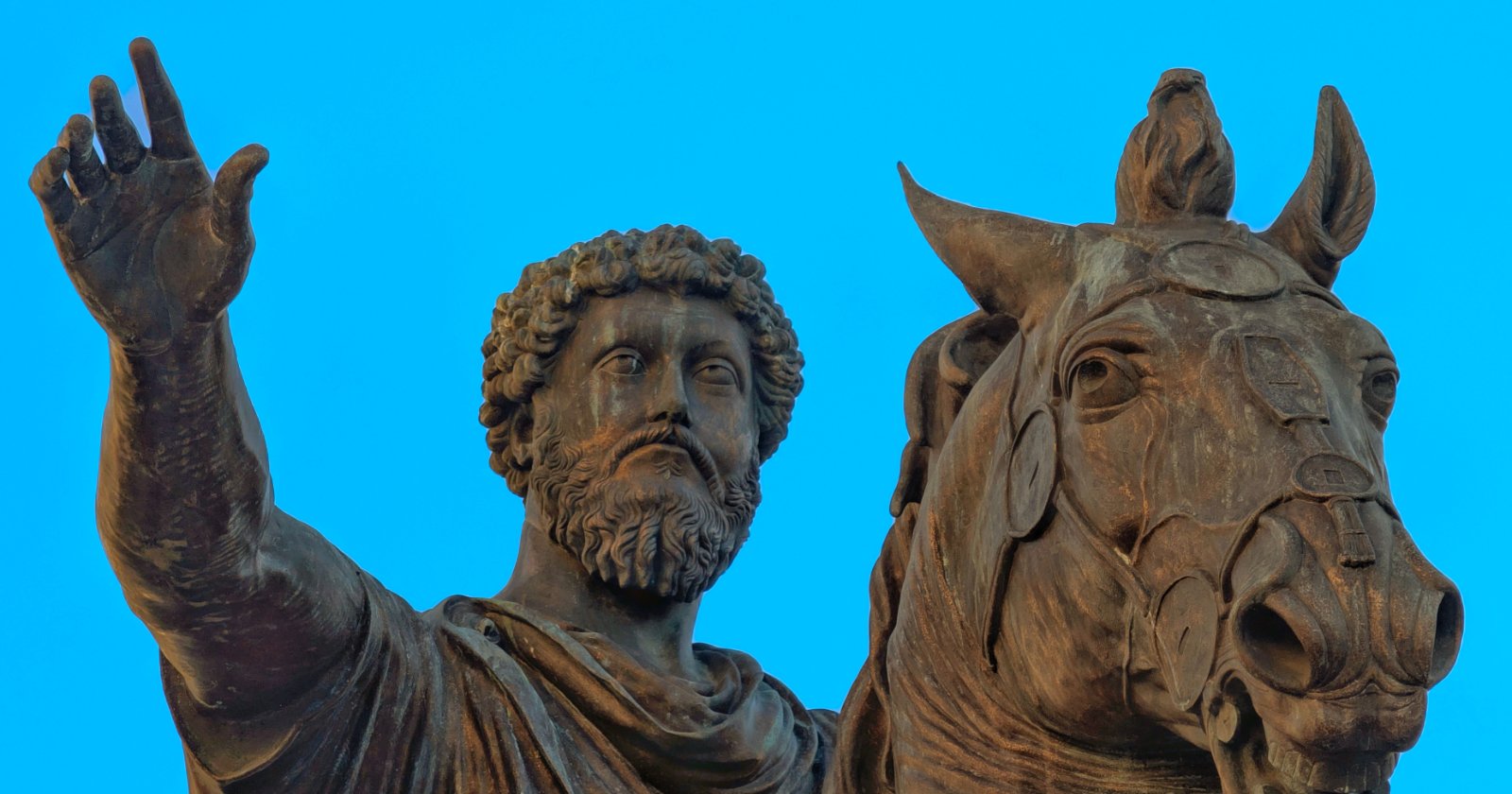
This line from Marcus Aurelius turns up on a lot of minimalist mood boards, usually next to a photo of an empty white room. Read on its own, it sounds like advice about owning fewer things. In context, it is about something closer to the bone.
The passage sits in Book Seven of the Meditations. Marcus has just reminded himself that "it is very possible to be a divine man and to be recognised as such by no one." Then comes the line about how little a happy life needs. Then he admits he has "despaired of becoming a dialectician and skilled in the knowledge of nature," and tells himself that this is no reason to give up on being free, modest and sociable.
The man running the Roman Empire was consoling himself about the things he had not managed to become.
That makes the line a lot more than a decluttering slogan. It speaks to a very current kind of wanting: for recognition, for achievement, for a life that looks impressive from the outside.
Wanting to be seen
Marcus's first point is that a person can be good without anyone noticing. That is a hard sell in a culture where so much of life is visible and counted. Promotions get announced. Trips get posted. Even quiet hobbies come with follower numbers.
None of that is necessary for a good life, and treating it as necessary can crowd out the parts that are. The question he leaves is a practical one: if nobody ever saw it, would you still want to do it? The answers tend to show which goals are yours and which are borrowed.
Money matters, up to a point
It would be easy to turn "very little is necessary" into a claim that money doesn't matter. The research doesn't support that.
For years, psychologists argued over whether happiness levels off once income passes a certain point. In 2023, Daniel Kahneman and Matthew Killingsworth, whose earlier studies had reached conflicting conclusions, teamed up with Barbara Mellers to settle it. Their joint analysis found that for most people, happiness keeps rising with income. The leveling off showed up only among the least happy fifth of people, whose emotional well-being stopped improving above about $100,000 a year. "In the simplest terms, this suggests that for most people larger incomes are associated with greater happiness," Killingsworth said.
What tends to go with lower well-being is making money and possessions the point. A 2014 meta-analysis led by Helga Dittmar, pooling 259 independent samples, found that people who placed a high priority on wealth and possessions reported lower well-being across a range of measures.
Having enough and chasing more turn out to be different things.
Why more stops working
Part of the reason is how quickly people get used to things. "One of the enemies of happiness is adaptation," Cornell psychologist Thomas Gilovich, who has studied money and happiness for more than two decades, told Fast Company. "We buy things to make us happy, and we succeed. But only for a while. New things are exciting to us at first, but then we adapt to them."
Gilovich's research has found that experiences tend to hold their value longer than objects, partly because they become part of who we are and are harder to compare with what other people have. The new phone becomes the normal phone within a few weeks. The trip with an old friend gets better in the retelling.
The little that does seem to matter
If very little is necessary, the obvious follow-up is: little of what? One of the longest-running studies of adult life offers one answer. The Harvard Study of Adult Development has followed participants since 1938, and its central finding is about people rather than possessions.
"The surprising finding is that our relationships and how happy we are in our relationships has a powerful influence on our health," Robert Waldinger, the study's director, told the Harvard Gazette. "Taking care of your body is important, but tending to your relationships is a form of self-care too."
Time is the other recurring answer. In a 2017 study across four countries, Ashley Whillans, Elizabeth Dunn and colleagues found that people who spent money on time-saving services, such as paying for help with chores, reported greater life satisfaction, and the effect held after accounting for income. Money spent on freeing up an afternoon seems to go further than money spent on one more thing to own.
Putting "very little" into practice
Marcus didn't leave a checklist, but his passage suggests a few modern questions worth asking now and then.
What are you working toward mainly so other people will notice? Some of those goals are still worth keeping. Others start to look optional once the audience is taken away.
Where is money going that doesn't come back as time, connection or experiences? Subscriptions that go unused and upgrades to things that already work are the usual suspects.
Which relationships are getting the leftovers? The Harvard findings suggest the people around you are a bigger part of "very little" than almost anything you could buy.
The line asks for less than it seems. It doesn't ask anyone to give up comfort or ambition. It asks us to notice how short the list of essentials really is, and to stop treating everything else as if it were on it.