
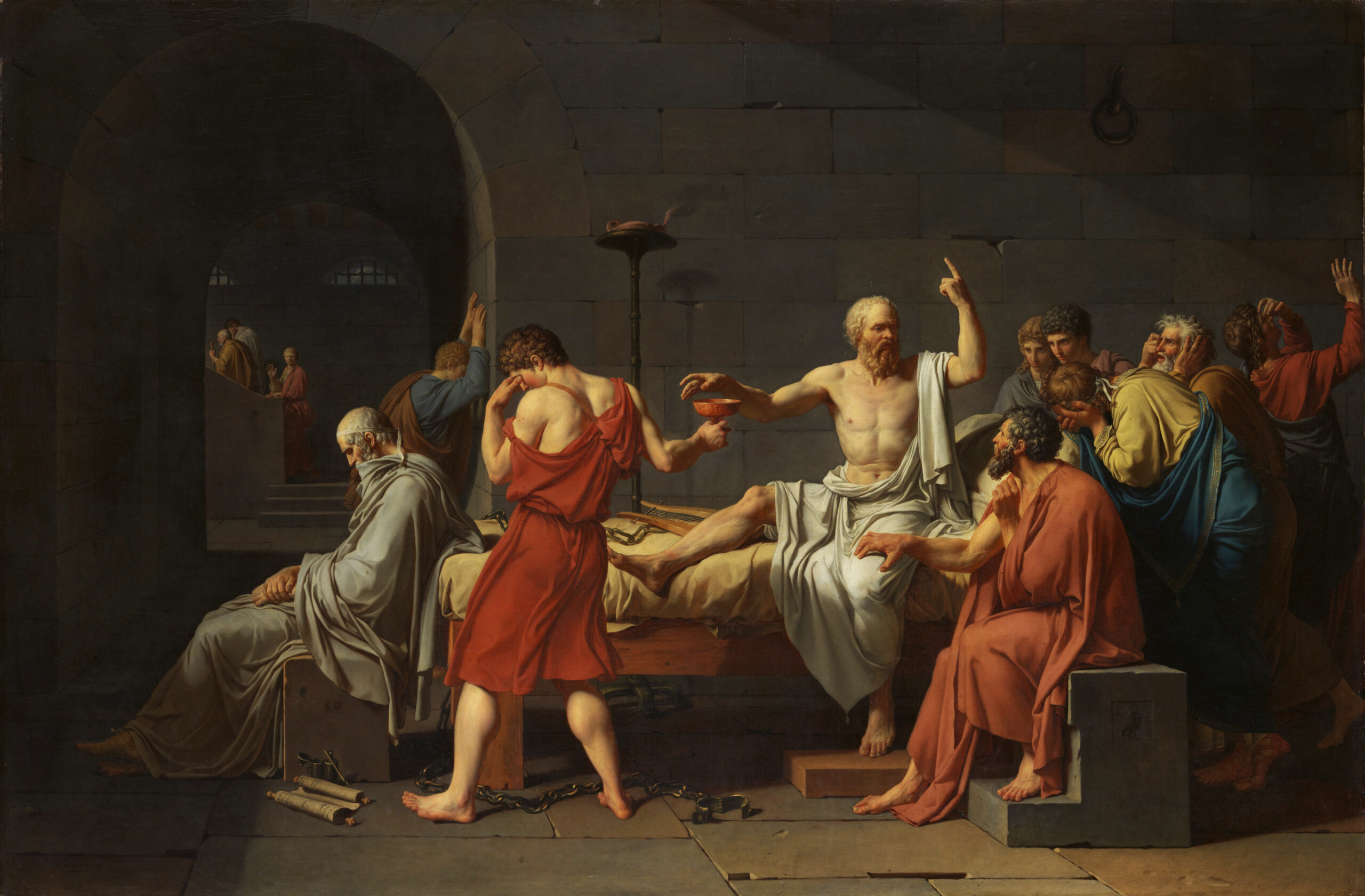
Socrates uncovers his face in Plato's Phaedo, after the chill had reached the region about the groin, and speaks once more to Crito. A cock is owed to Asclepius, he says, and the debt must be paid. The Greek verb is ὀφείλομεν, first-person plural: we owe.
A common English wording says something narrower. The translation posted as Benjamin Jowett's on a Boston University course page gives the line as “Crito, I owe a cock to Asclepius; will you remember to pay the debt?” That is singular, and it is a translator's English, not the Greek.
Harold Fowler's Loeb version, on Perseus, keeps the plural: “Crito, we owe a cock to Aesculapius. Pay it and do not neglect it.” Aesculapius is the Latin form of the same god. The two verbs of paying, pay and do not neglect, are plural as well.
Not every English printing under Jowett's name uses the singular. Still, this widely reprinted Jowett wording has been repeated often enough to sound like the line itself. Translation can quietly reshape a saying, the way an English Analects adds a word the Chinese does not have.
Who the we includes, and what the debt covers, is unsettled.
The last words are famous because they sound like a riddle. The Greek is "we owe," not "I owe," and serious readers still do not agree what the debt was for.
The passage is Phaedo 118a, the last page of the dialogue. Phaedo is recounting the death to Echecrates. It is Plato's dramatic report of a scene, not a transcript, and not evidence that Socrates spoke the sentence outside the dialogue.
Shortly before, Socrates takes the cup and asks whether he may pour a libation from it to a god. The man who brought the poison answers that they prepare only as much as they judge enough. Socrates prays for a good journey instead, then drinks.
Asclepius was a god of healing, and a cock was a customary thank-offering after a recovery. That background sits under most readings of the line. The Phaedo does not say the debt is thanks for a cure, and it gives no reason for the debt at all.
Friedrich Nietzsche took the offering as thanks for a cure, and the cure as death. In The Gay Science, section 340, “The Dying Socrates,” quoted by Morgan Rempel in the journal Minerva, Nietzsche writes that he wished Socrates “had remained taciturn also at the last moment of his life,” and hears a verdict in the request: “O Crito, life is a disease.”
Nietzsche calls the saying veiled, gruesome, pious and blasphemous, and takes it as a last revenge on life. He returns to the same disappointment in Twilight of the Idols. His reading is not the settled scholarly answer, and nothing in the text disposes of it. A version of it is older than he is, since Neoplatonic readers already treated embodied life as a sickness and death as its cure.
Glenn Most argued in “A Cock for Asclepius,” in Classical Quarterly in 1993, that the vow is real rather than cryptic. On his reading the debt may be connected to Plato's illness, which the dialogue mentions, and the last words are about settling an ordinary obligation.
James Crooks, a professor and chair of philosophy at Bishop's University who published his own reading of the riddle in Classical Quarterly in 1998, told Philosophy Basics that the conversation itself is the treatment. “Asclepius, as you know, was the god of healing. I take Socrates at his word – the conversation reported in the Phaedo is a kind of therapy. Therapy for what? That’s the question,” he said. His answer turns on misology, a distrust or hatred of reasoned argument, which the dialogue raises at its midpoint. He went on:
Nietzsche’s view, as you know, is that the dying Socrates thanks Asclepius for curing him of life. But this overlooks both the first-person plural in the Greek formulation (i.e. “We owe a cock to Asclepius”, not “I owe a cock to Asclepius”) and, more importantly, the fact that at the literal centre of the dialogue, where the first arguments for the immortality of the soul have been effectively called into question by Simmias and Cebes, there is a discussion of the dangers of the disease of misology and an agreement, in the face of that danger, to pursue intellectual/spiritual health. I take Socrates’ final words, then, as an expression of gratitude, on behalf of the group gathered in the cell, for deliverance via philosophy from the degeneracy of misology.
Colin Wells, writing in Arion on the mystery of the last words, treats the tradition of a hidden healing meaning as a red herring and ties the line back to the libation Socrates was not permitted to pour. On that view the unfinished ritual is what needs completing, not a cure that needs thanking.
The argument has stayed open elsewhere too. Laurel Madison asked “Have We Been Careless with Socrates' Last Words?” in the Journal of the History of Philosophy in 2002, and Emily Wilson's The Death of Socrates followed in 2007. No single reading has carried the field.
In the text, Crito says the debt will be paid and asks whether there is anything else. Socrates gives no answer. Jowett's version then closes by calling him “the wisest, and justest, and best of all the men whom I have ever known,” and Fowler has “the best and wisest and most righteous man.”
The eulogy is as large as the last words are small. The instruction goes to the room, in the plural, and nobody in the cell asks what it was for.