The Declaration of Independence of 1776 made the pursuit of happiness a right, and Mill's Autobiography of 1873 says the pursuit is self-defeating, since those only are happy who have their minds fixed on some object other than their own happiness.
I think chasing happiness directly doesn't work, and that it turns up as a by-product of meaning, goals and people. John Stuart Mill argued something similar in 1873. Psychologists have since tested it in the lab and across four regions, and the results have a lot to say about where the damage actually happens.



The pursuit of happiness is written into the founding document of the United States. The Declaration of Independence of 1776 names it as an unalienable right, sitting there next to life and liberty.
Most of us read that as an instruction as well as a right. Happiness is a thing you go after directly, and the more you want it and the harder you chase the feeling, the more of it you should end up with.
Even the psychologists who have spent years picking that apart grant how sensible it sounds. Their 2011 paper on the subject says it is "reasonable to expect that valuing happiness will have beneficial outcomes". A companion paper of theirs begins with the sentence "Few things seem more natural and functional than wanting to be happy." That one also notes that people, and North Americans in particular, rank wanting to be happy above many other goals they could pick.
I think the instruction is wrong.
My contention is that chasing happiness directly doesn't work, and that happiness turns up as a by-product. A by-product of how we find meaning along the way, of goals we're actually working towards, and of feeling connected to other people.
Part of why I hold that is personal. I lived in Los Angeles and got really into the new age spirituality communities there. So much of it was about raising vibrations and thinking positively, and a by-product of that is that you end up aiming at the feeling of happiness itself. I embraced it for a while and found myself frustrated. Seeking out hedonic experiences can of course be good. But over time I felt like my life wasn't on track.
Then I moved to Southeast Asia, first as a digital nomad, and ended up settling in Singapore. At first I threw myself into setting more goals and bigger ones, and I expected the happiness to turn up when I hit them. It's a place that encourages that, with opportunity everywhere. I hit some of them and felt flat and pretty exhausted. It didn't make me happier.
Looking back, I was treating goals as the route to the feeling, as if happiness was one more achievement away. Over time the journey became about direction, and working through things step by step for their own sake. The happiness has come as a by-product of that rather than from aiming at it. I've talked about this on my YouTube channel.
Justin Brown's YouTube video "7 Life Lessons I Know In My 40s I Wish I Knew Sooner", uploaded 29 August 2024. The seventh lesson is about why happiness can't be chased. (Justin Brown, YouTube)
So that's my position, stated up front. What follows is the case for it, including the evidence that complicates it, because some of it does.
The old version of the worry
John Stuart Mill put this about as personally as anyone has.
In the autumn of 1826, aged 20, Mill fell into what he called "a dull state of nerves". He describes it in his Autobiography, published in 1873, the year he died. He put a question to himself: suppose every one of his life's objects was achieved, every reform he was working for carried through, would that make him happy?
His answer was "No!"
What came out of that crisis was a theory of life. Mill was a utilitarian, so he never dropped the idea that happiness is what matters in the end. He kept the conviction "that happiness is the test of all rules of conduct, and the end of life". What changed was the route. "But I now thought that this end was only to be attained by not making it the direct end," he wrote. "Those only are happy (I thought) who have their minds fixed on some object other than their own happiness." He lists what those objects might be: the happiness of others, the improvement of mankind, some art or pursuit followed as an end in itself. "Aiming thus at something else, they find happiness by the way."
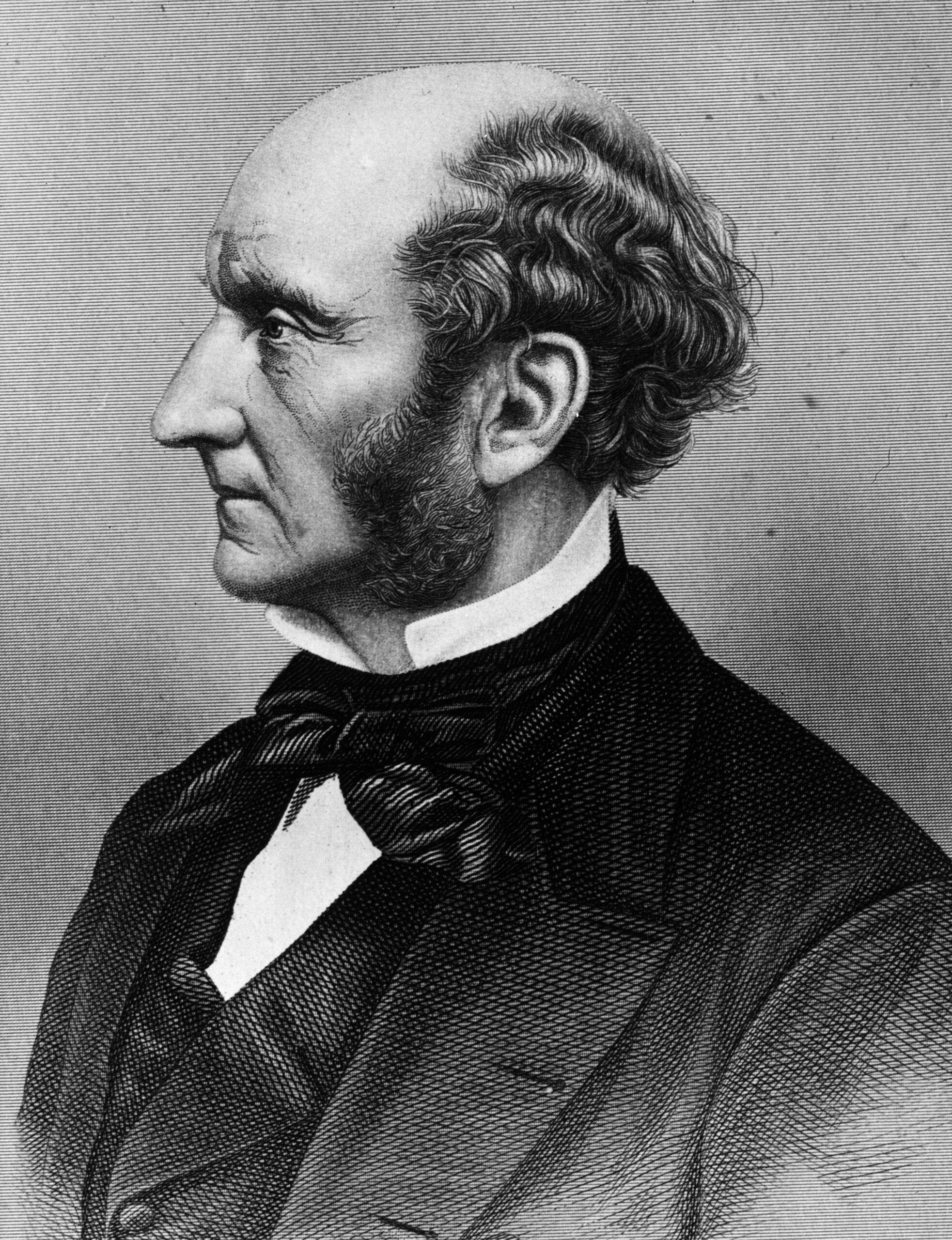
And, more bluntly: "Ask yourself whether you are happy, and you cease to be so."
Mill thought this held for most people, writing that he still considered it the best theory for anyone with a moderate degree of sensibility and capacity for enjoyment, which he took to be the great majority of mankind.
Henry Sidgwick later gave the idea a name. In The Methods of Ethics he calls it "the fundamental paradox of Hedonism, that the impulse towards pleasure, if too predominant, defeats its own aim." His example is a man who keeps his conscious aim fixed on his own pleasure and therefore "does not catch the full spirit of the chase". Philosophers still call it the paradox of hedonism.

Here's the thing about both of them. They weren't only making a point about ethics. They were making a claim about how human beings actually work, and that is the kind of claim you can take into a lab.
What happened in the lab
Which is what a group of psychologists did. The 2011 paper is called "Can seeking happiness make people unhappy? Paradoxical effects of valuing happiness", by Iris Mauss, Maya Tamir, Craig Anderson and Nicole Savino, in the journal Emotion. Mill's line about having your mind fixed on some object other than your own happiness sits at the top of it as an epigraph. They were testing him on purpose.
First they needed a way to measure how much a person values happiness. They built a seven-item questionnaire. You rate how far you agree with statements like "How happy I am at any given moment says a lot about how worthwhile my life is," and "If I don't feel happy, maybe there is something wrong with me," and "I am concerned about my happiness even when I feel happy."
Read those again and you can see what's being measured. It's whether a person treats their own moment-to-moment positive feeling as the measure of how their life is going. The authors say their scale captures valuing happiness "to a potentially extreme degree", and that it defines happiness as a person's own positive feeling, which is how the word tends to be used in Western contexts. The same paper has a line about books that urge people to maximise their happiness, noting that "further encouraging a mindset to maximize happiness (as some 'self-help' books do) may be counterproductive".
Their first study was correlational, meaning they measured what was already there rather than changing anything about people's lives. Fifty-nine women in the Denver area, average age 37.6, all of whom had recently been through a stressful life event. The more a woman valued happiness, the lower her happiness, life satisfaction and psychological well-being, and the more depression symptoms she reported.
That pattern came with a condition. It only showed up among the women whose recent lives had been relatively low in stress. Among the highly stressed women, it wasn't there. The authors are careful to say this study can't establish cause and effect, because being unhappy might make you value happiness more, rather than the other way round.
So they ran an experiment.
Seventy women, average age 21, taking part for course credit or $20. One was dropped for guessing what the study was about, leaving 69. They were told it was a study about TV programming. Then they were randomly assigned, meaning chance alone decided which group each woman went into, so that the two groups should be alike in every other respect. Half read a fake newspaper article praising happiness, which claimed that "the happier people can make themselves feel from moment to moment, the more likely they are to be successful, healthy, and popular". The other half, the control group, read an identical article with every mention of happiness swapped out for making accurate judgments. Then everyone watched a two-minute film clip, either a happy one (a popular figure skater winning gold, the crowd cheering, her celebrating with her coach) or a sad one.
After the happy clip, the women who had been nudged to value happiness felt less happy than the control group. After the sad clip, there was no difference between the groups. The researchers also used an indirect measure of mood, how much the women liked two abstract shapes, and that showed the same drop.
Why would a happy clip make you less happy? The answer sits in what the women rated afterwards. The nudged group reported more disappointment with their own feelings, including that they "should have enjoyed the film clip more". That disappointment fully accounted for the drop in how happy they rated themselves. As the authors put it, "valuing happiness may lead people to be less happy just when happiness is within reach." In a happy situation you have every reason to feel good and no excuse if you don't.
And there's a detail in that paper that matters a lot later on. The nudged women tried harder to feel good after both clips, the sad one included. Only the happy-clip group ended up worse off. The authors put the problem down to "how people evaluate their progress toward this goal", rather than to having the goal or being aware of it.
The trouble was in the grading.
There may also be something going on underneath the grading. One potential problem, in Maya Tamir's words, is "pursuing happiness for happiness itself rather than for the things happiness tends to reflect". Tamir is Professor of Psychology at the Hebrew University of Jerusalem and co-authored that 2011 paper with Mauss, Anderson and Savino. "We tend to feel happy when we achieve our goals, when our needs are met, when we feel connected and supported," she said. Happiness, on her account, usually signals those things. Chase the signal on its own and you may end up with the feeling and none of what it normally stands for, which is to say without meaning. She suggests pleasure without meaning may not do much for well-being, and points to the work of Laura King at the University of Missouri, who studies meaning in life.
Her second thought is about standards. If you're pursuing happiness for its own sake, how much happiness counts as enough? "High standards tend to be difficult to achieve, but they determine satisfaction," she wrote. Her example is two people who both score 80 on an exam. One is elated, because they expected to fail. The other is disappointed, because they expected 100. Scale that up to whole cultures, she said, and ones that set very high standards for happiness "may lead people to feel disappointed when they are not 'happy enough'."
The loneliness studies
The same group published a second line of work, "The pursuit of happiness can be lonely", in Emotion. Mauss and Tamir are both on it, with Savino, Anderson, Weisbuch and Laudenslager.
Their reasoning starts from a definition. In Western contexts, happiness is usually understood as a personal positive feeling, a private gain, and striving hard for private gains can cost you your connection with other people.
In the first study, 206 adults from the community, 58% of them women, kept a diary for two weeks. The more a person valued happiness, the lonelier they reported feeling during each day's most stressful event. Again, that was measured rather than manipulated, so it can't show which way the influence runs.
In the second, 43 female undergraduates got the same fake-article treatment, happiness versus accurate judgment, then watched a 35-minute film clip built around themes of closeness and intimacy. The happiness group reported feeling lonelier afterwards. They also had lower levels of progesterone in their saliva, a hormone that tends to go up with feelings of social closeness. Their general mood was accounted for, so this wasn't simply the happiness group feeling flat across the board.
The authors themselves raise the obvious limit. People who define happiness less as a personal feeling, they suggest, such as people with Asian cultural backgrounds or with strong communal goals, "might show weaker or even reversed effects". Their closing line is that "it may be that to reap the benefits of happiness people should want it less."
That is one small experiment, on one sex, with students.
Does this hold outside the United States?
That was my question when I came across this material. Everything above was run in the US. The two experiments used young American women, short film clips and short-term mood. And the version of happiness being measured is itself a pretty American one: a personal feeling you're meant to maximise.
In 2015 a large team went after it. The paper is Culture shapes whether the pursuit of happiness predicts higher or lower well-being, led by Brett Ford, then at UC Berkeley and now at the University of Toronto, with Tamir and Mauss among the twelve authors, in the Journal of Experimental Psychology: General.
They surveyed 786 people across four regions: 307 American undergraduates at the University of Denver, 91 German undergraduates at Tübingen, 184 Russian undergraduates in Moscow and Tomsk, and 204 participants in East Asia, students at Kyoto University in Japan plus students and community members in Taiwan. Mostly students, deliberately, so that age and social class stayed roughly comparable.
They measured three things. How much people wanted happiness, using a shortened version of the same questionnaire. Overall well-being, combining life satisfaction, psychological well-being, the balance of good to bad feelings, and depression symptoms. And how far people define happiness in social terms, with items about spending time with family and friends, helping the people they care about, caring for others in need.
Wanting happiness went with lower well-being in the United States. It made no significant difference in Germany. And it went with higher well-being in Russia and East Asia.
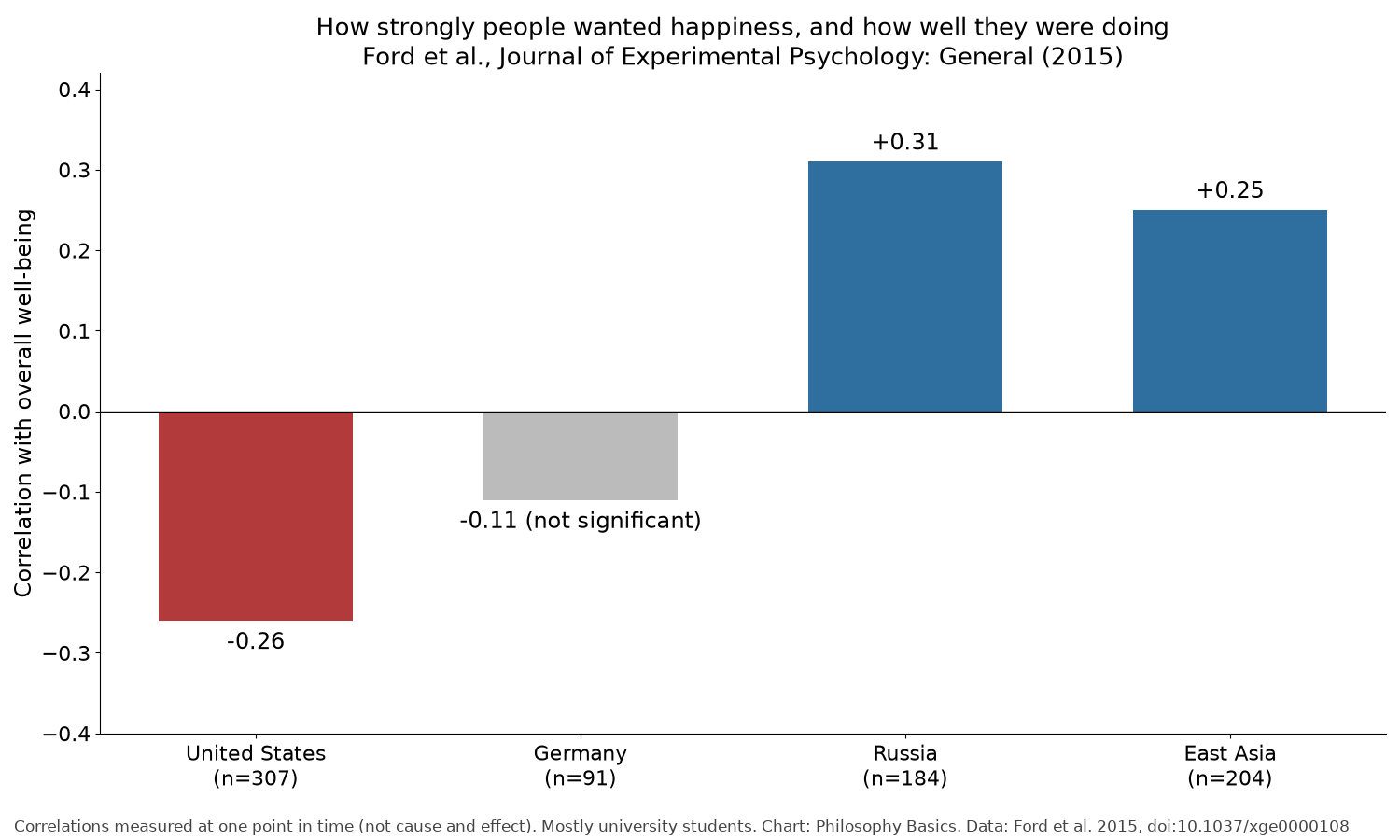
The explanation the authors land on is in that third measure. In Russia and East Asia, the people who wanted happiness most also tended to define happiness socially. In the US and Germany, there was no such link, and that difference statistically explained much of the cultural gap. The shorthand researchers use here is individualist versus collectivist. Individualist cultures emphasise the independent self and personal goals, with the US as the classic case. Collectivist cultures emphasise relationships and the group, and the study treats Russia and East Asia that way, with Germany somewhere in between.
Then there's the finding that cut across all four regions. Defining happiness in social terms went with higher well-being everywhere, whatever people's level of wanting it. The authors' own reading is that happiness is perhaps best achieved by orienting yourself toward social connection and engagement and "letting happiness follow", rather than by pursuing it intensely.

So, on my question, the answer is partly, and I want to be honest about how partly.
What varies across these regions is how people go about wanting happiness. In the US, wanting happiness wasn't tied to defining happiness socially at all. In Russia and East Asia, the two came bundled together, so wanting happiness there arrived alongside time with family and friends and helping people you care about.
There's a real limit on what that study can tell us, though, and the authors state it themselves. Everything was measured at a single point in time, which tells you two things go together without telling you which is driving which. They point out that the experimental and over-time evidence that wanting happiness damages well-being was "all conducted in the United States", and that "until additional research is conducted in collectivistic cultures, the alternative direction of effects cannot be ruled out in those cultures". People with lower well-being might simply want happiness less.
My reading is that the backfire is real in individualist settings and much less clear anywhere else. The experiments that actually change something and watch what happens are small studies of young American women from one research group, and I don't think you can stretch them further than that.
Wanting it versus judging it
Wanting happiness is natural, and going after it in some ways goes with feeling better. In 2014, Lahnna Catalino, Sara Algoe and Barbara Fredrickson published Prioritizing positivity: an effective approach to pursuing happiness? in Emotion. They surveyed 233 community adults, young through older, and measured how far people make their everyday decisions in a way that organises their lives around positive experiences. The ones who did that reported more positive emotions and fewer depressive symptoms. Their conclusion is that seeking happiness, "although a delicate art, may be a worthwhile pursuit."
Michel Hansenne found the same pattern in Belgium in 2021, with 683 participants, 75% of them women. Prioritizing positivity went with more happiness, more life satisfaction, more psychological well-being and fewer depression symptoms, while valuing happiness partly went the other way. Both of these studies surveyed people at one point in time, so the same caution applies as with the cultural study.
And then there's the 2024 paper, Unpacking the pursuit of happiness, by Felicia Zerwas, Brett Ford, Oliver John and Iris Mauss, again in Emotion. It came out of Mauss's own group, the people behind the original backfire experiments, and it drew on student and community samples totalling 1,815 participants collected between 2009 and 2020, using one-time surveys, daily diaries and follow-ups over time.
They split valuing happiness into two separate things. Aspiring to happiness, meaning treating it as a very important goal. And concern about happiness, meaning constantly judging how happy you are and whether it's enough.
Only concern was linked with worse well-being, at a single point in time and over time as well. Aspiring wasn't linked. The people high in concern reported more negative feelings about their own feelings during ordinary good events in their lives, which partly explained it. The authors' conclusion is that "highly valuing happiness is not inherently problematic", while "concern and judgment about one's happiness can undermine it."
I think all of that is real, and I think it supports my position and adds one refinement to it. What keeps turning up as the damaging move is aiming at the feeling and then grading yourself on it. In the 2011 experiment that showed up in the seconds after the happy clip, when the nudged women wanted to feel good and came away disappointed with how good they felt. Tamir's point about standards describes the same mechanism, since the mark you set is what decides whether a given result leaves you elated or flat. The 2024 paper separated that component out, calling it concern, and found the goal itself carried no such cost. Hansenne names it too, listing among the reasons pursuing happiness can be counterproductive that people "might focus continuously on their level of happiness instead of just behaving normally".
Aiming at the things happiness tends to come from looks fine, and in places looks good. The prioritizing positivity work is about which activities you choose, and Hansenne describes the idea as "selecting environments and activities that give rise to positive feelings", calling it efficient "to make positivity a priority when choosing the activities we want to do". Choosing your week around things that feel good is a different operation from judging how happy you feel. The social definition of happiness went with higher well-being in all four regions of the Ford study. And Mill's advice was to fix your mind on an object other than your own happiness, which is advice about where to aim.
A word about my own experience, because I don't want to overclaim it. Those communities were about raising vibrations and thinking positively, and aiming at the feeling of happiness came along with that. The studies are about valuing and monitoring happiness. Both involve aiming at the feeling itself, and that is as far as the overlap honestly goes. None of this research tested new age practice, positive thinking or manifestation.
So the refinement the research adds to my view is this: wanting happiness is fine. Constantly judging how much of it you're feeling is what hurts, at least in Western settings, and outside those settings we don't yet know.
What I do with this personally is straightforward. I aim at direction and at goals I can work through step by step, and I put real effort into the people I want close. The feeling itself I leave alone. Nothing in these studies gives me a reason to run it the other way.
Justin Brown writes about philosophy as a way of understanding how societies change. He holds a Master of Arts in International Relations from the Australian National University and a Master of Science in Economic History from the London School of Economics. His studies have been grounded in social constructivism, the idea that much of what we treat as fixed is built and rebuilt by people together, and he has long been drawn to critical theory. He's also fascinated by human creativity and where new ideas come from. Justin co-founded The Vessel and helps run Brown Brothers Media, a Singapore-based media company he leads with his brothers. He also makes video essays on YouTube.
More by Justin Brown →