
I deleted Instagram from my phone a few days ago.
This is a bit embarrassing to admit, but I had started to notice that I would open the app on a 'quick break' and then come back to myself twenty or thirty minutes later, thumb still moving, with no memory of deciding to watch any of it.
Reels, mostly. Short videos I did not choose and could not have described to you afterward. I cannot say I enjoyed them. They just consumed me, without my knowing it was happening.
That last part is what bothered me. I have written before about mistaking busy for productive, and I know what it feels like to drift from a research tab into YouTube and look up to find the afternoon gone. But this was a step further. The drift was happening without a decision anywhere in it.
So the app went. And then I went a bit further and set about making my phone as boring as I possibly could. Nothing with an endless feed. The things that are left on it are the things I actually need it for, and most of them are dull.
It is, for the first time in years, only a tool rather than a slot machine.
I am not telling you this because I think everyone should delete Instagram. I am telling you because it sent me back to a line I first read a long time ago and have never quite shaken.
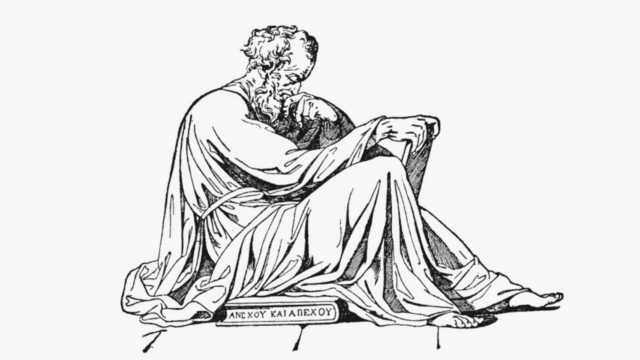
Seneca writes in his essay On the Shortness of Life with the sentence in the title: “It is not that we have a short time to live, but that we waste a lot of it.”
He keeps going. “Life is long enough,” he writes, “and a sufficiently generous amount has been given to us for the highest achievements if it were all well invested.” And then the summary, which is the bit I think about most: “Life is long if you know how to use it.”
I came across this during a stretch of my life that was not going well. A business had failed and I was reading a lot of Stoic philosophy, partly for the ideas and partly, if I am honest, because I was looking for something to hold onto.
Most of what I read from that period has blurred. This line did not.
What I like about it is that it refuses the usual complaint. We say we do not have enough time. Seneca says we have plenty, and that the shortage is something we are doing to ourselves.
He was writing two thousand years ago. The specifics have changed. The pattern has not.
When people talk about wasting time, they usually mean the lazy version. Lying on the couch. Doing nothing. I do not think that is what Seneca was getting at, and it is not what caught me with the phone either.
The time I was losing to short videos did not feel like rest. It did not leave me refreshed. It did not even leave me entertained in any way I could point to. If you had stopped me mid-scroll and asked whether I was enjoying myself, I think I would have had to admit that I was not. I was just occupied. Something was filling the minutes, and the minutes were going.
That is a different kind of waste from doing nothing. Doing nothing can be the best use of an evening. Sitting outside on a clear night and noticing how dark the sky gets is doing nothing, and I would not trade it.
I think the waste Seneca is describing is closer to the opposite: being constantly busy with things that leave no trace. Occupied, but not living.
I am clearly not alone in sensing this. In a Pew Research Center survey of 9,750 U.S. adults this past summer, just over half said they spend too much time on their smartphone. Among adults under 30 it was seven in ten. Only 3% thought they spent too little. That is a lot of people who already know, without a philosopher telling them, that something is being wasted.
I do not want to blame an app for a habit I built myself but it does seem that short video is unusually good at producing exactly the state I was in.
A team at the University of Bayreuth published a review of 42 studies this year covering around 47,000 participants, most of them teenagers, and found that heavy, unstructured use of short-video platforms was associated with more inattention and impulsivity and with weaker self-regulation.
These were mostly snapshot studies of young people, so I would not stretch them to cover a grown adult on his couch. Still, the pattern they describe, use without structure leading to less control over your own attention, was a fairly accurate description of me.
The format is built to remove the decision. There is no end to reach, no episode to finish, no point at which the thing naturally asks whether you would like to stop. The next one simply arrives. That is the whole design, and I had been treating it as if my willpower should be a match for it.
It was not. I have said before that I do not believe in discipline as a stand-alone mechanism, that systems and environment do most of the work the word gets credit for. Deleting the app was not a feat of willpower. It was the admission that willpower was never going to be enough, so the environment had to change instead.
The first few days have been odd. I keep reaching for the phone out of habit, unlocking it, and finding nothing there to reward the reach. A calendar. Maps. Messages from actual people. Then I would put it down.
What came back was not a surge of productivity. I haven't written a book in the recovered hours. What I got back is smaller. Gaps. The two minutes waiting for a coffee that are now just two minutes waiting for a coffee. An evening where I notice I am tired and go to bed, instead of surfacing at one in the morning three videos deep. A clearer sense, when I pick up a book or go out for a walk, that I chose it.
Perhaps, Seneca would say that is the point. His complaint was never that people enjoy themselves too much. It was that they hand their time to whatever happens to be in front of them, and then wonder where their lives went.
I still waste time. I will probably always waste some. But I would rather waste it on something I picked, a golf video I actively went looking for, a slow afternoon doing nothing in particular, than have it taken from me a few seconds at a time by something I never decided to watch.