William James wrote in 1890 that in most of us the character has set like plaster by thirty. A 2003 study of 132,515 adults found conscientiousness and agreeableness still rising.
William James thought character sets like plaster by thirty, and that this was good for the world. A 2003 study of 132,515 adults tested the line and found conscientiousness and agreeableness still climbing. I'm in my mid-forties now, settled and happy, which is where the feeling of being finished turned up.

.jpg)
A choice that protects you can quietly harden into who you think you are. Once that happens you stop seeing it as a choice at all, and you start believing you've finished changing.
You haven't. That includes me, right now, in the settled, happy version of my life.
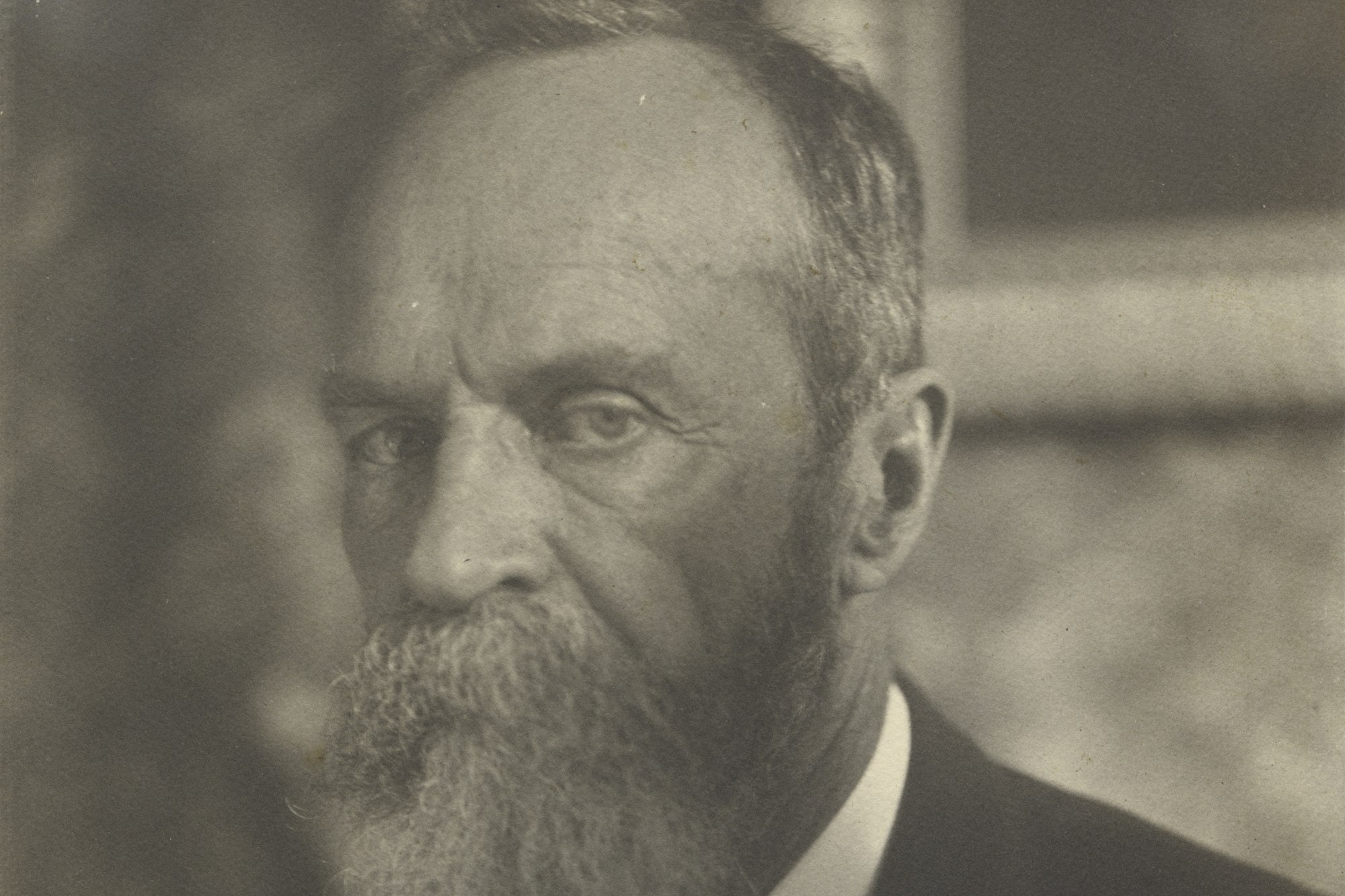
William James said the opposite, and with approval. In chapter four of The Principles of Psychology, 1890, he wrote: "It is well for the world that in most of us, by the age of thirty, the character has set like plaster, and will never soften again."
Well for the world. That sentence lands right after James describes the professional mannerism closing over the young doctor, minister and lawyer by twenty-five. The man can no more escape it, he says, than his coat-sleeve can fall into a new set of folds. His reason: "Habit is thus the enormous fly-wheel of society, its most precious conservative agent." Choose your habits early, he tells the young, because they will set.
In 2003, four researchers tested the line directly and named it after him. Sanjay Srivastava, Oliver John, Samuel Gosling and Jeff Potter called it the plaster hypothesis, after Paul Costa and Robert McCrae, whose theory held that traits reach mature form by around 30. Hard plaster meant no change after 30. Soft plaster meant change merely slows.
The sample: 132,515 adults aged 21 to 60, volunteers who filled in a Big Five questionnaire online. In their words: "On no Big Five dimension did we find support for the hard plaster hypothesis among both men and women". Conscientiousness rose across the whole range, fastest in the 20s, so it slowed after 30 without stopping. Agreeableness rose most during the 30s, so for one trait the change sped up after the deadline.
Does that bury James? The authors reject the hard version outright, and the soft version only fits conscientiousness, but they're candid about the design. It's a snapshot of different people at different ages, taken at one moment, and as they say, "Cross-sectional designs cannot intrinsically differentiate between developmental and cohort effects". It's a self-reported internet volunteer sample. The movements are modest, which the authors call medium to small.
Character does get steadier with age. Roberts and DelVecchio, pooling 152 longitudinal studies in 2000, found consistency in people's place relative to others rose from .31 in childhood to .64 at age 30, then plateaued around .74 between 50 and 70. People mostly keep their place in the line. Though .74 isn't 1.
The longitudinal work points the same way. A 2006 meta-analysis by Roberts, Walton and Viechtbauer pooled 92 studies of the same people over time and found rises in conscientiousness, emotional stability and social dominance, especially between 20 and 40. Costa and McCrae replied that this fitted their own view of modest change after 30, explained by intrinsic biological maturation. Roberts and colleagues answered that maturation isn't the only cause. Still unsettled.
So the hard version of the plaster line failed a direct test at scale. The data can't tell me anything about me. A rise in conscientiousness on a questionnaire isn't the same event as deciding to change your life.
I was single for fifteen years, and that choice became my identity. An essential step for me at the time. It also kept me pretty stuck in place.
Did the identity cause all fifteen of those years? No. There was also a fear of losing my drive, and it shaped relationships I shut off along the way.
The wrinkle: back in 2021 I said publicly that the commitment to being single wasn't a fixed and final state, that life is dynamic and constantly evolving. I never thought it would be forever. For me the gap was between saying the future was open and living as though it wasn't.
That part is easy to tell because it's finished. The harder part is now.
I've settled down here in Singapore, in a relationship of about two years, and I'm thinking long-term about it. I'm in my mid-forties, and things settled about five years ago. The shift was from a sense of possibility, where my decisions created change in the future, to the realisation that I'm still making decisions but the structure has been settled. If I settle into the idea that everything is done, not much change is coming, and each year will look like the one before. It's starting to look that way. The feeling is constricted. Stultifying, like the flow is gone.
Justin Brown's YouTube video "Why your 30s feel so exhausting", uploaded 5 June 2026. (Justin Brown, YouTube)
My own 2021 to 2026 is one person's story, not evidence. But if the traits themselves keep moving well past thirty, then the sense that I'm done in my mid-forties is a feeling, and nothing in these papers makes it a fact about me.
Montaigne, in "Of Repentance", wrote "I may presently change, not only by fortune, but also by intention." By intention is where the personality data go quiet. They record drift that happens to people. They say nothing about the kind you pick.
I've decided there are two options for me. I can accept it consciously, which is different from drifting into it. Or I can spend a small fraction of my capacity protecting the becoming, keeping one variable genuinely open. I don't think that means pulling down the structures. Moving them a little is enough.
James has his own words for that, oddly. "Plasticity, then, in the wide sense of the word, means the possession of a structure weak enough to yield to an influence, but strong enough not to yield all at once."
What I can't tell you is whether moving one variable does anything at all, or whether a decade from now will look much like this one. The 2003 snapshot can't answer that. All it shows is that the older groups differed from the younger ones well past thirty.
Justin Brown writes about philosophy as a way of understanding how societies change. He holds a Master of Arts in International Relations from the Australian National University and a Master of Science in Economic History from the London School of Economics. His studies have been grounded in social constructivism, the idea that much of what we treat as fixed is built and rebuilt by people together, and he has long been drawn to critical theory. He's also fascinated by human creativity and where new ideas come from. Justin co-founded The Vessel and helps run Brown Brothers Media, a Singapore-based media company he leads with his brothers. He also makes video essays on YouTube.
More by Justin Brown →