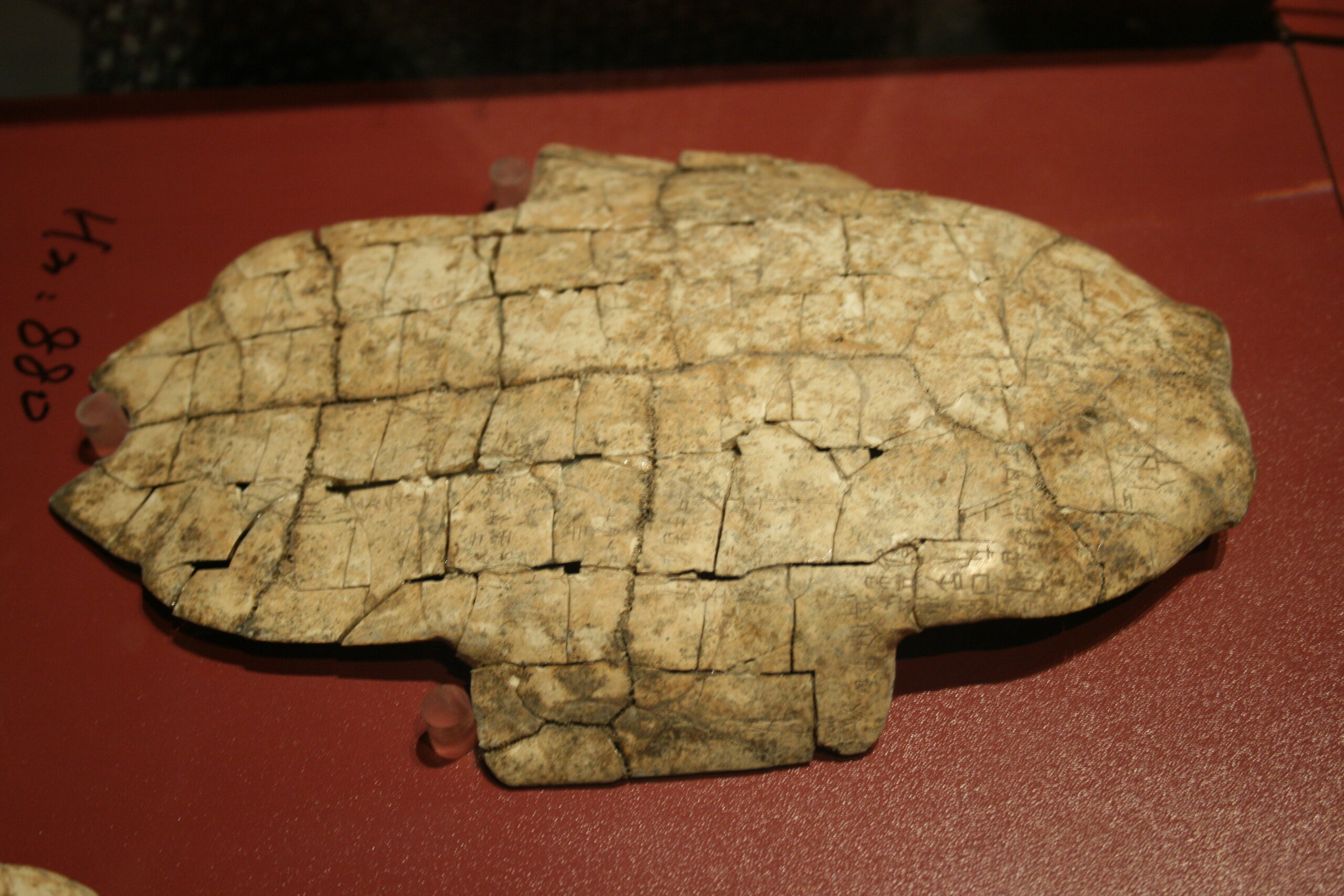
When Zhuangzi was fishing on the Pu River, two officers sent by the king of Chu reached him with an offer: the king wished to hand him charge of everything within his borders. Zhuangzi did not put down his rod or even look at the officers. The scene is told in chapter 17 of the Zhuangzi, "Autumn Floods" (Qiushui 秋水), and his response has become one of the best-known refusals in Chinese philosophy. Rather than accept or decline, he asked them a question about a tortoise.
The passage
In Richard John Lynn's translation, published in the journal Religions in 2019, the episode begins: "Once when Master Zhuang was fishing in the Pu River, the King of Chu dispatched two officers of state." Zhuangzi keeps fishing and says: "I have heard that in Chu there is a sacred tortoise, already dead for three thousand years." The king keeps it wrapped in cloth, in a box, in the ancestral hall.
Then the question: "Would this tortoise rather be dead and have its bones left behind to be venerated, or be alive so it could drag its tail in the mud?" The officers give the only possible answer: "It would rather be alive so it could drag its tail in the mud." And Zhuangzi: "Get you gone! I am going to drag my tail in the mud!"
That is all of it. The original runs to under 100 characters, and the line people remember is the last one, 吾將曳尾於塗中:
Literally: "I will drag my tail in the mud."
What the sacred tortoise was
It is easy to picture a live tortoise on a cushion, but the text points somewhere else. The tortoise has been dead for three thousand years, and what the king keeps in the temple is what is left of it. The translator Frank Saunders Jr. notes in his translation of "Autumn Floods" that the term shen gui (神龜, "divine tortoise") could mean a sacred ornament, but may also refer to an ancient turtle shell used in divination. Lynn reads it as a divination shell too.
That reading fits the history. In early China, tortoise shells played a central role in state divination. Diviners applied intense heat to them until cracks appeared, then interpreted those patterns as answers to questions about harvests, warfare and the king's health. During the Shang dynasty, scribes carved the questions and answers directly into the shells and bones. The sinologist Victor Mair puts the surviving Shang divination archives at nearly 200,000 inscribed bones, known today as oracle bones.
The revered object, then, is no living creature benefiting from its prestige. It is a dead animal made into a tool of the court, wrapped and preserved for the king's use. For Zhuangzi, accepting office would mean being put to much the same use.
How scholars read it
Lynn puts the point plainly: "The fable succinctly summarizes the contrast between the simple joys of the secluded life" of the recluse fisherman and the prestige and danger of high office. The Western Jin commentator Guo Xiang (252–312), whom Lynn translates, leaves a six-character comment that I read as being about nature rather than politics: 性各有所安也, "The nature of each would thus be content." The tortoise belongs in the mud, just as Zhuangzi belongs by the river.
Zhuangzi never argues against the king, government or public service. He asks the officers to acknowledge what a living creature would choose, then lets them see how their answer applies to him.
The owl and the ox
The next episode in the same chapter makes a similar point, this time with a bird. Zhuangzi's friend and debating partner Huizi is a minister in Liang when he hears a rumor that Zhuangzi plans to take his job. He panics and orders a search across the state for three days and nights. When Zhuangzi finally appears, he tells Huizi about the Yuan Chu, a phoenix-like bird that travels from the South Sea to the North Sea, eating and drinking only the purest things. An owl holding a rotten rat spots it overhead and shrieks, afraid the bird will steal its meal. Was Huizi doing the same thing, Zhuangzi asks, guarding his position in Liang as though Zhuangzi had any interest in taking it?
Another version appears outside the book. In his short biography of Zhuangzi in the Shiji, the historian Sima Qian (c. 145–c. 86 BCE) describes how King Wei of Chu sent envoys bearing expensive gifts to offer Zhuangzi the position of chief minister. Zhuangzi laughed and brought up the sacrificial ox. For years, it is well fed and eventually dressed in fine embroidery, only to be led into a temple and killed. By then, it might wish it were an ordinary pig, but the chance to live that life is gone. Will Buckingham also retells this episode in his introduction to Zhuangzi.
Whoever first told them, the tortoise, the owl and the ox share one view: a powerful position may come with comfort and prestige, but it also puts your life at someone else's disposal.
How his followers remembered him
The Zhuangzi is a collection of philosophical tales, and "Autumn Floods" belongs to a group of chapters, 17 to 22, that the Stanford Encyclopedia of Philosophy attributes to Zhuangzi's followers rather than to Zhuangzi himself. Sima Qian's biography, written about two centuries after Zhuangzi's death, gives almost nothing about his background beyond his hometown, Meng, and a minor post as a clerk in a lacquer garden. The fishing trip cannot be dated or confirmed as an event, and the three thousand years is a round, rhetorical figure, not a temple record.
What the episode does show is how early Chinese readers remembered Zhuangzi: a man who turned down the kind of offer most scholars could only dream of, without even putting down his fishing rod. He was from Song, which makes the offer all the more striking. The king of Chu was asking someone from another state, who had held only a minor post, to take charge of his kingdom.
Why it still works
People who turn down power usually explain why. Zhuangzi asks a question instead and lets the officers answer it for him. The king's tortoise has been kept and honored for three thousand years, and it is still the court's property. Zhuangzi has no wish to be kept like that. Then he goes back to fishing.
Correction, October 20, 2026: The 'Written' comment says Lu Qi was contacted for comment on this piece. That is a mistake: the outreach to Lu Qi was for a different title (the Nature Communications loneliness study). No one was contacted for this piece and no interview material is in it. Please disregard that sentence.