In 1845 Henry David Thoreau built a cabin at Walden Pond for $28.12 and said he went to the woods to “live deliberately” — to face only the essential facts of life and see what they had to teach

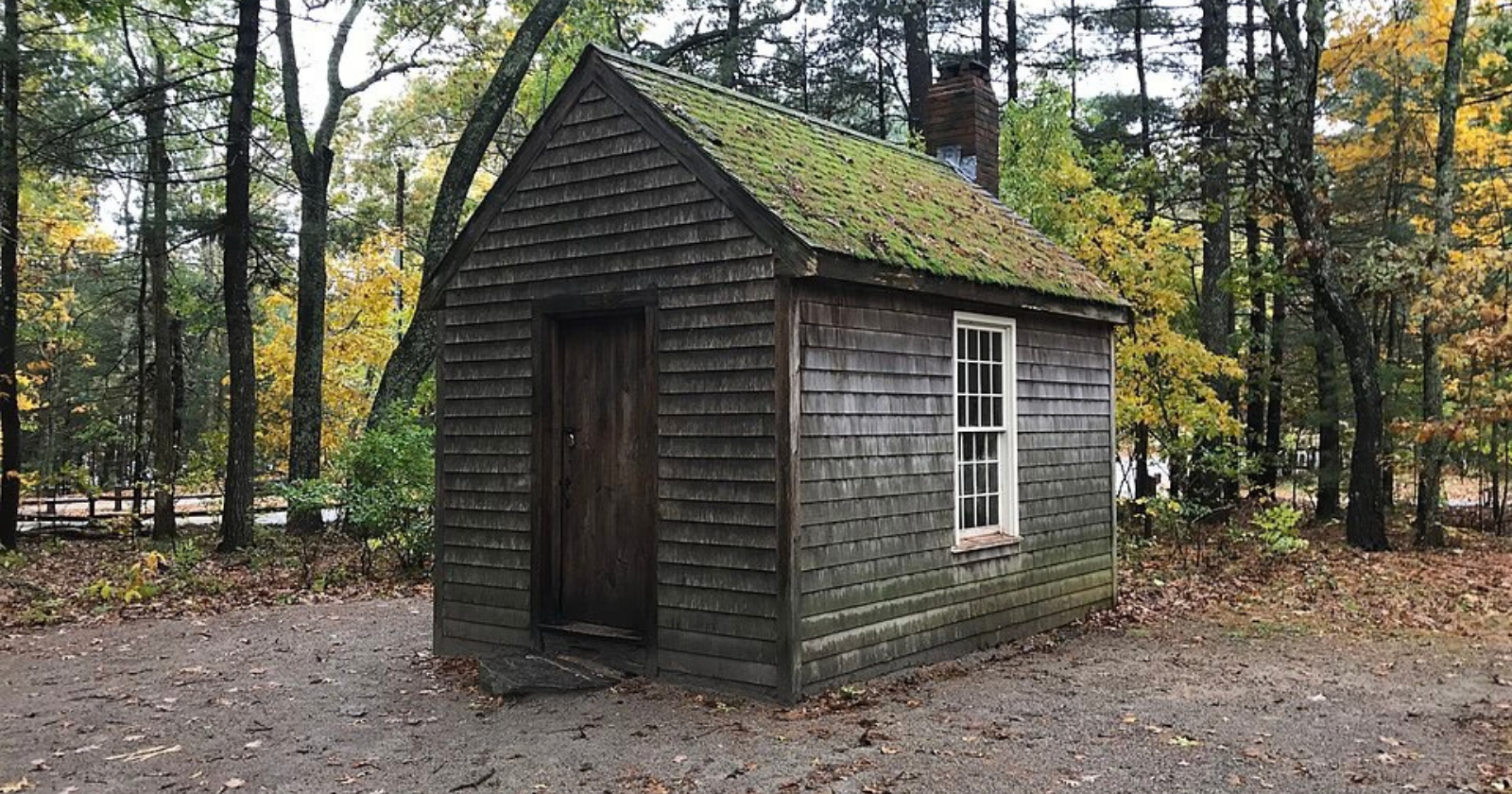
Photo: John Phelan / Wikimedia Commons, CC BY 4.0.
I've rented my whole adult life, and lately I've been seriously considering building a small cabin of my own instead of a conventional house. Not the sort you construct from trees you've cut down yourself, but a ready-made cabin, built in a factory and delivered.
The initial attraction is fairly simple. A smaller home will cost less, hopefully require a little less looking after and leave more money for everything else. But I've also been wondering whether it might give me something harder to put a price on: more time, more freedom, even.
I've found myself coming back to Henry David Thoreau's Walden.
Near the end of March 1845, Henry David Thoreau borrowed an axe and went into the woods beside Walden Pond, about a mile and a half south of Concord, Massachusetts. He cut white pines for the frame, bought an old shanty from a railway labourer named James Collins for its boards, and on the 4th of July 1845 moved into his cabin. It measured just ten feet by fifteen, and although it had been boarded and roofed, he still had work to do before winter.
That's 150 square feet, smaller than plenty of hotel rooms.
He published the cost in detail. In Walden, he lists every material, down to the half-cent.
The boards, mostly salvaged from Collins's shanty, cost $8.03½. Refuse shingles for the roof and sides came to $4. Two second-hand windows with glass were $2.43. Nails added another $3.90. There were bricks, lime, hinges, a latch and even a penny's worth of chalk.
The total was $28.12½ in 1845 money.
Perhaps, the best part is the little notes he leaves beside the numbers. Next to the lime he grumbles, “That was high.” Next to the hair used in the plaster: “More than I needed.” Next to transportation: “I carried a good part on my back.”
He's gives this level of detail because very few people can say exactly what their houses cost, and fewer still can account for the separate materials.
To be fair to anyone who has ever priced up a build, this isn't the whole story. The total leaves out his own labour, and the timber, stones and sand, which he says he took “by squatter's right.” The land itself belonged to his friend Ralph Waldo Emerson, who had allowed Thoreau to build there. Friends helped him raise the frame, and he continued visiting people in Concord. The arrangement with Emerson also meant that the cabin could later serve as Emerson's study.
Thoreau's circumstances were unusual, and of course, his material costs aren't directly comparable with what someone would pay to have a house built today.
I'm certainly not planning to follow his example quite that literally. I won't be cutting down trees myself, and I'm unlikely to be salvaging old buildings or carrying materials on my back. The cabins I've been looking at are manufactured elsewhere and delivered largely complete. I'd be paying for someone else's labour as well as the materials.
But that's partly why his accounts interest me. He wasn't just recording how cheaply he'd built a house. He was questioning how much of his life a house ought to consume.
It's tempting to read all this as a 19th-century money-saving challenge. Thoreau says plainly that it wasn't. His purpose in going to Walden, he writes, “was not to live cheaply nor to live dearly there.”
My reading from the book is that he wanted to find out how little he actually needed, and what he could do with his life once the unnecessary demands had been taken away.
One idea from Walden has stayed with me more than the others.
“The cost of a thing,” Thoreau writes, “is the amount of what I will call life which is required to be exchanged for it, immediately or in the long run.”
He wasn't interested merely in what a house cost in dollars. He wanted to know how much of your life you had to give up to pay for it.
In the chapter “Economy,” he estimates an average house around Concord at about $800 and reckons that saving this amount could take ten to fifteen years of a labourer's life, “even if he is not encumbered with a family.” Meanwhile, the rent on a student's room at Cambridge College was $30 a year, for a room he describes as “only a little larger than my own.” His cabin cost less than one year of that rent.
Perhaps, the clearest result of his thinking appears in his Economy chapter. Reflecting on more than five years of supporting himself with his hands, including his time at Walden, he writes:
“I found that, by working about six weeks in a year, I could meet all the expenses of living.”
Most of the remaining year, he said, was free for study.
He had deliberately arranged his life so that earning a living consumed relatively little of it. The time left over was, it seems, the point.
I couldn't arrange my own working life quite that way, but it has changed how I've been looking at cabins and prices.
From what I've found, some ready-made cabins appear to cost roughly half as much to construct as a similarly sized conventional new build. And because much of the work happens in a factory, the building price seems easier to pin down in advance. There's less of the uncertainty that comes with having a house constructed from scratch.
The timescale is appealing too. The cabins I've been looking at could be manufactured and delivered in two to three months, compared with the eight months or potentially longer that a conventional build would take.
Those are estimates from my own research, not a comparison of finished, ready-to-occupy homes. There would still be site preparation, services and other expenses to account for. I realise that a cabin arriving after eight weeks doesn't mean moving in after eight weeks.
Even so, it’s attractive to me. Less money spent on the building might mean fewer years earning the money to pay for it. A shorter construction process might mean less time and energy taken up by the whole business of getting a home built.
Thoreau's calculation makes me think about those savings differently. The building price is important, but so is everything that comes with it, including the time involved in making the place somewhere I can actually live.
These savings are appealing, although I do have some reservations about living in a small space.
A while back, my wife and I lived in a studio apartment in Bangkok while we were travelling. I found it rather confining. We had noisy neighbours, and there was nowhere to escape the noise. No garden or outdoor space to speak of, just the apartment and the city beyond. For a long time afterwards, I assumed that small living simply wasn't for me.
Then I noticed something in Walden that made me reconsider. When Thoreau compares his cabin with a student room at Cambridge College, he points out that the student pays thirty dollars a year in rent and suffers “the inconvenience of many and noisy neighbors.”
That sounded familiar. Perhaps I'd been blaming the size of our apartment for something that had more to do with its surroundings.
Thoreau's cabin was only 150 square feet, considerably smaller than many modern apartments. But Walden Pond was nearby, with woods stretching out around him. In “Where I Lived, and What I Lived For,” he writes:
“Though the view from my door was still more contracted, I did not feel crowded or confined in the least. There was pasture enough for my imagination.”
He had the woods to walk through, the pond to visit and room to wander whenever he felt like it.
Looking back at Bangkok, I wonder how differently I might have felt about that little apartment if we'd had somewhere quiet to sit outside, or a private patch of green to escape to. The four walls might have been perfectly adequate if we hadn't felt so confined by everything around them.
I don't particularly want to test how little space I can endure, and I certainly don't want to recreate our Bangkok apartment in a different setting. But I can imagine being quite happy with a small home if there's somewhere pleasant to step outside. The size of the building matters, of course, but I'm beginning to think that what surrounds it matters just as much.
The more I read Walden, though, the more I realise that Thoreau wasn't simply advocating small houses.
He describes his farming neighbours “toiling twenty, thirty, or forty years” to become the real owners of their farms, and most of them still hadn't managed it. If you want the history of these homesteads, he says, ask at the bank where they're mortgaged.
He goes further. Even after a farmer has acquired his house, Thoreau suggests, he may be poorer rather than richer because of it. Our houses are such unwieldy property that “we are often imprisoned rather than housed in them.”
Nearly two centuries later, that observation doesn't seem particularly dated. The thirty-year mortgage is still a familiar feature of American homeownership. According to Harvard's Joint Center for Housing Studies, the median price of an existing single-family home in the United States was nearly five times the median household income in 2025.
Those figures don't mean homeownership is a bad bargain. A house can provide security, stability and something valuable to pass on. But they do bring me back to Thoreau's question. How much of a person's working life goes towards acquiring and maintaining a home, and what might that time have been spent doing otherwise?
Earlier in the opening chapter of Walden, he'd written his most famous sentence:
“The mass of men lead lives of quiet desperation.”
It's usually quoted as a general observation about unhappiness. But in context, it seems he's concerned with the burdens people accept as unavoidable: the property they must pay for, the work required to maintain their way of life, and the obligations that leave them with little freedom to choose how they spend their days.
His criticism wasn't that people wanted comfortable homes. It was that they could spend so much of their lives acquiring and maintaining them that they had little life left to enjoy.
Which brings me to a story in Walden that I find even more interesting than the cabin itself.
Before moving to Walden Pond, Thoreau very nearly bought a farm. It was called the Hollowell place, about two miles from Concord, situated by the river. He liked its seclusion, its old trees and even the dilapidated condition of the buildings. He'd already begun sorting seeds and gathering materials for a wheelbarrow.
Then, before the deed was transferred, the owner's wife changed her mind and wanted to keep the property. The owner offered Thoreau ten dollars to release him from the deal.
Thoreau, who by his own account had ten cents to his name at the time, let the man keep both the farm and the ten dollars.
He describes the episode with evident amusement. He had enjoyed imagining his life there, but he hadn't had to take on the burden of owning and improving the place. He'd escaped the transaction without feeling deprived.
His conclusion is one of my favourite lines in the book:
“A man is rich in proportion to the number of things which he can afford to let alone.”
I've spent my adult life renting, usually thinking of ownership as something to work towards. A place of my own has always seemed like it would bring greater independence.
But renting has also meant not having a building to maintain, or a permanent place to be responsible for. When I travelled, I could move on. There were inconveniences, of course, but we weren't tied to one particular piece of property.
A cabin might cost less to build than a conventional house. It might avoid some of the headaches of construction. And if it stood in the right place, I can imagine enjoying a much smaller indoor space than I once thought I could live in.
But once it was there, it would still be something to look after. There would be repairs, maintenance and the ordinary responsibilities of owning a home. Even a very small house can become a large commitment.
I don't think Thoreau would necessarily tell me not to build it. After all, he built a cabin himself. But his own experience at Walden suggests that the important thing wasn't possession of the cabin. It was what living there allowed him to do.
The numbers I've been looking at still make a cabin seem like a sensible choice. It could be cheaper, quicker and simpler than building a conventional house. Those are good reasons to consider one.
Yet the more I read Walden, the less convinced I am that choosing the cheaper house is quite the same thing as choosing the freer life.
I still like the idea of having somewhere of my own. I can picture a small cabin with the woods or a garden beyond the door, enough room inside for what we need, and no more house than we want to look after.
But I can also remember how easily we could leave our rented home when we decided to travel. I hadn't thought of that as a form of wealth until I read Thoreau's story about the Hollowell farm.
So I'm left with his questions more than his answers. How much of what this is costing me — in money, in hours, in years — would I actually miss if it disappeared? Would the thing I'm about to commit to give me more of my life back, or quietly take it?
Sources
- Henry David Thoreau, Walden; or, Life in the Woods (1854). Full text, Project Gutenberg. Primary source for the cabin's construction costs, economic calculations, quotations about debt and ownership, and the Hollowell farm story. Principal chapters: “Economy” and “Where I Lived, and What I Lived For.”
- The Walden Woods Project, “Thoreau's Place”. Historical background about Walden Pond, Emerson's ownership of the land and Thoreau's living arrangements.
- Harvard Joint Center for Housing Studies, The State of the Nation's Housing 2026 — press release. Source for the comparison between median existing single-family home prices and median household income in the United States.
- Prefabricated cabin comparison. The comparison between ready-made cabins and conventional new builds is based on my own research into advertised prices, particular cabins and estimated construction times, rather than a published national cost survey. The figures are indicative and do not establish the total cost of a completed home.
Mal James
Mal is a senior writer at Brown Brothers Media, the publisher of Philosophy Basics. He has a particular interest in philosophy, psychology, and the questions surrounding happiness, personal growth, and what makes for a meaningful life. When he's not writing, he's usually reading or working on his far-from-perfect golf swing.
More by Mal James →