

Kitty Genovese was 28 and coming home from work when a man followed her through her Queens neighborhood and stabbed her. The story that made her murder famous was about what her neighbors supposedly did next.
On March 27, 1964, two weeks after she was killed, The New York Times reported that 38 people had watched a killer attack her three times over more than half an hour. Nobody had called police during the assault, the article said. The call finally came after she was dead. It was a horrifyingly clear account of people recognizing an emergency and choosing to leave a woman to die.
The original article described something I struggled to understand: how could people hear someone asking for help and do nothing?
This story helped inspire research into what became known as the bystander effect, the finding that, in certain circumstances, people are less likely to help when others are present. Kitty's murder became one of its most famous real-world examples.
Except the newspaper had got fundamental facts wrong. In 2016, the Times acknowledged that its original article had “grossly exaggerated the number of witnesses and what they had perceived.” Nobody had seen the entire attack. There were two attacks, not three. People had called police. And a neighbor had gone to Kitty and held her while they waited for help.
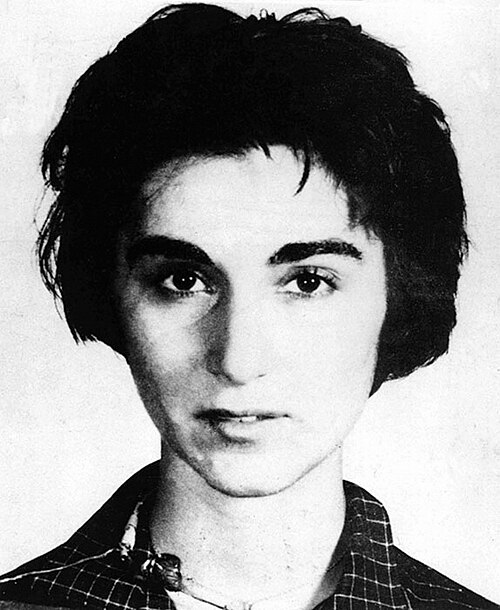
Were there really 38 people watching the crime and doing nothing?
Naturally, my mind imagined exactly 38 people standing together watching what was happening in front of them. I don’t think you can blame me for that. The number 38 seemed so specific and confident that I did not even question its origin.
However, it turned out to be much more complicated than that. Hearing a noise and watching a murder are very different experiences.
I found a possible explanation in an interview with journalist Kevin Cook, who investigated the case for his book. He described finding a police synopsis containing almost 50 interviewees, grouped into 38 entries. Some entries covered several people. Cook’s hypothesis was that someone counted those entries and passed the number to police commissioner Michael Murphy, who then gave it to Times editor A. M. Rosenthal over lunch.
The distinction was crucial: Cook had located a document with 38 entries, but the counting error he proposed was a theory about how the number reached the newspaper. It did not establish a group of 38 people who had knowingly watched an entire murder and refused to act.
A list of people interviewed by police could include someone who heard a cry, someone who saw a car leaving, and someone who saw an attacker. It started becoming clear to me that it was not 38 people who watched an attack happen from beginning to the end.
This is when I stumbled upon a goldmine for my investigation. It was the trial testimony, preserved online by local researcher Joseph De May. I wanted to see how closely the scene described under oath resembled the one the newspaper had given its readers.
The court records changed the scene
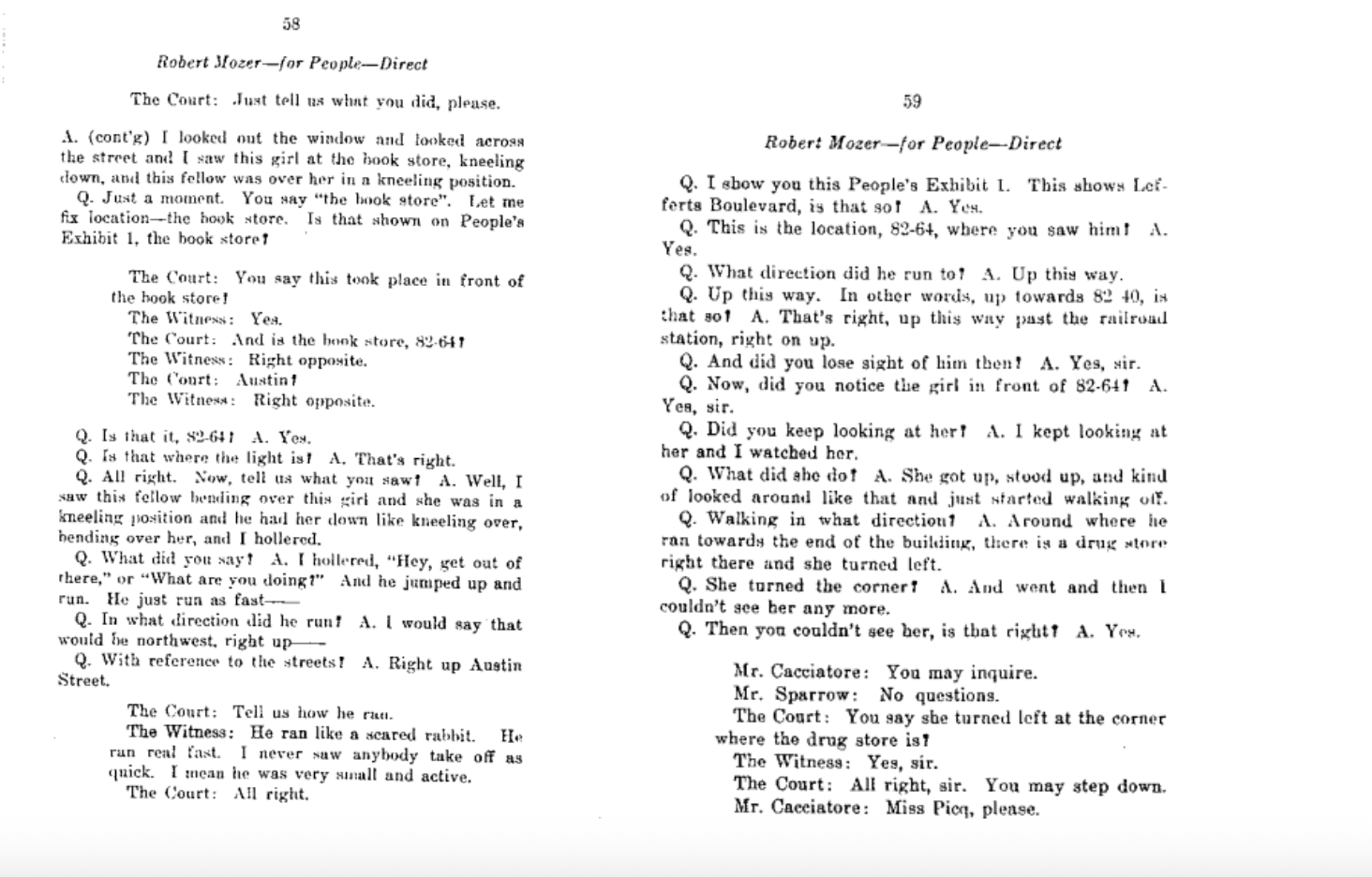
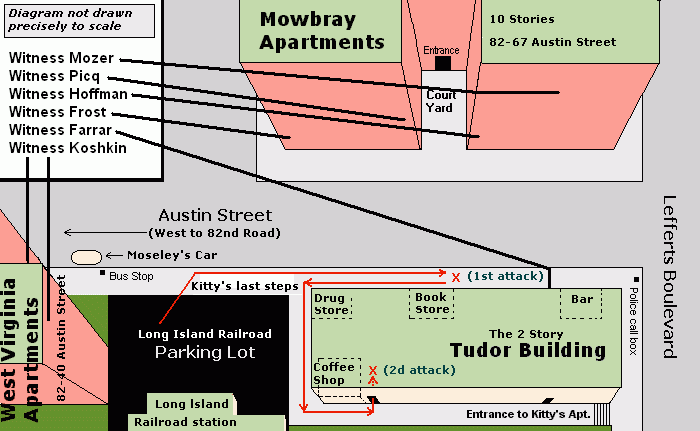
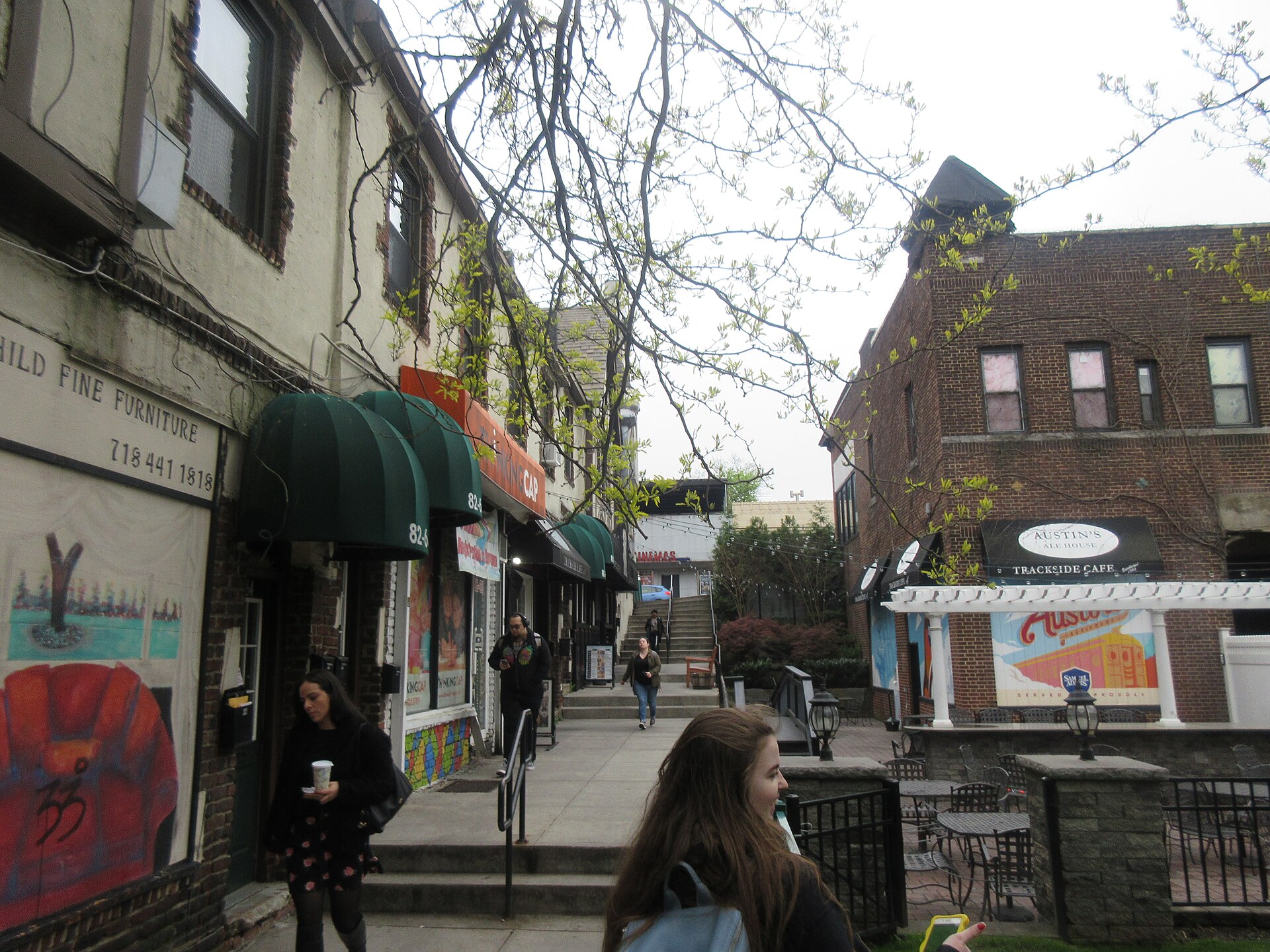
The first attack took place outside a row of shops on Austin Street in the early hours of March 13. Robert Mozer, who lived in the apartment building across the street, heard a woman asking for help and went to his window. In his testimony, he described Kitty kneeling near a bookstore, with a man bent over her.
Mozer shouted, recalling his words as “Hey, get out of there” or “What are you doing?” The attacker jumped up and ran. Then Mozer saw Kitty stand, look around and walk toward the corner. Once she turned it, she disappeared from his view.
It hurt me to think that the story could have ended there. There was an intervention that interrupted the attack. Someone at a window had frightened the killer away. Kitty was wounded but still able to get up and move.
She made her way around the building and collapsed in a rear entrance. The geography explained another major problem with the original reporting: the second attack happened in a hallway hidden from the apartments across Austin Street. The people looking from those windows were not watching the whole sequence unfold. I started to understand a little more how someone would say that multiple people witnessed the event and did nothing. The witnesses were not watching the event unfold together. Rather, it was multiple people getting glimpses of the events at different times.
Then I reached Moseley’s own testimony on page 236. He explained why he had returned:
“I did not go home because I did not think that the person that called would come down to help her regardless to the fact that she had screamed, so I came back.”
He searched for Kitty, found her in the rear hallway and attacked her again. During that attack, he testified, he heard doors opening upstairs but did not think anyone was coming down.
This is the part that shocked me so much in this particular case. Moseley had already been spotted by someone who shouted at him from a window. He was clearly concerned about getting caught, because he even moved his car so that nobody could identify its license plate. Yet somehow, he felt confident enough to return and continue the attack. He was worried that someone might identify his car, but not worried enough that someone would actually come downstairs to help Kitty. I found that absolutely chilling.
The often-repeated ten-minute gap appears in detective Albert Seedman’s later account of the interrogation, reproduced by De May: Moseley said he parked elsewhere and waited about ten minutes before going back. That is a later recollection, rather than an independently timed interval. The records nevertheless establish that he left after the first attack and returned to find Kitty alive.
I could not read his explanation as proof of what every neighbor knew. It was the killer describing what he believed he could get away with. Yes, Mozer had sent him running. But did he, or anyone else, understand enough of what went on to bring help to Kitty?
The witnesses missing from the trial
The New York Times article wasn't wrong about everything. There were genuinely disturbing accounts of people who witnessed parts of the attack and failed to seek immediate help. In 2004, prosecutor Charles Skoller described two such cases: Joseph Fink, who reportedly witnessed the first attack, and Karl Ross, who reportedly witnessed the second. Neither man witnessed the entire murder unfold. They saw separate parts of the attack.
According to Skoller, Joseph Fink, an assistant superintendent in the building opposite, saw the knife during the first attack, went downstairs to his apartment, and returned to bed. A telephone was beside his bed.
Separately, Skoller said Karl Ross opened a door onto the second attack, closed it, and called a girlfriend for advice instead of immediately calling police. Ross subsequently contacted Sophia Farrar.
Other accounts, including Cook’s NPR interview, differ about the sequence of calls and who ultimately phoned police. I could establish the reported hesitation without pretending the chronology was settled in every detail.
Neither Fink nor Ross testified at the trial. According to Skoller, prosecutors deliberately left them off the witness list because they feared the jury’s anger at the men would distract from Moseley’s guilt. They were seeking the death penalty. The absence of their testimony therefore had an explanation beyond the possibility that they had seen nothing.
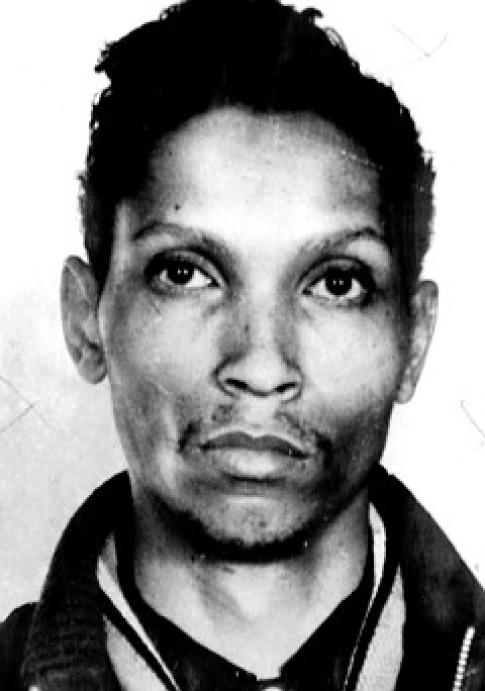
These two accounts show that there were genuine failures to seek immediate help. But we cannot assume that all the other witnesses behaved the same way.
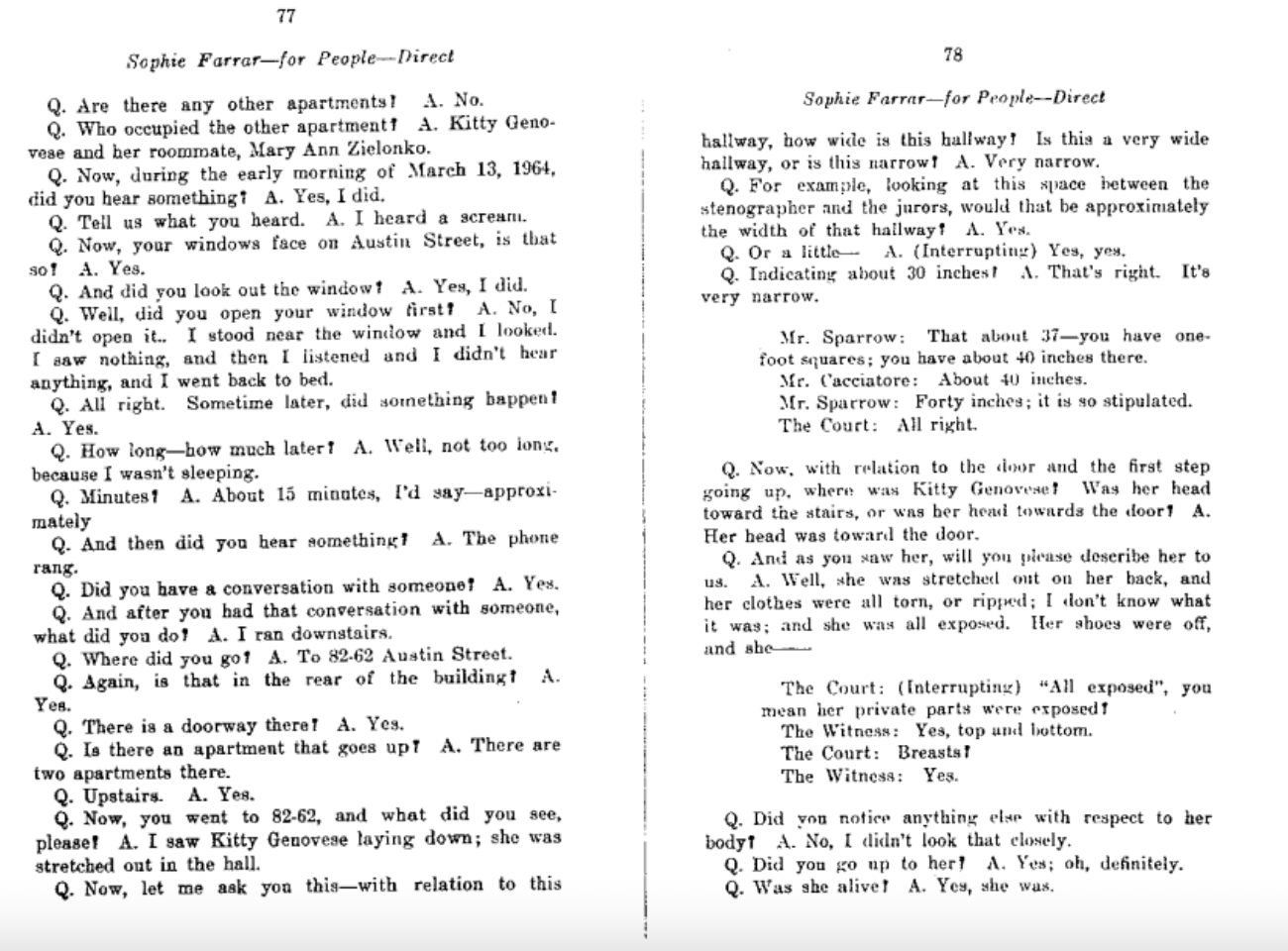
Sophia Farrar’s testimony tells a different story. She described hearing a scream earlier, looking outside, seeing nothing and returning to bed after listening without hearing more. Later, a telephone call alerted her that something had happened downstairs. Asked what she did then, she answered: “I ran downstairs.”
She found Kitty alive in the hallway. Kitty was moaning while Farrar spoke to her. Farrar waited there for police and an ambulance, and testified that Kitty was still alive when she was taken out on a stretcher.
Skoller’s account adds that Farrar cradled Kitty in her arms without knowing whether the killer was still nearby. Kitty died on the way to hospital.
By now, the problem with the famous story was much larger than an inflated number. The original Times report did include a man shouting from a window and the attacker leaving. Yet the version that endured reduced uncertainty, intervention and delayed action to a single lesson about people doing nothing. Farrar’s presence made that lesson harder to sustain.
What makes it specifically unfair to me is that Sophia ran downstairs without knowing whether the attacker was still there, whether there was any danger to her. She just went to help the person she knew and liked. In my head, this is a heroic act of a brave woman. So how could The New York Times publish a story centered on the neighbors' failure to help, yet completely leave out the woman who went downstairs and stayed with Kitty in her final moments?
Kitty’s brother had been asking these questions too
The Witness, directed by James Solomon, addresses this issue. The film follows Kitty’s younger brother Bill as he tries to discover what happened and recover the sister whose life had been overshadowed by the public story of her death. It took 11 years to make, and his investigation was prompted by questions the Times itself raised in 2004, before its more widely quoted acknowledgment in 2016.
The filmmakers describe how the account of neighbors refusing to get involved helped shape Bill’s decision to volunteer for service in Vietnam. He lost both legs in combat. That story was one influence on his decision, and it would be wrong to turn it into the sole explanation for his service or his injuries. But it shows how deeply an account of someone else’s inaction could enter a person’s life.
Bill’s search made me more conscious of how easily a story can become useful before it becomes accurate, and how much the people inside it can lose in the process.
Something else occurred to me as I was watching the film: how much can we trust the recollections of witnesses?
I couldn't help wondering whether fear of being judged might influence what people were willing to admit. Of course, after so many decades, some might genuinely remember very little. I couldn't know which explanation applied to anyone in particular.
The newspaper’s account also helped inspire psychological research into the bystander effect, with Kitty’s murder becoming one of its best-known real-world examples.
What the psychologists had actually studied
I went back to Darley and Latané’s 1968 paper, and there was the inaccurate figure, right at the beginning of a scientific paper. It described 38 people watching Kitty’s murder without intervening or calling police. The claim had entered the research as accepted background.
Their experiment was a separate source of evidence. College students sat in individual rooms, believing they were in an intercom discussion. A recording sounded like another participant having a seizure. Some thought they alone heard it. Others believed one or four additional listeners were present. Those who believed others were listening were slower to report the emergency and less likely to report it before the apparent seizure ended.
The proposed explanation was diffusion of responsibility: knowing others could act might reduce your own sense of responsibility. The experiment demonstrated a pattern under its particular conditions, and I want to make it clear that it did not establish what Kitty’s neighbors understood or why they acted as they did.
Based on what I have read, the newspaper’s errors did not automatically invalidate the measurements. But using Kitty’s murder as a verified example confirming the explanation was unjustified. The event being explained had been badly misrepresented.
A 2007 analysis by Rachel Manning, Mark Levine and Alan Collins raised a further concern. They argued that the 38-witness story had helped focus the field on how groups inhibit helping, drawing attention away from how groups could enable it. Their criticism concerned the influence of the story on the questions psychologists imagined and pursued. They explicitly did not set out to overturn the existing experimental findings.
It’s one thing when it’s a problem with an old newspaper story. However, I think it still shaped how people understood helping. I emailed Mark Levine, one of the authors of the 2007 paper, to ask what consequences he still noticed nearly twenty years later.
In his reply, Levine described the belief that people do not help in emergencies because of the bystander effect as a “zombie idea”. He argued that the image of us as self-serving individualists “has a powerful grip on our imagination”, despite evidence of strangers helping and of other people’s presence supporting intervention.
His answer sharpened the concern I had found in the paper. A false story can influence research without making every result false. It can make one question seem so obvious that another receives less attention. If you begin with 38 people watching and nobody helping, you naturally ask why other people prevent us from acting. The possibility that people might help one another act becomes easier to overlook.
A 2011 meta-analysis led by Peter Fischer, pooling 105 independent effects and more than 7,700 participants, found an overall bystander effect. It also found that the effect weakened when situations were perceived as dangerous, when perpetrators were present, and when intervening carried physical costs. In some dangerous situations, other bystanders could provide support.
So there was substantial evidence for the effect, alongside reasons to question the sweeping lesson attached to Kitty’s name. The presence of others could discourage an individual from helping under some conditions. That did not mean an emergency surrounded by people would generally leave its victim without help.
Then the real-world research surprised me
I guess it all comes down to one question, at least for me: if I were the person in trouble, would anyone help me?
Thankfully, there is some research that shows that it’s likely that someone jumps in. In a study published in American Psychologist in 2020, Richard Philpot and colleagues examined CCTV footage of 219 public conflicts in the United Kingdom, the Netherlands and South Africa. Someone intervened in about nine out of ten incidents, often with several people helping. More bystanders were associated with a greater likelihood that at least one person would intervene.
At first, that seemed to contradict the earlier findings. Then I understood that an individual’s likelihood of helping and a victim’s likelihood of receiving help were different questions. One person might feel less responsible in a group, while the person in trouble has more potential helpers nearby.
The footage was observational, so we don’t know whether adding people caused more helping. Public street conflicts are also different from an attack in a hidden entrance at three in the morning. I don't think we can use that finding to explain Kitty’s murder retrospectively, but it does offer me a comforting thought that strangers can help you when you need assistance.
The question I had not been asking
I remember being around nine years old, walking home from school with my friend. It was already dark. We saw two grown men having a fistfight, and one seemed to be much stronger than the other. We looked at each other and then took the long way around them, avoiding the potential trouble. We could have called the police, but at that age, we were more worried about getting home in time for dinner so we wouldn't get in trouble at home.
We never knew what happened to these two men. Looking back, I sometimes wonder whether calling for help could have made a difference. Fights were rather common in my neighborhood, and we thought it would be better for adults to step in. We also assumed the police would laugh off a report from two nine-year-olds. So we left and did nothing.
I think what’s still unclear to me is when exactly the helping begins. How do you know when it's the right moment to take the initiative and call the authorities?
When I emailed Levine, I also asked about Sophia Farrar first hearing a scream without understanding what was happening, then running downstairs after a telephone call.
“What Sophia Farrar’s story reveals is that bystander intervention is an unfolding process,” he replied. Emergencies can begin ambiguously, he explained. People try to make sense of what is happening, look to others for clues and sometimes attempt an intervention that does not work.
Then he made a distinction I had not given enough attention: “But just because intervention happens, doesn’t mean the intervention will be successful.”
That sent me back to Mozer’s window and Farrar’s testimony. Mozer’s shout interrupted the attack, but it did not prevent Moseley from returning. Farrar reached Kitty and stayed with her, but Kitty still died. Those outcomes do not erase the value of someone being there. They tell us that counting interventions cannot, by itself, tell us whether someone was protected.
“What we should focus much more on, is the question of what makes some interventions unsuccessful, while others succeed?” Levine wrote.
Going back to the hallway
I cannot know how I would respond to a scream in the night. Reading a record with the outcome already known is different from waking up uncertain and afraid. I remember walking away from a fight when I was nine, thinking it was something the adults should deal with.
I've read and watched countless cases where someone heard a scream but wasn't sure if anyone was actually in trouble. I think about all the times people assume someone else will call for help.
Just one emergency call might be the lifeline someone needs. If you believe someone could be in danger, don't simply assume someone else has already called. Contact your local emergency services and tell them what you saw or heard. You don't have to put yourself in danger to ask for help.
Kitty’s story has been used for decades to make us imagine the people who stayed behind their windows.
But I want to remember the woman who left her apartment, found Kitty still alive, and stayed with her. Sophia Farrar was there. Her courage inspires me to take action when I can.
A story about whether people help should never have made her so easy to miss.
Sources and further reading
People v. Moseley (1964), Robert Mozer testimony, pp. 58–59. https://www.oldkewgardens.com/kitty_genovese-3-Mozer.pdf
People v. Moseley (1964), Sophia (Sophie) Farrar testimony, pp. 77–79. https://www.oldkewgardens.com/kitty_genovese-3-Farrar.pdf
People v. Moseley (1964), Winston Moseley testimony, pp. 236–237. https://www.oldkewgardens.com/kitty_genovese-3-Moseley-d.html
The New York Times (1964), original report. https://www.nytimes.com/1964/03/27/archives/37-who-saw-murder-didnt-call-the-police-apathy-at-stabbing-of.html
The New York Times (2016), later reassessment. https://www.nytimes.com/2016/04/05/nyregion/winston-moseley-81-killer-of-kitty-genovese-dies-in-prison.html
Kevin Cook, Publishers Weekly interview (2013), on the 38-entry hypothesis. https://www.publishersweekly.com/pw/print/20131223/60451-urban-legend-pw-talks-with-kevin-cook.html
Charles Skoller, 2004 remarks on Fink, Ross and Farrar. https://www.oldkewgardens.com/ss-nytimes-skoller.html
Darley and Latané (1968), Bystander Intervention in Emergencies. https://academicweb.nd.edu/~rwilliam/ndonly/readings/Methods/01-Experimentation/Darley-Bystander%20Intervention%20in%20Emergencies.pdf
Manning, Levine and Collins (2007), The Kitty Genovese Murder and the Social Psychology of Helping. https://www.csun.edu/~drnancyb/Kitty%20Genovese.pdf
Fischer et al. (2011), bystander-effect meta-analysis. https://pubmed.ncbi.nlm.nih.gov/21534650/
Philpot et al. (2020), CCTV research on public conflict and intervention. https://pubmed.ncbi.nlm.nih.gov/31157529/
Original email correspondence with Professor Mark Levine, October 7, 2026 (retained by the author).