

You meet someone. You talk. Then you keep talking, long after either of you meant to. They like you. You like them. You can both feel it. Still, there's that small voice telling you that you liked them a bit more than they liked you. So you say it was lovely to meet them, and you walk away.
It has happened to me more than once. I can't even count how many times. And as I've been in the field of psychology for years, most people assume it would help.
It doesn't.
Every time, I was sure I'd been the more interested one. Sometimes I still imagine the other ending in my head. Other times, I didn't even let the thought near me.
In 2018, four psychologists gave that small voice a name. Erica Boothby and her colleagues called it the liking gap, and in five studies they found the voice was wrong: the other person liked us more than we thought.
The stranger liked you more. You just didn't know it
The logic of the paper is simple, and I like it for that. When two people talk, they can't both be right in thinking they liked the other more than they were liked back. On average, somebody's guess has to be off. Boothby, Gus Cooney, Gillian Sandstrom and Margaret Clark set out to check whose.
In the first study, 36 people from the community around Yale were paired with a stranger for about five minutes of small talk. Afterwards each person answered two questions on a scale from 1 to 7: how much do you like your partner, and how much do you think your partner likes you? On average, people rated their liking for their partner at 5.82. The guess about being liked came out at 5.17.
This simply means people liked their new partner more than they believed their partner liked them back. And since everyone in the study was also somebody's partner, the liking they actually received averaged out at the same 5.82. So the guess fell short of the truth by about two-thirds of a point.
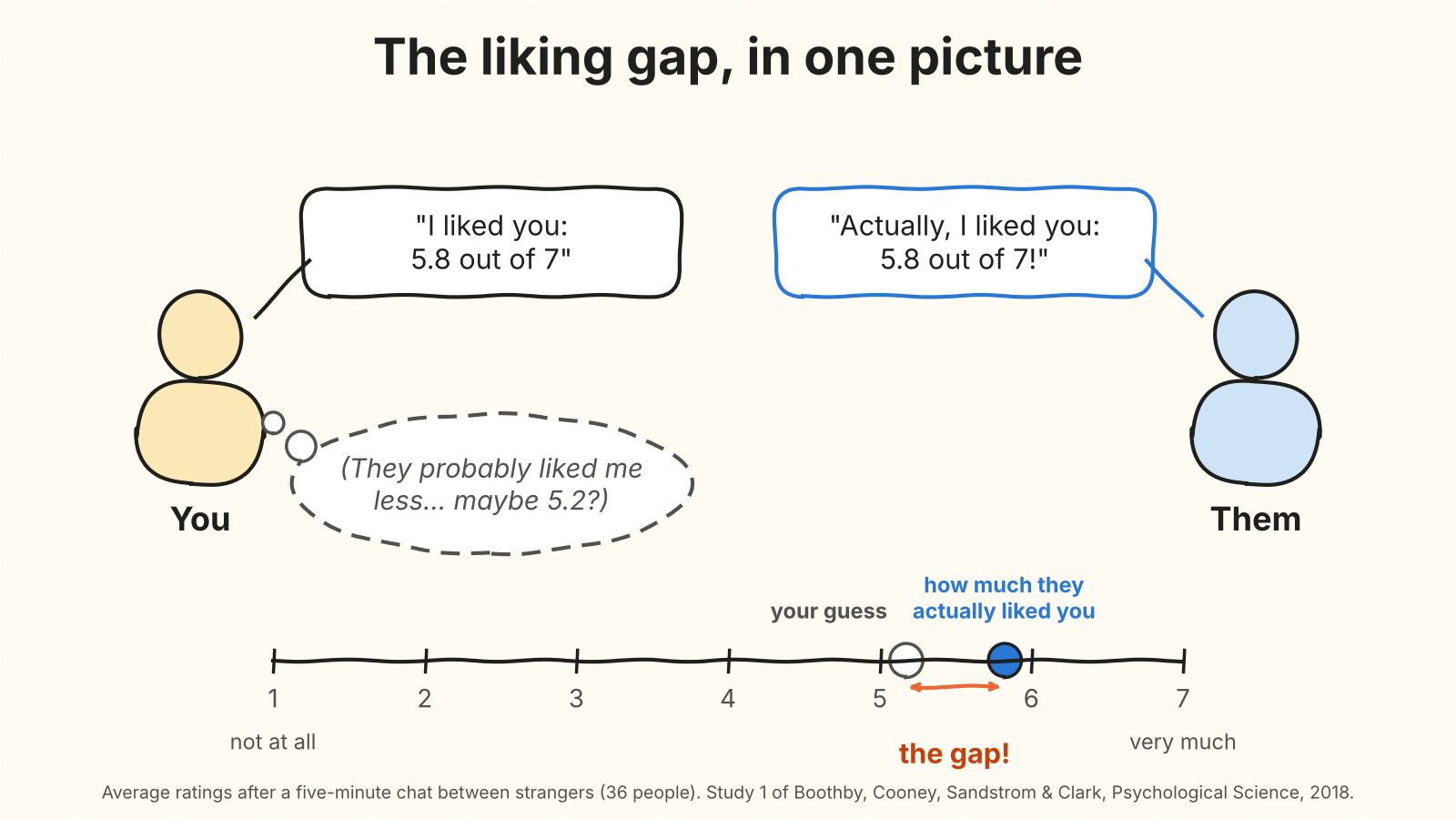
The studies that followed went longer and further, and two findings surprised me most:
- At workshops in the UK on how to talk to strangers, people guessed, before speaking to anyone, that they'd seem a little less interesting to others than others would seem to them. After the conversations, that gap was almost twice as big as they'd predicted. Talking to people made the guess worse.
- In a study of college roommates, the researchers offered $100 for accurate guesses. It made no difference to the guesses.
The gap starts early, too. In a 2021 study of 241 children aged 4 to 11, it showed up from about age five and grew with age. And it survives a second language: when 76 students in Montréal held a ten-minute discussion in English, which wasn't their first language, they guessed they were liked about 14 points less than they really were, on a scale from 0 to 100.
So it isn't just me being dramatic. Or rather, it is, but I have a lot of company, apparently.
The smile you gave and never saw
The part of the paper I keep thinking about is a small one. Two coders watched videos of 15 of the conversations from the first study. Their ratings of how much each person seemed to like the other matched how much people actually liked each other. They didn't match how much people thought they were liked.
In other words, the liking was visible from the outside. Just not from the chair across the table.
Why would that be? A second study asked 84 Yale students what had gone through their heads during the conversation. Their thoughts about how their partner saw them were more negative than their thoughts about the partner, and that negativity explained part of the gap. I'd call that the inner critic, though the paper is more polite about it.
Shyness mattered too. In the first study, the shyest people showed the biggest gap: they liked their partner at 6.16 out of 7 but guessed they were liked at 5.02, more than a full point lower. For the least shy third, the gap was small and not statistically significant. The authors write that conversation seems to be a place where people "display uncharacteristic pessimism about their performance." Uncharacteristic, because in most other areas we're rather generous with ourselves.
Does the liking gap ever go away?
Now imagine you'd stayed. You say, "I really enjoyed this." They say, "Me too." Somebody suggests coffee next week. It's a bit awkward and very ordinary. There's a second coffee, then a walk, then the kind of friend you text when a stupid thing happens on the tram.
The researchers have something close to that story in their data. In the fifth study, 102 first-year students at Yale rated their suite-mates five times between September and May. The gap was there in September, October, December and February. By May, it was gone.
The authors don't know why. One guess is that by then the students simply knew each other well. Another is that they'd just been deciding who to live with the next year, which forces the kind of honest conversation where people say out loud what they think of each other. Neither guess was tested.
I like the second guess more, probably because it's the more hopeful one. It means the fix might be embarrassingly simple: somebody says the quiet part out loud.
The looking-glass self: why we misjudge what others think of us
I first met Cooley in an anthropology class, not a psychology one, and I've had a soft spot for him ever since.
Charles Horton Cooley was an American sociologist. In Human Nature and the Social Order, published in 1902, he described what he called the "looking-glass self," and he quoted a couplet to explain it: "Each to each a looking-glass / Reflects the other that doth pass."
For Cooley, the idea comes in three steps. First, we imagine how we look to the other person. Second comes "the imagination of his judgment of that appearance." Third, we have a feeling about ourselves, "such as pride or mortification."
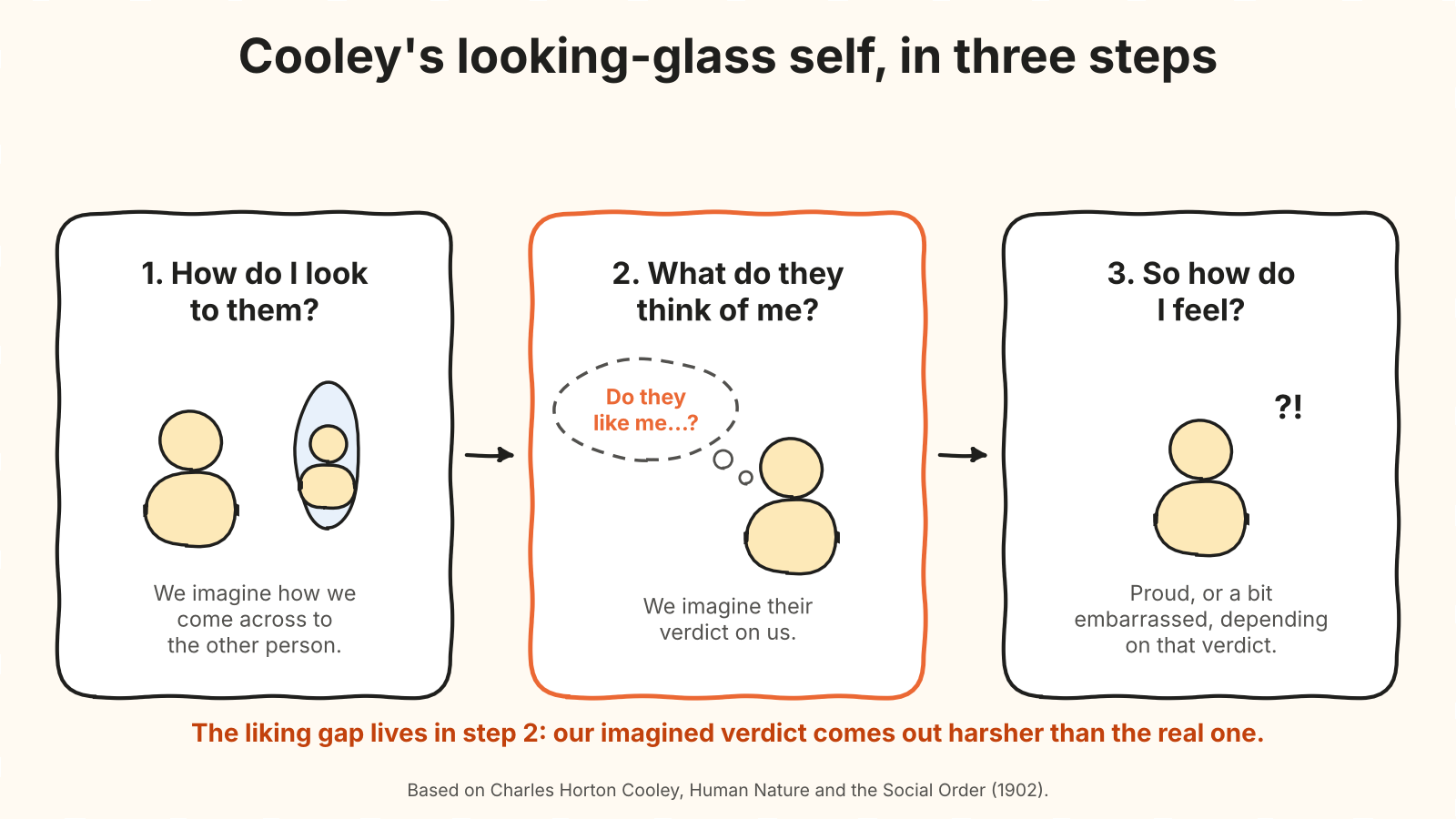
What I love about the idea is that it doesn't treat the self as something you carry around inside you. For Cooley, it's something you keep borrowing from other people's faces.
Reading it again now, the word I'd underline is imagination. Cooley never says we see what other people think of us. He says we imagine it: "We always imagine, and in imagining share, the judgments of the other mind." A century later, the liking gap shows which way that imagining leans. It's the second step, the imagined verdict, that comes out harsher than the real one.
"Conversations have the power to turn strangers into friends, coffee dates into marriages, and interviews into jobs." (Boothby, Cooney, Sandstrom and Clark, Psychological Science, 2018)
Does the liking gap really cost us friends?
Now, I have to be careful with my own story here. The research shows the misreading. It hasn't shown that the misreading stops friendships from starting. The 2018 studies measured guesses. Nobody followed people afterwards to see what they did next. A 2025 study of 2,753 people found that the vast majority underestimated how much they were liked, and that bigger perceived gaps went with insecurity, such as lower self-esteem and higher social anxiety. But, as BPS Research Digest reported, neither gap was linked to how much people enjoyed the conversation. And the studies in this piece were run mainly in the US, Canada and the UK.
Erika Carlson, an associate professor of psychology at the University of Toronto Mississauga and the senior author of that 2025 study, told me the paper found that "the assumption that the gap matters isn't really that true...it's just the metaperception alone (or impression alone) that can matter a lot." In plain words: what counts is the guess itself, however far it is from the truth. "What's interesting about that is that our perception matters more than reality," she said. And because people meeting someone new tend to hedge, "that hedging can make people fail to pursue a relationship or put themselves out there as much as they could."
When I asked Jeffrey Hall, a professor of communication studies at the University of Kansas who has studied how many hours it takes to make a friend, what has to happen after one good conversation, he said "there isn't just one thing that has to happen next. Many good conversations are left right there and then. Both people are happy to have found someone enjoyable to talk to."
"People form friendships after a positive first interaction because they have a reason to keep interacting," he told me. "Most likely, that reason is they live, work, or learn near the other person. It is much less frequent that people repeatedly follow up because of the interaction itself."
So maybe my unlived friendships weren't lost to the small voice alone. Some of them just had no tram in common.
Carlson's last line stays with me, though: "if we all assumed things are going well, we would probably act more extraverted and start more conversations/relationships."
Still, I'll take what the research gives me. But no, I'm not saying I'll stay next time. I'm saying I'll at least suspect the small voice of lying.