
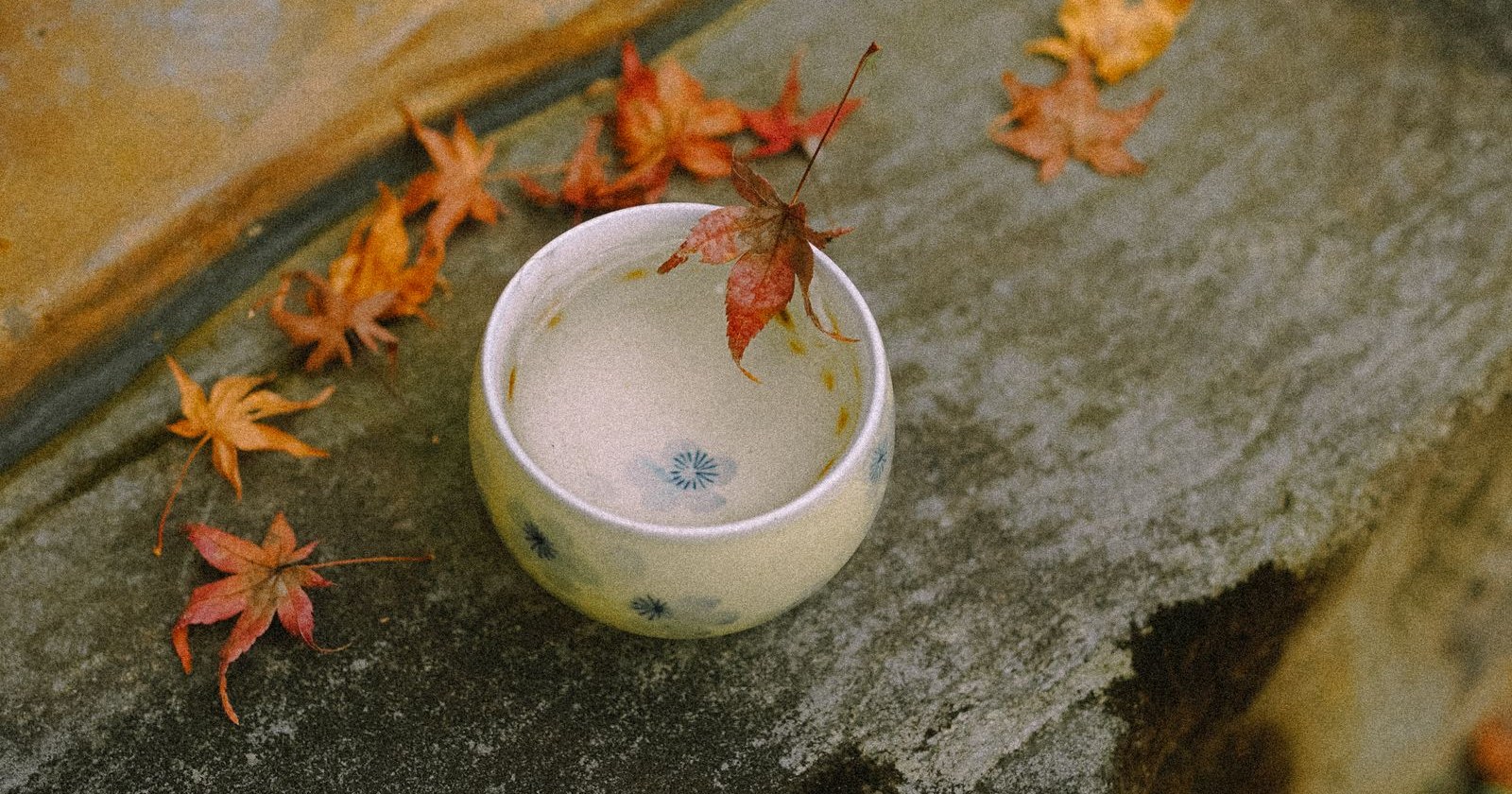
The tea master Sen no Rikyū once watched his son sweep and water the garden path. When the young man finished, Rikyū told him it wasn't clean enough and sent him back. After an hour of work, the son protested that there was nothing left to do: the steps had been washed three times and "not a twig, not a leaf have I left on the ground." Rikyū called him a young fool, walked into the garden and shook a tree, scattering "gold and crimson leaves, scraps of the brocade of autumn" across the path (The Book of Tea, ch. 4). The story comes from Okakura Kakuzō, who spells the name Rikiu and wrote it down more than three centuries later, so it may be more legend than record.
The point of the story is that a perfect path wasn't the goal. Something natural and a little imperfect was more beautiful than something scrubbed bare.
That idea is often summed up today as wabi-sabi. The two words have separate histories. Wabi refers to a subdued, austere beauty, and sabi to a kind of rustic patina, the look of something that has aged well (Stanford Encyclopedia of Philosophy, "Japanese Aesthetics"). The paired phrase is much more common in modern writing, especially in the West, than in the older sources. But the core idea runs through centuries of Japanese poetry, essays and tea practice, and it applies surprisingly well to getting older. Here, aging well means meeting change with care, curiosity and room for enjoyment. The eight habits below are modern applications of ideas from Kenkō, Okakura, the tea masters and the craft of kintsugi.
1. They don't save their enjoyment for "full bloom"
In the 1330s, a Buddhist monk named Yoshida Kenkō wrote a collection of short reflections now known as Essays in Idleness. One of the best known begins with a question: "Are we only to look at flowers in full bloom, at the moon when it is clear?" Kenkō's answer is no. "There is much to be seen in young boughs about to flower, in gardens strewn with withered blossom." People naturally regret that the blossoms have fallen, he says, but "they must be perverse indeed who will say, 'This branch, that bough is withered, now there is nought to see'" (Essays in Idleness 137, G. B. Sansom's translation).
Applied to ourselves, the idea is that later life isn't just what's left after the peak. Modern research hints that this view may matter. In a 2002 study of 660 adults aged 50 and older, Becca Levy and her colleagues found that people with more positive views of their own aging lived 7.5 years longer than those with more negative views, even after accounting for age, health, loneliness and other factors (Journal of Personality and Social Psychology). It was an observational study, so it can't prove that attitude caused the difference. But it's a useful nudge.
One way to practice: when you catch yourself saying "I'm past it," finish the sentence differently. "I'm past that, and here's what I enjoy now."
2. They let the patina show
Kenkō had firm views about houses. He admired one "set among venerable trees, with a garden where plants grow wild and yet seem to have been disposed with care," with furnishings "simple but antique." By contrast, a house crowded with rare objects, "where even the trees and shrubs are trained unnaturally," was in his view "an unpleasant sight, depressing to look at" (Essays in Idleness 10).
This is close to what sabi came to mean: the beauty that time adds to things. The modern application is about how we treat signs of age in ourselves. Gray hair, laugh lines and hands that show years of work can be read as damage to be hidden, or as the patina of a life that has been used.
That doesn't mean anyone should stop coloring their hair or caring how they look. Plenty of people enjoy both. The habit is about not treating every sign of age as an emergency. If someone remarks that you've gone gray, a light reply works: "I earned every one of them."
3. They stop sweeping every leaf
Go back to Rikyū's garden path. Okakura's own summary of the story is that "what Rikiu demanded was not cleanliness alone, but the beautiful and the natural also" (The Book of Tea, ch. 4).
Many people carry a sweeping habit into later life. The house has to be spotless before the family visits, the photos have to be retaken until nobody looks tired, and every flaw has to be fixed before anyone sees it. That standard is exhausting, and it can crowd out the moments people are preparing for.
A small experiment: next time guests are coming, leave one thing undone. Let the fallen leaves stay on the path, and spend the extra twenty minutes sitting down before the doorbell rings.
4. They're comfortable being a work in progress
Okakura described the tea room as a space devoted to "the worship of the Imperfect, purposely leaving some thing unfinished for the play of the imagination to complete." True beauty, he writes, "could be discovered only by one who mentally completed the incomplete," and "the virility of life and art lay in its possibilities for growth" (The Book of Tea, ch. 4).
Okakura was writing in English for Western readers in 1906, and his account is an interpretation rather than a neutral history. Still, the idea transfers well. A half-learned language, a garden that will never be finished or a skill you're still clumsy at isn't a sign you started too late. On this view, the unfinished part is where life still has room to grow.
Okakura also records that Rikyū loved to quote a poem about "the full-blown spring which abides in the toiling buds of snow-covered hills" (ch. 7). Even in winter, something is still on its way. When someone asks why you're bothering to learn something new at your age, "Because I'm not finished yet" is a perfectly good answer.
5. They mend instead of hiding the cracks
Kintsugi, or "golden joinery," is a Japanese method of repairing broken ceramics with lacquer, then dusting the seams with powdered gold. As the Smithsonian's Freer Gallery describes it, unlike restoration methods that try to hide damage, kintsugi "not only accepts but highlights the life of the object" ("The Beauty of Broken Objects"). Its exact origins are unknown. A popular story credits a fifteenth-century shogun who disliked the metal staples used to fix his favorite bowl, but Britannica notes that "it is unclear how much of the story is true" (Britannica, "Kintsugi").
Kintsugi is a craft, not a philosophy of life, and turning it into a metaphor is a modern habit. But it's a useful one. By later life, most people have some cracks: a health scare, a divorce, a business that failed, a friendship that broke. The habit is to give those experiences the care they need. Repair might mean getting support, rebuilding a routine or finding words for what happened. You can choose which parts of your story to share, and with whom.
The same goes for relationships. If you regret how you handled a friendship, repair might begin with something specific: "I'm sorry I stopped replying when things got difficult. I'd like to talk if you're open to it." The other person gets to decide whether to respond; making an honest attempt is the part you can choose.
6. They choose what moves them, not what's fashionable
Okakura tells a story about Kobori Enshū, a later tea master. His students praised his collection, saying everyone admired it, while Rikyū's collection "could only be appreciated by one beholder in a thousand." Enshū replied sadly: "This only proves how commonplace I am. The great Rikiu dared to love only those objects which personally appealed to him, whereas I unconsciously cater to the taste of the majority" (The Book of Tea, ch. 5). Okakura then complains that people "want the costly, not the refined; the fashionable, not the beautiful."
Getting older often brings a little freedom from the pressure to keep up. You can wear the coat you love even if it's twenty years out of date, and decorate your home for yourself rather than an imagined visitor.
A useful question when choosing anything, from a haircut to a holiday, is the one Enshū wished he had asked: "Does this appeal to me, or am I catering to the majority?"
7. They keep the worn things that carry a story
Kenkō describes going through his belongings late at night and finding, among scraps of paper he means to throw away, "the handwriting of one who is no more, or an idle sketch maybe," that brings a moment back vividly. He ends the passage with a quiet line: "The things they were wont to use have no heart, yet remain unchanged throughout the long, long years" (Essays in Idleness 29).
Later life often brings downsizing. The wabi-sabi approach is less about owning nothing and more about keeping things whose wear means something: a chipped mug from a parent's kitchen, a wooden spoon worn smooth, a letter with a familiar signature.
When you sort through belongings, try keeping fewer things but writing down why the important ones matter. A short note tucked inside a box, "This was Grandma's bread bowl. She used it every Sunday," turns an old object into something the next generation can treasure too.
8. They see endings as part of the beauty
Kenkō wrote that if life went on forever, "then indeed would men not feel the pity of things. Truly the beauty of life is its uncertainty" (Essays in Idleness 7). In another passage, he observes that leaves don't fall first and then make way for buds. Instead, new buds push from beneath, and the old leaves, "unable to withstand the strain, perforce must fall" (155).
In fairness, Kenkō went much further than most readers would follow. In the same passage about uncertainty, he says it is "seemly" for a man to die before forty, and he is scornful of older people who want to keep living to see their children prosper. He himself lived into his late sixties.
The part worth keeping is the first line. Knowing that time is limited can make the present feel more precious rather than less. In practice, that might mean saying the important things now, telling family what you'd want if your health changed, or simply noticing an ordinary afternoon a little more closely.
Wabi-sabi isn't a reason to ignore real problems
Accepting the marks of age is different from accepting pain or illness that could be treated. Wabi-sabi is no reason to skip a checkup, ignore a new symptom or put up with a fall risk at home. Mending the cracks includes getting help.
Aging well also isn't equally available to everyone. Health, money, disability, caregiving and simple luck all shape how later life goes, and many people's cracks weren't chosen. It's also worth remembering that the tea masters' rustic simplicity was often enjoyed by wealthy patrons, and that some of the most prized "imperfect" bowls were very expensive. Seeing beauty in what's worn is easier when your basic needs are met.
And there's no single right way to grow older. Some people love their gray hair, while others prefer to color it. The aim isn't to adopt a Japanese aesthetic wholesale. It's to borrow one useful idea: that what time leaves behind can be beautiful too.
One place to start
This week, during a short walk or while looking out of a window, notice a weathered fence, a tree changing with the season or a bud that hasn't opened yet.
Then try the same with yourself. Name one way time has changed you, something you value about your life now, and something you would still like to explore. You can appreciate what remains while grieving what has changed.