
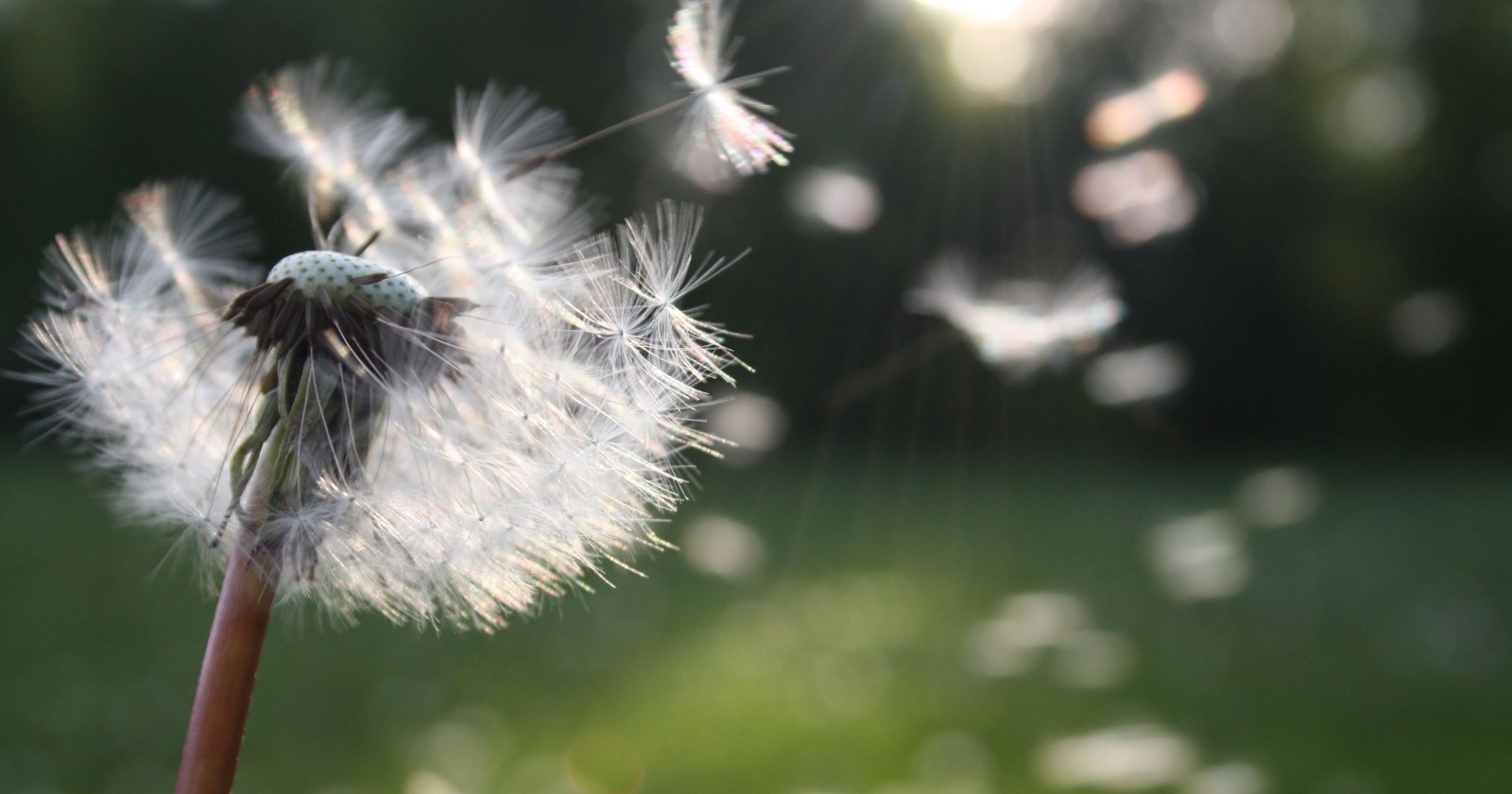
The people who struggle most with letting go are rarely careless people. Usually they're the opposite. They care about getting things right, about the people they love, about how things turn out. The grip comes from a good place. It just gets tiring to hold.
Buddhism has spent around 2,500 years thinking about that grip. The Pali word usually translated as "clinging" is upādāna, and it has a second meaning I find more useful: fuel. In the early texts, a fire keeps burning because it holds on to what it's burning. The monk and translator Thanissaro Bhikkhu points out that the word carries both senses at once, clinging and sustenance. A lot of our suffering keeps burning simply because we keep feeding it.
None of this means the answer is to stop caring. Here are eight ideas from the Buddhist tradition that can help you loosen your grip without going cold.
1. The first arrow hurts. We can learn to stop adding another.
In a short discourse known as the Arrow, the Buddha describes a man who is shot with an arrow and then, right afterward, shot with a second one. In the original teaching, the first arrow is physical pain. The second is the mental anguish we pile on top of it: the sorrow, the resistance, the distress. Both the untrained person and the wise person feel the first arrow. The difference is in what follows.
The discourse is about bodily pain, but the image carries over naturally to everyday life. A rejection stings. Then the mind starts adding to it, replaying the conversation and deciding what it says about us.
Noticing the second arrow doesn't mean blaming yourself for it. Start by separating what happened from what your mind keeps saying it means about you. "She didn't reply to my message" is the first arrow. "Nobody really wants me around" is usually the second.
2. The glass is already broken
The Thai forest teacher Ajahn Chah often taught impermanence with an ordinary drinking glass. In one talk, Still, Flowing Water, he points out that you can't stop something breakable from breaking. If you don't break it, someone else will, and if they don't, he says, one of the chickens will. The Buddha, he says, "saw the broken glass within the unbroken one." So use the glass, look after it, and when it finally slips from your hand, there's no great problem, because you saw that it would break before it did.
People who hold on tightly are often quietly trying to stop things from ending. Accepting impermanence (anicca) doesn't ruin the enjoyment. It can make it easier to enjoy, because you're not bracing for the loss the whole time.
A small way to practice: name one thing you appreciate about a person or moment today, before you start asking how long it will last.
3. A raft is for crossing, not for carrying
In one of the best-known similes in the Pali Canon, the Buddha describes a traveler who builds a raft to cross a dangerous river. Once safely across, should he hoist the raft onto his head and carry it everywhere because it was so useful? No. He should leave it on the bank and keep walking. The Buddha said his own teaching was like this, "for crossing over, not for holding on."
It's worth asking what rafts you're still carrying. Being the one who handles everything, never asking for help, keeping score, staying on guard: these might have got you through something hard once. That doesn't mean you need to haul them up every hill for the rest of your life.
Choose one habit that once protected you. Ask whether it still helps in your life as it is now.
4. "Are you still carrying her?"
"Muddy Road," one of the stories in Zen Flesh, Zen Bones, compiled by Paul Reps and Nyogen Senzaki, follows two monks, Tanzan and Ekido, walking down a muddy road in the rain. They come across a young woman in a silk kimono who can't get across, so Tanzan picks her up and carries her over. Ekido says nothing for the rest of the day. That night he finally bursts out: monks aren't supposed to go near women, so why did you do that? Tanzan replies, "I left the girl there. Are you still carrying her?"
Ekido never touched her, yet he carried her for hours. That's what holding on often looks like in practice: an awkward comment, a decision we disagreed with, something someone did years ago, all carried long after the moment itself has passed.
It helps to ask an honest question about whatever you're carrying. Does it need an action, like an apology, a conversation or a boundary? Or are you replaying a conversation you can't finish? Putting something down is different from leaving it unresolved. Sometimes the right way to stop carrying it is to deal with it.
5. Give your cow a large meadow
The Japanese Zen teacher Shunryu Suzuki, in Zen Mind, Beginner's Mind, offered an unusual piece of advice about control. The way to control a sheep or a cow, he said, is to give it a "large, spacious meadow." With people, his view was that ignoring them is the worst approach, trying to control them is the second worst, and the best is simply to watch them. Suzuki applies the same approach to meditation: allow mental images to come and go without struggling to suppress them.
If you tend to hold on tightly to the people around you, whether that's grown children, a partner, or a team at work, this one is worth sitting with. Space isn't the same as neglect. Often it's the thing that lets a relationship settle into its own shape.
Try it somewhere low-stakes first. Before stepping in with instructions, ask what kind of support the other person actually wants.
6. Every house has lost someone
A story preserved in the commentary on the Dhammapada tells of Kisā Gotamī, a young mother whose son died just as he learned to walk. Unable to accept it, she carried his body from house to house looking for medicine. The Buddha told her he could help if she brought him a few mustard seeds from a house where no one had ever died. Every house had mustard seed. No house had escaped death.
The story doesn't make grief disappear, and it isn't meant to. One way to read it is as a story about loneliness as much as loss. Kisā Gotamī begins her search convinced that her pain sets her apart from everyone else. By the end, she has discovered that no household has escaped loss.
Knowing that loss is universal doesn't make your particular loss smaller. It may, however, make it easier to seek company in it. You don't have to stop grieving to stop grieving alone.
7. What happened to you isn't who you are
In the same discourse as the raft, the Buddha gives a plain instruction: "whatever isn't yours: Let go of it," adding that doing so will be for your long-term welfare and happiness. In context, he's talking about something very specific: the body, feelings, perceptions, mental formations and consciousness. These are the five things we most often take to be our self, and the teaching is that none of them is truly "me" or "mine."
One everyday way to explore this teaching is to notice how quickly an experience can harden into an identity. A mistake can quietly become "I'm a failure." A rejection can become "I'm unwanted." A hard season can become "this is just who I am now."
Try noticing the moment an experience starts turning into a definition of who you are. You can acknowledge what happened, and take responsibility where it's needed, without making it your permanent identity.
8. Letting go isn't the same as not caring
This is the one that worries people who hold on tightly. If I let go, won't I just stop caring? Buddhist teachers saw this coming. Buddhism describes four "divine abidings" (brahmavihāras): loving-kindness, compassion, appreciative joy and equanimity. In the Visuddhimagga (IX.98–101), the fifth-century commentator Buddhaghosa describes each of the four as having a "near enemy," something that looks similar but is really a counterfeit. For equanimity (upekkhā), the near enemy is a dull, unknowing indifference that simply ignores what's good and what's bad.
Real letting go is closer to the opposite. You stay present, you keep caring, you keep doing your part. You just stop demanding that things turn out one particular way before you'll allow yourself any peace.
Loosening your grip
Start with one thing you're gripping today. Ask whether it needs action, a conversation, or simply your permission to remain unresolved for now. Take the next useful step. When you notice yourself rehearsing it again, gently return to what you're doing.
You don't have to release everything at once. Practice loosening one finger.